
Bring light to the invisible

That little snap of fall in the air, pumpkins piled in front of the bodegas, kids in early costumes (I ran into a fairy princess and a unicorn on the way to the grocery store yesterday!)—it all has us in a festive mood and feeling extra creative!
Flo taught his first Advanced Studio zoom session, and it was awesome! Jacob had us responding to a prehistoric timeline. But first, we had an abondanza of art books donated by AYB Board Secretary Patrick Grenier. Wow, what gifts!
Dennis and Denzel were out in the dazzling sunshine yesterday, teaching a session about Yayoi Kusama inspired pumpkins for the PS34 Fall Festival.
In other art news, Vee has a fun project you can participate in, Vera B. has work on view, and Jacob has planned a superb art field trip for Saturday, which will culminate in attending the closing party for an exhibition featuring Evelyn! And here are the details…
Advanced Studio on Zoom
Congratulations to AYB artist Florian Kiniffo-Neven du Mont on his inaugural Advanced Studio Zoom session as a Teaching Artist! Flo’s enthusiastic participation in Advanced Studio, both on Zoom and in person, has made him an expert in how we like to roll. That was obvious from his superb lesson planning and remarkable art examples.

Flo summarizes his session: “For this class I wanted to dive into what I believe is at the core of our human nature: the need to look and see beyond our own self and connect with something bigger than us, that yet resides inside of all of us. A desire to see beyond the visible and bring light to the invisible.
We explored this obsession for the invisible through Aboriginal X-ray art (a painting tradition from over 10,000 years ago in Northern Australia), anatomy, X-ray technology, and the works of three artists I believe used their inner instruments in very personal and unique ways to bring light to the invisible.

Leonora Carrington and her work with dreams, symbols and myths. Wassily Kandinsky and his ability to give colors and shapes to sounds, music and even smells. Betye Saar for her ability to alchemize objects through her assemblages and give a voice to populations that systems of oppression constantly try to hide or erase.


I then asked the class to make a piece of work showing aspects of the invisible, and I was very impressed with the variety of the work, but mostly with how personal the pieces were.
Kevin and Neah did a beautiful job at putting colors to a very vulnerable subject that we often try to hide: our pains, whether emotional or physical, and the chronic pain many people live with every day but that we don’t see.
Kevin describes his work: “When thinking about what is invisible, I found myself looking inward. I thought about the need for connection and what happens to the body when we don't get it. For me, I feel stressed, anxious, and sometimes lonely when I am not able to see people. Although we may all feel these things on the inside, others may view us as healthy on the outside. This is why the right side of the heart looks healthy, as shown through the use of primary colors. The left side, however, uses green and dull brown to show signs of decay and a buildup of plaque, representing how we may feel internally.”


Rashidah explored the duality of oneself with beautiful lines and colors that reminded me of the work of Alex Gray.
Rashidah Green, The Invisible (Self), and Alex Gray, Painting, 1998
Marilyn showed us how science and art can enhance each other with her splendid watercolor frog dissection and the juxtaposition of organic matter on top of a picture of viruses.
Marilyn J. August, The Invisible l (Frog) & ll (Virus)
Adji gave life to a very mystical yet real story of heart transplants and the multiplicity of souls within oneself, but also between people. I loved the different uses of perspective, symbols and figures in her piece. One of those pieces that bypasses your intellect and talks directly to your soul.

I loved how many different interpretations I had of Leah’s piece. She drew a tree with its roots, and I first saw a volcano explosion, then an anatomical view of the back of someone’s neck, with veins going down to the upper back. As always, beautiful use of watercolors.

Vee always impresses me with the profound wittiness of their pieces. Only two words, and it opens the door to so much: “Feelin Fruity.”

One of my ideas that didn’t make the cut was to also explore astrology in parallel with anatomy, so I was very happy that Cheyenne chose to paint her own birth chart. Looking at her piece, I feel like I’m looking at a piece of the sky.

Meridith’s watercolor looked like a painted conversation between her flowers and her. Her ability to give life to the inner spirit of her garden is hypnotizing. I can smell the colors.

Like Vee, Ed’s ability to convey a whole prophecy in a few words is always striking. Not only do the trees talk, but you can feel the sky looking at them and the ground having to deal with their constant yapping.

Karla’s use of shapes, forms and colors is always such a pleasure to look at. The juxtaposition of anatomical sketches with solid black and opaque paper is a great translation of that human quest for the invisible.
Karla elaborates: “Thank you Flo for a very inspiring lesson. I really liked the concepts and work everyone presented. X-rays have always fascinated me. Once I saw them in the lesson, I reached into my studio trash can to retrieve the X-ray of my daughter’s broken ankle. I had hoped to use it in artwork somehow but a concept didn’t develop so out it was to go….until Flo’s presentation!!! How timely!
My collage is an assemblage in the spirit of Betye Saar. It includes mat board, X-rays, handmade paper and old anatomical and mechanical illustrations. X-rays allow us to “see beyond” and complex drawings present a need for interpretation. I hoped layering materials would take the viewer beyond the surface and into a puzzling narrative.”

Aaron’s progress with watercolors is such a pleasure to witness. The depth and colors are so on point, it makes you feel like the skull could start floating out of the page at any moment.

The simplicity of Jules’ piece gives just enough to my imagination to want to sit on that couch and chill. I love the welcoming spookiness of the room, the way those frames feel like they hold secrets we all wish to know. And that dog!

I (Flo) decided to make a mask of invisibility with mirror paper. My thought process was that by acting as a reflection of themselves to others, I could make myself invisible. Except that when I tried to take a selfie to see where to cut holes for my eyes, it was very hard to get it right.
I could have asked someone to help me, but that would mean making myself visible. So I tried many times until I kind of got it right. In the process, I realized that I could try to make myself invisible to the world as much as I wanted, but I still had to deal with myself. Therefore, I couldn’t be fully invisible.
So I printed all my selfie attempts on paper that I glued on the inside of the invisible mask. This piece is called The Struggle of the Invisible Men Is That He Has to Deal with Himself (on Its Own.”
Florian Kiniffo-Neven du Mont, The Struggle of the Invisible Men Is That He Has to Deal with Himself (on Its Own)
Advanced Studio in Person
Tuesday’s Book Bonanza was partially fueled by Patrick’s huge bag of Halloween candy!
On that sugar rush, with book bags overflowing with gorgeous selections for our personal libraries, we settled into Advanced Studio in person at 180 Franklin Avenue with AYB artist Jacob Rath.
Gifts of Candy and Books
Gathered around the little blackboard, we kicked things off with a surprisingly lively discussion. Then Jacob led us into the gallery, where, surrounded by Ajani’s artwork, he slowly unfurled a Montessori timeline, recounting the story and drawing us into a surprising, fun, and funny dialogue.
Jacob presents the lesson
Jacob recaps: “I began class by discussing fundamental human needs and sharing what Maria Montessori counted as a fundamental need. Many were pleased that art was considered a fundamental need, but some were surprised by the inclusion of vanity.
I then shifted to the main focus of the lesson: the second timeline, Human Beings. This timeline tracks human history from the last Ice Age up to the Bronze Age. It focuses on the agricultural revolution, contrasting agricultural life with that of hunter-gatherers. The timeline is meant to celebrate the innovations of the Neolithic Revolution and the ways that human beings cooperated with each other throughout the ages.

Afterwards, participants made artwork in response to the timeline.
Abriel (Bob) and Flo took an intuitive and abstracted approach with their work.

Florian Kiniffo-Neven du Mont, The Second Timeline - Human Beings
Ed, Vee, Evelyn, and Ajani made work depicting hunting scenes from prehistoric times.

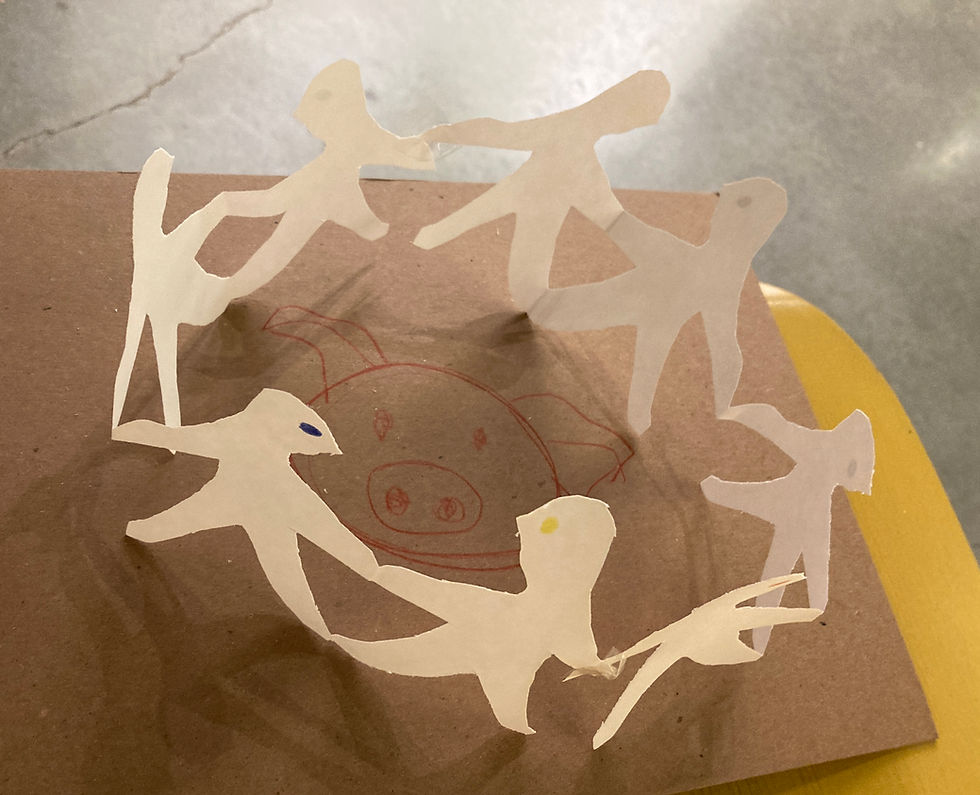


Leah and Kevin chose to draw foods that reflected their cultural heritage.


Meridith was especially taken with the hairdos (human and animal) depicted in the Montessori timeline and with the inclusion of Stonehenge next to a herd of wild pigs. This led her to a conversation with Leah about Stonehenge and the fact that, until 1978, people were allowed to wander freely among the stones—as evidenced by little Meridith in this photo!

Fatima made a drawing of vanity, and many appreciated the tenderness of the hands holding the face.

I (Jacob) made a drawing contrasting wild and domesticated animals.”


ART YARD Art Matters in the School
Dennis gives us the inside scoop: “On Thursday, we participated in PS 34 (The President Barack Obama School)'s Fall Festival - an annual event that includes pumpkin picking (hundreds of pumpkins are donated to the school and scattered around the school building on the front lawns), dance activities, guess the corn kernels in the jar, game, and ART MAKING. I am always happy that the school invites us to participate.

It is a marathon type event - think speed dating in a school yard! - we're provided with several tables where the students come in large groups (sometimes 3 classes at a time!) for a 20 minute art lesson. Keep in mind - this is outdoors - we start in the shade but after the first hour, we're in the sun - and sometimes the wind picks up - so, you get the picture. The grades range from K to 4th.
Teaching Artist Evelyn Beliveau prepared the lesson (to fit in with OUR theme of Drawing The Line and THEIR theme of Fall Festival) inspired by Yayoi Kusama's drawings, paintings, and sculptures of pumpkins. A perfect fit. Evelyn also created the panels for the presentation board and the demonstration instructions. Talk about a lot of prep work (more on that later!)

I was assisted by Denzel Jeter and Marilyn Carpena (PS 34's art teacher) and two 7th grade ATC (Artistically Talented Class) students, Anthony and Skylar. We created a presentation board (which I schlepped from Manhattan on the bus out of Port Authority) about Kusama and her pumpkins - with an emphasis on patterns/repetition. After a brief intro, Denzel took center stage and gave step by step demonstrations for drawing a Kusama-like pumpkin outline and students chose the shape they'd like to repeat (circles, dots, squares, hearts, diamonds, etc.). Using black chisel tip and regular Sharpies on 12 inch square colored cardstock, (in autumn colors), they were all smiles when their works were completed.
Use arrows to scroll through images of the kids drawing at PS 34 Fall Festival
Denzel did an excellent job of demonstrating at different paces for the various age groups and even simplified the pumpkin shape for the youngest ones. Ms. Carpena was a tremendous help with crowd control and the kids loved seeing her draw along with Denzel's demonstrations. Plus she's always happy so her big smile always puts the students at ease.
Several of the classroom teachers asked if their students could add color to their drawings once they got back inside - perfect! My only request was that they send me some pictures of the finished pieces.
While the sun made it difficult to photograph their work due to shadows, you will surely see their successes in these photos.

Who needs a YMCA gym membership when one can participate in an outdoor Fall Festival event with about 250 kids in 2 hours?”

What We Are Reading
I (Meridith) was excited to read a piece in The New York Times about an exhibition of 11 paintings by Catharina van Hemessen, the earliest female artist from the Netherlands whose work has survived. She made history at a time when painting was largely a male domain.
Van Hemessen & Father: The Antwerp Workshop of Jan and Catharina van Hemessen is on view at the Snijders&Rockoxhuis museum in Antwerp, Belgium, through January 31, 2027.
Karolien De Clippel, head of collections and research at the Royal Museum of Fine Arts Antwerp, began digging into van Hemessen’s life in the 1990s as part of her master’s thesis. She explains, “She was almost eliminated in writing about art.”
The Times also notes that some of Catharina’s works will travel to the National Gallery in London for an exhibition devoted entirely to her. It’s wonderful to see an artist who made history more than 450 years ago receiving this kind of attention today.

I (Meridith) am currently reading, and quite enjoying, The Wonderful World That Almost Was: A Life of Peter Hujar and Paul Thek by Andrew Durbin (Farrar, Straus and Giroux, 2026).
Durbin focuses on the years 1954–1975, following the artists from their early twenties through a pivotal period in their lives and work, a decade before their deaths from AIDS-related illnesses in 1987 and 1988. Rather than looking backward through the lens of their deaths, he brings us into the world they inhabited together: their art, their friendships, their love affairs, and their sometimes difficult personalities.

I was more familiar with Hujar’s story from his later years, when he was closely connected with the extraordinary David Wojnarowicz, so this book is presenting new terrain. Hujar and Thek lived in Italy, and one of their close friends, Ann Wilson, had a place in Sperlonga. I was really able to picture them there.
It helped that over the summer I saw Hujar:Contact, the exhibition of contact sheets at the Morgan Library & Museum. The people, places, and adventures all appear there! The contact sheets offer such an intimate view of Hujar’s life and working process, and seeing them made the world of the book feel even more vivid.
What I particularly enjoy about Durbin’s book is that he brings us into their complicated, creative world while they were living it. They were talented, charming, sometimes difficult, and fiercely committed to their own visions.

Other Art News
Adji Ngathe Kebe has completed the painting she began in the zoom session she lead two weeks ago exploring African masks.

TJ Edgar writes: “This is a piece that I’m working on for my photography class, we were tasked with responding to a short story with a collage, I responded Akwaeke Emezi’s A Child Ghost, An Escape, and a Watery Haunting in Curaçao”. There’s still a few things I want to add to it but this is where I am so far!”

Vera Brown reports: “I have a piece I made in an AYB session on display in the exhibition World Cultures multimedia exhibition exploring culture, identity, traditions, and diverse regional perspectives (such as customs, ceremonies, food, and patterns) was curated by Bronx-based multidisciplinary artist Luis Fonseca. The exhibition is view at the Ferguson Library, 1 Public Library Plaza, Stamford, CT through January 7, 2027.
Exhibition evite, and Vera Brown, Untitled, digital collage
Vee Tineo has listed a new sculpture Money Doesn’t Grow on Trees for sale on Ebay as a performative element to the work itself. Vee explains: “This is the first work I’ve made since returning from China. It brings together wheel throwing and hand building. The ceramic sculpture on sale through the link stands on human-like legs, with branches growing from its opening. The work explores the relationship between nature and economic necessity, asking what it takes to sustain ourselves and how we measure the value of our labor.”

Join in Vee’s project by placing a bid!
Evelyn Beliveau writes: “I’m pleased to have work included in Bathers, a visual art exhibition accompanying a new play of the same name. You are invited to the closing reception Saturday, October 24, from 5:30-7pm at The Lobby Gallery at Theater 154 (154 Christopher St, New York, NY).

Opportunities
Join us for an AYB Field Trip tomorrow Saturday Oct. 24 from 2:30-7pm lead by Teaching Artist Jacob Rath.

We will visit Fort Gansevoort Gallery to see Zoya Cherkassky: American Cooking, The Highline to view Andrew Nguyen: The Light that Shines Through the Universe, then head down to The Lobby Gallery at Theater 154 for the closing party for Bathers including work by AYB Artist Evelyn Beliveau.
Please RSVP email or text to Meridith!! Limited spots available.
AYB Artist Sigrid Dolan writes: “The New School Curators Collective invites submissions for an upcoming exhibition opening in late November at 72 5th Ave, New York, NY 10011.
We are thinking about
digital technology
in person interactivity
liminality
nostalgia
If your work touches on any of these themes, we encourage you to apply! We are interested in considering these themes as poles, how they might be combined for a new approach. We are looking for artworks in a range of perspectives and mediums, as we want to put them in conversation for the exhibition.”


Comments