
The spaces in-between

Updated: Sep 4
I like the word—and the notion—of a trajectory. A relatively new word in English, “trajectory” entered the language in the late 1600s, retaining its core Latin meaning of a path or course. There’s something wonderfully dynamic about it, too: to hurl or throw across.
Artmaking is filled with trajectories: some that come toward us, some unexpected, and some that feel like a natural next step. This week at ART YARD BKLYN, there was a trajectory into history, an honoring of the past, and a few unexpected crossings along the way.
Starting Friday, after posting the recap early, we headed into Manhattan for a visit to The New-York Historical Society to see the Betye Saar exhibition—and, of course, got caught up in several other fine exhibitions along the way.
In our usual exchanges throughout the week, several AYB artists referenced the sketchbook I shared in an image—both in a seaside coffee-break view and in the painting I made that week. Travis asked more about the book itself. There’s an especially nice trajectory here: the sketchbook came from Fabriano, Italy, a place whose paper is already deeply familiar to me through my own painting practice. The sketchbook itself was made using traditional Italian papermaking methods, and I’ve asked Catherine, who gifted me this beautiful thing in the first place, to share more about its story and making below.
And then there’s one of the books I read this week, Nonstop Bodies: How Dance Shaped New York City by Rennie McDougall, which centers on NYC’s artistic history and connects with many of the recent good reads I’ve been reviewing this summer.
With more coming from the studios, too. We’ll share what everyone has been making, along with exhibitions we think are worth seeing, books we’re recommending, and a few other discoveries that have crossed our paths as summer winds down.
Art Field Trip
As I picked up our tickets to New York Historical (170 Central Park West at 77th Street, NYC) at the desk and complimented the pink leopard hairdo of the desk attendant, the person taking my tickets urged me to look up. There it was: the actual ceiling from Keith Haring’s Pop Shop. Keith Haring opened the Pop Shop on Lafayette Street in SoHo in 1986 as a way of bringing his art beyond the gallery world. He covered the shop’s walls, floor, and ceiling with his wonderfully energetic black-and-white mural. I was there. Were you?

The impetus for our visit was Betye Saar’s Black Dolls, The exhibition is like a tiny gem in a Prussian-blue-lined velvet box. Dolls, watercolors, assemblages, and photographs sit together in a way that makes you want to slow down and look closely. The wall labels are short, thoughtful, and full of useful connections between the objects and Saar’s ideas about memory, spirituality, history, and energy.
AYB views Betye Saar’s Black Dolls. Photos by Meridith McNeal (use arrows to scroll)
“My art becomes an explorer, a tracer of forgotten tribes, a seeker of sanctified visions. These works are what I leave behind.” — Betye Saar
Saar collected dolls because she felt they carried energy from their previous lives. She then brought that energy into her own work, reimagining the dolls through watercolors and assemblages.

I suggested to the group that during the week we each make a piece in honor of Betye Saar, or a piece inspired by something else we saw during the visit.
Flo writes: “My piece is still a work in progress, but I was very inspired by Betye Saar’s capacity to capture objects’ spirits and also instill them with her own spirit. I decided to use materials like cardboard and bubble wrap, but also a branch.
Also, the two protagonists playing piano are Marjorie Eliot and her son, Rudel Drears. We went to see them perform last Sunday with Leah and Sanjay in Harlem, and I kept thinking about Betye Saar while listening to them. I felt the piano was alive and floating. Just like Betye Saar, they were instilling the piano with their spirit.”


Cheyenne Rivera shares sketches from the visit alongside a new painting in progress: “The first image shows sketches from the visit, and the second is the first draft of a new painting inspired by the experience.
I was really inspired by the way Betye Saar reimagined harmful stereotypes as a way of reclaiming their power. It made me think about the negative connotations associated with brujería practices in the Caribbean and Latin America, even though many of these practices are rooted in Indigenous traditions that predate the influence of organized religion across the region.
My piece in progress which comes from these thoughts features a woman practicing spiritually in a way that blurs those lines. I’m excited to continue working on it!”
Cheyenne Rivera, Sketch from Betye Saar exhibition, and Drawing in progress

Jules Lorenzo created "a missing toy poster of a a plush star charm I lost on my birthday. The star is done in water color (inspired by Betye Saar’s watercolor painting of her dolls) and colored pencil and pen! Her exhibit made me think a lot about the toys and dolls we lose/forget about as we enter adulthood."

From Saar, we flowed into New York, New York, and this was where the museum really became a conversation about the city itself. Some of the views were surprising in their time-machine-like feel once you read the location on the label. There were so many familiar names—Mark Rothko, Keith Haring, Thomas Hart Benton, Françoise Gilot—but often with works we hadn't seen before. It was fun to watch everyone stop at different things.
Cheyenne said that seeing all this work actually made her feel great about where she is right now in her own artmaking. She isn't sure what comes next—and that suddenly seemed like a very good place to be.


Ajani, Jules, and I went through Queer Joy / Gay Power together, and we loved it.
The show looks at queer life through photographs, posters, flyers, performances, parties, dances, and gatherings. The point is an important one: joy and pleasure can be political, too. Creating spaces for people to be fully themselves is part of building community, resilience, and resistance.

There are great photographs of performances and parades, handmade flowers and posters, Rollerina's Eyeglasses, and even the remnants of the Stonewall jukebox that survived the riots.
Fred McDarrah, Sylvester Performing NYC, 1971 and Hand drawn fundraising flyer
By this point we were happily wandering wherever something caught our eye – Jules pulling us in to see a Shoe exhibition. There were many remarkable (tiny!) handmade shoes, Beyonce’s boots, amazing acrylic heels, high arched t-straps and shoes that were signed by 27 members of the 1941 Yankees. I took a photo to send to my nephew. Meriting an immediate “That’s so cool!!” reply.

We recommend a Friday evening visit, when admission is free.
Dennis Buonagura is gearing up for ART YARD Art Matters in the School programming for the 2026-27 school year.
Dennis shares his thoughts on the partnerships ahead: "In preparation for our upcoming short-term residency at PS 34 in Jersey City (5 days a week for 3 weeks!), I reached out to our teaching artists and have created a daily schedule with lessons based on our current year's theme Drawing The Line. This is our third (fourth, maybe?) year at PS 34, the President Barack Obama School. Additionally, I created our invoice and contract for PS 6 (our longest term school in JC) and received an offer from PS 17 (which will require some mulling over).
I had a virtual meeting with Melissa Cuccinello, the Arts Supervisor for the Jersey City Board of Education, to discuss our further presence in other schools in JC - we'd met at an opening exhibit at PS 6 a few seasons back and she will discuss our program (which she praised) with other schools which are in need of art education. While all of the schools we are currently assigned to have an art curriculum (and art teachers who are happy to have our programming join theirs), Ms. Cuccinello explained to me that several/many do not. That's where we will come in.
A small issue is that the Board of Education creates a 'threshold' for contracted vendors (which we are) - this means their budget only allows for a certain amount of funds to be distributed amongst each vendor - with 3 schools in JC at this time, we're just about at our cap. Ms. Cuccinello will do her best to increase our threshold so that we can participate in more schools. Fingers crossed.
NOW we need a strong presence in NYC schools! I am open for suggestions and recommendations!"

Art News – Work in Progress & New Work
Rachel Palmer texts: “Oh! I do actually have an update this week. It hasn’t been fired yet - but after a year of hand building, I decided to try a wheel throwing class - and this is a bowl I made. I wedged two colors of clay together to make this marble and left the edge organic. We’ll see what it looks like after it’s fired in about a week! ☺️”

Evelyn Beliveau shares: “Here's the work in progress I'm returning to after my trip, in an unusual-for-me tondo format, 8 inches in diameter, water-soluble oil on canvas. I'm making use of a magnifying glass (whose edge you can just see in the top left of this photo; I believe it actually came to me from a longer-ago AYB closet cleanup!) to explore the plastic dolls I've been using in my recent series at a relatively larger scale.”

Jazz Guillet continues working on her exploration of clouds in this new drawing. Jazz texts: “I left my green pastel oils at home but still a success, I feel!”

Ariel Abdullah is hosting a yoga retreat at Kripalu in Stockbridge, MA. AYB artists Jazz Guillet, Alex Lopez, and Juliet Adams are attending along with other friends. Ariel reports: “We’re spending a lot of time in nature!”


Photos from the retreat by Ariel Abdullah
Also enjoying nature, Abriel (Bob) Gardner writes from Utah: “Back with the mountains, and it feels really good. They have such a presence. It’s hard to describe, but you can almost hear them. They’re so old and have a very strong pull. I’m so grateful for them. Went on a hike today with Bowie (: The colors were amazing. It smelled like sage and wet rock (granite), and the mountains told me to put my phone down and appreciate the moment for what it is. I’m still processing their wisdom.”
Abriel (Bob) Gardner, Utah Mountains, August 2026
Inspired by my recent trip to Connecticut, I created a new cut-paper Necessary Objects wall relief sculpture, Osprey with Helleborus. The osprey symbolizes focus, vision, and the balance between different realms. The helleborus, a flower associated with Minerva—the Roman goddess of wisdom, medicine, and strategic warfare—has also been historically associated with healing, intellect, and the treatment of mental affliction.

Throughout my CT visit, my friend Nathaniel and I had one of those rambling art conversations in which we kept encountering the Helleborus, and that brought to mind my earlier piece, Magical Things Minerva Mandala, which I made during an Advanced Studio Session with Ajani Russell.

Lila Green shares a poem and an accompanying photograph.
An idea! Let’s take the ferry. To where?
An isle of governance where secrets hide
Where glamping, spas, and restaurants are far and wide,
And surreys are present to catch a ride.
A day of short adventures found its stride:
Crisp Korean snacks, margaritas bright,
As hours drifted on the harbor side
And the day melted smoothly into fading light.
The sun went down, a fireball, a curious sight,
Gliding horizontally, dipping deep,
Perfectly framed by the city's towering feats.
While busy buildings witnessed the shadows creep.
Peeking through gaps to catch a wandering glance,
Of people traveling, discussing where they’d been,
Lost in the quiet magic of the chance
That caught us in the spaces in-between.
~ Kalila Green, 2026

Marie Roberts continues to inspire us this summer with her wonderfully observant drawings on the go. Her latest updates capture the quick, responsive nature of sketching wherever the day takes you.
After a research day, Marie was treated to a snack and put the moment to work: the first two drawings were made quickly in a restaurant, followed by sketches from NYC Urban Sketchers on Governors Island. One captures the “Coconut Man” at Fauzia’s food truck; another began with a found flat stick that caught her eye and became the subject of further drawings.
Marie Roberts, Observational Drawings, 2026
There’s a lovely reminder here that drawing doesn’t always happen in the studio. Sometimes it’s fast, improvised, curious—and a little bit of a struggle. And that’s precisely the point: keep looking, keep drawing, keep going.
I thought it would be a good moment to profile Sanjay Velayandom-Neven du Mont, Flo’s younger brother, who visited from France for the summer and participated in ART YARD Summer Session.
Sanjay attends a high school in France without art classes, so we were especially curious to hear how spending the summer making art alongside the AYB artists shaped his experience and his thinking about art.
Which AYB sessions did you enjoy the most? What made it interesting to you?
My favorite AYB lesson was Chris Allen’s lesson because I did sculpture for the first time using iron wire. It was a challenge for me to learn how to use this material.
We made several field trips. During these visits, did you see an artwork, artist, museum, gallery, or place in New York that really interested you? What did you like about it?
One artwork I saw on our field trip to the Met that really interested me was this painting of a tiger resting inside an ornate palace, The Grief of the Pasha by Jean-Léon Gérôme.

I liked the detailed architecture, colorful carpets, flowers, and clothing, which made the scene feel very complete. I also liked how realistic the tiger looks, especially its fur and expression. It made the artwork feel like a scene from a story.
What do you like about making art alongside the other AYB artists?
What I like most about making art alongside the other AYB artists is being able to share ideas and learn from each other. Everyone has their own style and way of expressing themselves.
You don't have art classes at your high school in France. Has this summer changed how you think about art or about making art in the future?
I really see the difference between before and after going to the art class. Before, I thought I was bad at drawing and art, etc. But I realized that I just have to draw without thinking about making something perfect. Then I can see the difference in my art. This experience makes me want to do more art because I really enjoy it now.
What is something you learned or discovered about your art this summer?
I discovered that there are a lot of different ways to make art and that we can use almost anything to create art.
What will you remember most about your summer with AYB and in New York?
The thing I will remember the most is how the AYB artists are almost like a big family. I think that is beautiful.
Anything else you’d like to share?
I want to say thank you to all the AYB artists for this amazing experience. I learned so much.
I’m really grateful for all the artists and teachers who supported me, shared their ideas, and made me feel comfortable expressing myself. I loved creating art alongside everyone.
AYB has given me so many great memories, and I will always remember how everyone felt like one big family. Thank you for everything. ❤️

The story of the beautiful sketchbook Catherine de Zagon gifted me takes us all the way to Fabriano, Italy, and to the centuries-old tradition of handmade paper.
Catherine met the artisan who made the sketchbook at a medieval festival in Capestrano, in a monastery courtyard transformed into a kind of medieval street, with individual “rooms” for the artisans and their crafts. The event was organized in part through Mastri nel Tempo (“Masters Through Time”), an association of traditional Italian artisans from across the country dedicated to keeping historic trades alive and passing those skills on by inviting the public to experience them firsthand—from making handmade paper to weaving baskets and assembling mosaics.
The woman Catherine photographed is one of these artisans. She travels to historical reenactment events, including the medieval festival Serremaggio, where she demonstrates the ancient art of handmade cotton paper in the Fabriano tradition.

Fabriano is, of course, familiar to many artists today as the name of a premium watercolor paper. But Fabriano is also an actual town in the Marche region of Italy, with a papermaking tradition that dates back to the 13th century and makes it one of the historic birthplaces of European papermaking.
The process itself is wonderfully tactile. Cotton rag pulp is suspended in water, and a wooden frame with a mesh screen—the mould—is dipped into the vat to lift out a thin, even layer of fibers. The sheet is then pressed and dried, transforming loose fibers into paper.
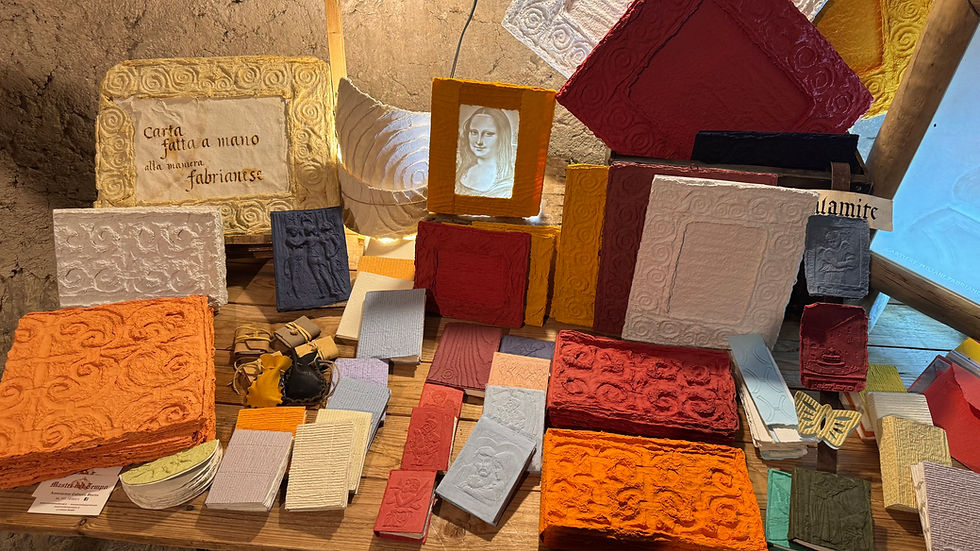
There is something especially meaningful about this particular trajectory: Fabriano is the paper I work on, and now I have a sketchbook made through a traditional Italian papermaking process rooted in the very place whose name has become so familiar in my own studio practice. A beautiful connection between material, place, craft, and artmaking.

What We Are Reading
I (Meridith) really enjoyed Rennie McDougall’s Nonstop Bodies: How Dance Shaped New York City (Abrams, 2026).
In my recent reading, I’ve been following a distinctly New York artistic trajectory—from Fab 5 Freddy & Mark Rozzo’s Everybody’s Fly, to Barry Walters’ Mighty Real, and now McDougall’s history of dance. Artists making waves, challenging the culture around them, and changing the city in the process.
What really makes this book speak to me is McDougall’s determination to recognize all the practitioners—not just the rarified pros who usually receive the accolades. The Lindy Hop dancers of Harlem sit alongside Martha Graham; Disco dancers at David Mancuso’s Love Saves The Day and alongside Simone Forti and dancers at Judson Dance Theater. Social dance, concert dance, clubs and experimental performance all become part of the same story.

McDougall’s great insight is a web of connections—artists, communities, movements and ideas constantly crossing paths. And because dance lives in the body, it becomes a particularly vivid way to understand the social history of New York: race, gender, politics, liberation and cultural change.
The book is deeply researched and erudite, yet eminently readable. Most importantly, it reminds us that the artists who eventually become “important” were often radical, unfamiliar, or even dismissed when they first appeared.
In the end, I’d call it a call to artistic arms: keep experimenting, keep crossing boundaries, and keep paying attention to what is happening before it becomes history.

Ed Rath emails: “What I am reading now: James Joyce, The Portrait of the Artist as a Young Man (Penguin Modern Classics, 1964). More like re-reading. It gets better every time I read it.”

Exhibitions
Margaret Hardigg has just returned from a trip to Spain. She texts: “My cousins and I went on an architecture packed trip to Barcelona this past week. The crown jewel of our trip was visiting the Basílica de la Sagrada Família. The way Antoni Gaudí designed the interior columns mimics the shape of trees, and they branch out to support the overall structure. It’s thanks to this forest that the towers of the Sagrada Família can be so tall. I especially loved how the stained glass windows cast a tunnel of rainbow light that you can see at certain angles. Below the ground floor, there is an exhibit on the repairs and final construction of the church. My cousin is studying industrial design so it was fun for us to see these 3-D models of how the plans were worked out in recent years!”
Antoni Gaudi, Basílica de la Sagrada Família. Photos by Margaret Hardigg. (use arrows to scroll)
Lilo Lewis writes: “I actually have more images from the MAC Museum in Niterói, Brazil.
I had so much fun taking these to share. Actually, the museum shape is so cool—it’s a circle and only two floors, so it’s easy to see everything. Here are pictures of my favorite artworks including pieces by include: Kaya Agari, Yaka Huni Kuin, and Denilson Baniwa, and look, this is the outside!”
The Museu de Arte Contemporânea de Niterói (MAC) was designed by the renowned Brazilian architect Oscar Niemeyer and opened in 1996. Perched at the Mirante da Boa Viagem overlooking Guanabara Bay, the futuristic, circular building is often compared to a flower or a spaceship. A sweeping red ramp leads visitors into the museum and up to its galleries, with panoramic views of Niterói, Rio de Janeiro, and the bay. (from the Museu de Arte Contemporânea de Niterói website)
Photos of the MAC Museum and art on view by Lilo Lewis.
AYB Artists Travis Deen (Pereira), Sudan Green, Candy Heiland, Free Inside, Florian Kiniffo-Neven du Mont, Meridith McNeal, Jacob Rath, Marie Roberts and Ajani Russell are thrilled to have work included in the Banned Book Trading Card exhibition at the Valley Cottage Library (Valley Cottage NY).
We invite you to attend the opening on Saturday Sept. 19 1-3pm.
Art Opportunities
Jacob Rath alerts us “Invisible Histories put out an open call for zines. There may be some art yard participants who have something to submit.”
Invisible Histories posts: “We are creating a physical and digital zine library for visitors to access when they visit the archive. Did you make a zine about LGBTQ issues, gender, sexuality, activism, or the US South and want to send us a copy for our archives?
You can mail them to PO Box 325 Matthews, NC 28105 or, if digital, email us at contact@invisiblehistory.org.”

A Note of Remembrance
We were saddened by the deaths of several remarkable artists this week. These losses led to a flurry of messages and recollections, which prompted me to include this in the recap.
Jenn Dodson thoughtfully reflects:
“Beware of artists—they mix with all classes of society,
which makes them the most dangerous.”
This quote, attributed to Queen Victoria, has long been one of my favorites. I believe artists possess a particular kind of power: the ability to connect us, to find common ground, and to unite us despite our differences.
Today I began a graphite drawing of Dolly Parton, a personal hero of mine—the queen of Appalachia, a remarkable musician, and a true humanitarian. I’ve always admired not only her extraordinary artistry, but her deep generosity and ability to bring people together through her music and her care for the world.
I worked on this drawing beside someone who was having a difficult day. Neither of us needed to explain. We simply sat side by side in silence, each of us working on our own drawing.
Jennifer Dodson, Portrait of Dolly Parton in progress, and Jenn (left) and her sister visit Dollywood in 2025.
I’m carrying grief over the loss of an artist who inspired me profoundly and it reminds me that grief can take many forms, and that we can channel what we carry in whatever way feels healing—drawing, writing, singing, dancing, or simply sitting beside someone in silence. Sometimes art is how we hold ourselves and each other.”
Eden wrote: “I’m still crying over Dolly Parton.” In my reply, I mentioned that I put on the Rocky Horror soundtrack in honor of Tim Curry while I hula-hooped yesterday. Dennis added another name to the list: “And one of my favorites from the 60s, 70s, 80s — Jaye P. Morgan.”
Jacob had several recollections: “I dressed up as Yayoi Kusama for Halloween in 2014. I even sewed my own polka dot dress! Quentin taught an Advanced Studio zoom session about Kusama in which he described her installation Flower Obsession as we visualized and drew. This is the drawing I made in the class. I put a bunch of old blueberries on my drawing and then smashed them.”

In honor of Yayoi Kusama, here is Jacob Rath dressed as Kusama, and artworks created in the session with Quentin by Jacob Rath, Quentin Williamston, Vee Tineo, Marilyn August, Jane Huntington, Meridith McNeal, Nayarit Tineo and TJ Edgar. (shown in that order below)



Comments