
A sense of wonder

Saturday Oct. 24 we enjoyed an art field trip to Chelsea and the west village lead by Jacob Rath on a glorious bright and crisp autumn day!
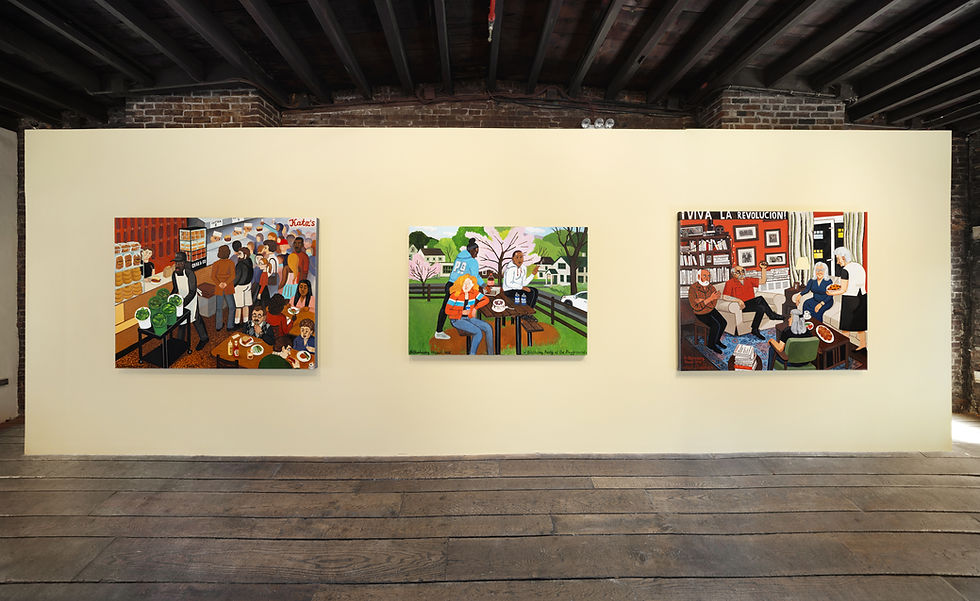
First stop Zoya Cherkassky: American Cooking at Fort Gansevoort Gallery (5 9th Avenue) in the Meat Packing District of Manhattan.


Cheyenne reflects: “I’m so glad we got to see Zoya Cherkassky’s exhibit American Cooking. I had never heard of the artist before, and I’m happy to have discovered her work. Katz’s, 2026, oil on linen, (pictured on left in installation view below) stood out to me most. It depicts a typical day at the iconic deli, yet the eye goes straight to the tired laborer rolling pickles in the foreground. It’s a quiet reminder of the work behind every meal.”

Then on to the Highline where we walked the length up town viewing the public work and native plantings and chatting.

We enjoyed: Raven Halfmoon: West Side Warrior — A monumental sculpture honoring Caddo heritage.

Vee writes: This Saturday we had the amazing opportunity to see public art at the Highline. I haven’t visited the Highline since I have returned to New York, so it was a refreshing trip even though we navigated the art through hills of people the first impression and most important to me of work was Raven Halfmoon. Raven is it indigenous artist based in Oklahoma that I have been following for a long time on Instagram who inspires me by the way she finish her ceramics. Through her bodily forms, you can see the hand that made them. It is more usual that the artists’ hand is hidden, so I love how visible you can see in the surface how she built the sculpture from coils being pushed upon each other to build a bodily form.
West Side Warrior is a bust that is on a beautiful black and white pedestal, matching the clay, which works as a form of a body. You can really see the talent and skill that they have developed building bodies and forms."
Derek Fordjour: ARCHETYPES (Archetype I: Seduction, 2026) Painted bronze sculptures depicting a burlesque dancer, at 26th Streets.

Diana Al-Hadid, Double Standard (2022): A bronze piece that conjoins two symmetrical, headless bodies at the neck—one right-side up and one upside down. It is nestled right among the native grasses of the rooftop can be viewed from the High Line pathway around 27th Street.

Ximena Garrido-Lecca, The Golden Crop (2026), nine-foot-tall bronze corn cob that functions as a water fountain. The water trickling down between the bronze kernels is dyed a glowing neon yellow to represent toxic pesticide runoff (specifically glyphosate), serving as a commentary on the environmental impact of industrial farming and genetically modified crops on native agriculture.

Evelyn writes: “High Line field trip: Jacob’s High Line field trip was a lovely period of reflection in the middle of a busy day. I hadn't seen this year’s sculptures yet, and it was very cool to see work by Diana al-Hadid (whose work inspired a lesson I taught last year for the Migration theme). Her two sculptures, In Mortal Repose and Double Standard, combine organic and geometric forms in a way that looks ancient, conjuring decay and regrowth; Cheyenne compared the texture to tree bark. Jacob, Cheyenne, and I also looked at Ximena Garrido-Lecca’s The Golden Crop, a bronze corn cob sculpture with dyed-green water trickling down the sides, and talked about different associations it brought up—the kernels made me think of stonemasonry at first. The piece I spent the most time with was the High Line Plinth commission, The Light That Shines Through the Universe by Tuan Andrew Nguyen, an enormous sandstone sculpture referencing the Bamiyan Buddhas, with hands cast from bronze artillery shells floating on poles before the figure. I made several sketches of different parts of the sculpture, trying to capture the texture of the stone with pen marks, then eventually switching to pencil to attempt the forms and reflections of the metal hands. Many groups came through this area while we sat drawing, and I saw families pose for photos making gestures to match the sculpture’s hands (the mudras for “fearlessness" and "compassion," I later learned here), overheard conversations about the Taliban's destruction of the Bamiyan Buddhas, and saw at least one kid lie down on the edge of the plinth for a rest. I wondered what the sculpture meant to tourists and New Yorkers who walked by without reading the informational plaque, those with an academic knowledge of the context, or those with a more personal connection to the historical roots of the sculpture.
Evelyn Beliveau, The Light That Shines through the Universe, 2026.
The group meet up to discuss and critique at Jacob’s favorite piece Andrew Nguyen, The Light that Shines Through the Universe, 2026.

Jacob ruminates: “I have visited "The Light that Shines through the Universe" by Tuan Andrew Nguyen at least five times since it was installed on the Highline. Every time I see it, the sculpture still creates a sense of wonder.
Jacob Rath, drawing and at work drawing.
This sculpture is inspired by the Bamiyan Buddhas. Nguyen's sculpture has a few key differences. The original Buddhas were carved into a mountainside, while Nguyen's sculpture is free standing. The sculpture also contains hands making a mudra that signifies compassion or fearlessness. These hands are made from melted down artillery shells from Vietnam. The hands levitate in the spot where the Bamiyan Buddha's hands would be, since the original sculpture lacked hands.
I feel particularly honored to have this sculpture in New York, in time for the 25th year anniversary of September 11. The Bamiyan Buddhas were destroyed by the Taliban in 2001, the same year as the destruction of the Twin Towers. The Buddha faces south, roughly in the direction of the World Trade Center site, as a way to memorialize that tragic day. The sculpture honors both what is lost, but also has a message of rebuilding. It is beautiful to see the Bamiyan Buddhas rebuilt; it shows that their message has not been permanently destroyed. The hands demonstrate that materials once used for destruction can be repurposed into a message of love and peace.
"The Light that Shines through the Universe" is the perfect finale for a walk down the Highline. It is a gorgeous work of figurative artwork, that connects multiple cultures and tragedies, while also providing us with hope that rebuilding a better world is possible.”
Drawings by Kevin Anderson, Jacob Rath and Cheyenne Rivera
We then hopped on the 9th Avenue bus, meeting up with Ed and M along the way, and Dennis and Joe at The Lobby Gallery at Theater 154, 154 Christopher St. for the closing Party for Bathers including 4 paintings by Evelyn Beliveau.

Evelyn recounts: “Saturday evening was the closing reception for Bathers, a group exhibition in the Lobby Gallery at Theater 154 that included my (Evelyn’s) work. Associated with the run of a new play by the same title, Bathers brought together nine artists whose paintings, photographs, 16mm film, prints on fabric, and sculptures treat some of the play’s themes: relationships, loss, estrangement, and of course, figures in and near water. The exhibition included four paintings from my Dolls series, and I was delighted to see the thoughtful curation by Miles Brautigam and Sarisha Kurup.
The AYB community came through to celebrate! Dennis and Joe were among the first arrivals for the reception, soon joined by a merry crew fresh from the High Line field trip, including Meridith, Leah, Ty, Ed, Jacob, M, Cheyenne, Kevin, and Vee. I was overjoyed by the group's feedback and engaging questions about the making of the works on view. Everyone's attendance made me feel very supported—thank you for making it a festive evening!"
This week in Advanced Studio on zoom AYB Artist Assata Benoit presented The Thin Line Between Spiritual & Physical.


Assata reflects: “I'm so proud of this class for diving into more complex territory. Everyone was pretty unafraid to show their vulnerable side! With the task of “bringing something figurative to life”, I knew the lesson was going to be a little more complex, but everyone embraced it with open arms.
It is such a great coincidence that this week’s topic fell in between 2 wonderful & similar classes. Flo’s was almost identical to mine, but a bit different, and then Mariah's next week is going to be going between the conscious and the unconscious. So we are really discussing ideas that go deeper than what the eye can see (pun intended).
I actually haven't been drawing or creating any art for a while, so I was able to express something that had not previously been articulated, and that I've just been feeling subconsciously.


Karla writes: "I created my collage on colored paper, vintage photo album pages, colored pencil, graphite, architectural drawing, machinist illustrations.
The human in nature...a somewhat surreal and eerie dreamlike expression of a landscape both familiar and unfamiliar. A fictional and spiritual narrative inspired by the work of Bette Saar and Leonora Carrington.
Thanks Assata! The lesson was filled with such a broad spectrum of artists and expression, prompting works based in personal experiences and beliefs. The lesson also seemed a continuation from that of the prior week."

Everyone in the class did truly beautiful work that was also thought provoking. I thought it was so endearing that we spoke about more personal ideas & I got a sneak peek into what is going on in everyone’s head. To me - art does not have to be “happy” or super positive. My favorite pieces make me feel something! Also… it's spooky season!
People are dying to... say, and express what others can't see. It's usually seen as... A burden to express yourself to others. It is a relief and a blessing to be able to express yourself. to be able to let others understand, let others understand what is not able to be spoken.”
The Line Between Visible and Invisible by Richard Lee Chong, Lila Green, Leah Eliopulous and Kevin Anderson


Lila complements Cheyenne: “To me, this painting captures the trials every love must weather. A couple clings tightly to the delicate stem of a fading flower. Yet the storms they face do not preserve its tender life; they shake its very core, scattering petals to the wind.
Look beneath the surface, where that fragile stem plunges deep into the earth. There lies the silent sanctuary of a foundation already laid, where deep roots offer quiet, enduring strength. In the end, the choice remains theirs: will they allow the turbulence to fracture what they’ve built, letting the beauty of all they’ve weathered crumble around them? Or will they reach down to remember their roots, finding anchor in everything they have grown together? It is completely up to them.”

Cheyenne compliments: Flo - I love the concept of matriarchy vs patriarchy and I think you perfectly captured the energy of each well, (especially patriarchy!) while also using your style that’s becoming more and more recognizable as your own and so I hope you continue it!

Vyomika - I love the idea of redefining female pleasure and agree that it isn’t often valued or normalized. I think the concept is super important to begin shifting societal view and the idea is inspiring a new piece for me as well so thank you for sharing!


Luna - so impressed by your use of abstract and I think it is a very successful expression of thoughts. The features of the portrait drawing are also depicted beautifully.

I (Meridith) created grey catbird chirping his song, represented as a glittery silver-blue filament of lace. In person, the glitter sparkles and makes me think of bird song. However, I found it very challenging to capture that in a photo. I moved the wall mounted sculpture into different streams of sunlight, took videos, and it still did not quite capture it well.
Then I noticed something unexpected in an image which included another bird sculpture (also made in a zoom session with Assata!) The crane appears to have a puff of sound shadow beyond the beak!! The shadow is cast from a crystal hanging in my window, interestingly linked to the glitter on the lace. I am including this particular photo of the crane and grey catbird singing.

Neah Gray introduced Advanced Studio in person at 180 Franklin Avenue participants to the work of Sam Moses, a 75-year-old traditional sign painter and musician from Brooklyn who’s painted hundreds of signs throughout Coney Island and surrounding neighborhoods. We will create our own signs inspired by his work.

Neah recaps: “Over the past few years, one of my main interests has been the intersection of public art, and the capacity our city holds for the legacy, culture, history, and legacies of native New Yorkers. This summer, I learned about a 75 year-old traditional sign painter named Sam Moses from South Brooklyn. He has hand painted hundreds of traditional signs for local stores and communities in Coney Island and surrounding neighborhoods. His legacy is important because it highlights an almost lost art technique of traditional sign painting, and Sam Moses’ recent recognition on social media is a breath of fresh air within our now AI-centered society. Instead of traditional paper or canvas, we used wooden signs during our Tuesday class.

During the lesson, we discussed what public art is, what murals are, how we use typography to visually communicate, and how words become part of our visual language. We looked at examples of Sam Moses’ artwork at infamous locations like Deno Park, and Denny’s Ice Cream shop in Coney Island. When thinking about accessibility, access to resources, and the breadth of our exposure to the arts, being able to experience so much free & public art in New York City is a beautiful gift.
This class tied in some aspects of other classes I taught. For example, my two-part class on NYC MTA Art & Mosaics came up, and reminded us of the rich beauty of mosaic art and poster designs that adorn our public transit system. During another class I taught at our Red Hook studio, we looked at examples of my own posters and graphic design work centering typography and affirmations. I make these posters for my inspirational art brand, PHAZE, serving as a way to inspire and uplift people in their homes, communities and safe spaces.

During our class on Tuesday, I also showed examples of a mural project I worked on this summer in Bed-Stuy alongside a team of other muralists. The mural, located on Tompkins Avenue and Jefferson Avenue, is a great example of public art that reflects the community it’s in. We also looked at my PHAZE posters again, and other text-heavy public art like Keith Haring’s Crack is Wack (which can still be seen today at the Crack is Wack Playground in Harlem).

During class, we had the three options for painting our wooden signs: create a sign that represents your borough, your 2026 experience, or a sign that you would envision at the entry point of New York.
Every person’s wooden sign was beautiful and unique in its own way.
Cheyenne decided to create a sign that reads, “Nueva Yol”. I enjoyed her nod to her country, Hispanic heritage, and New York roots. The details in her waving flag was an intentional, artistic choice that made her sign even more amazing. Wooden signs are often hung outdoors or somewhere public-facing. The wind, or even the movement of flipping a sign from front to back, ties into the movement depicted in her Puerto Rican flag.

As a Jamaican myself, I loved Kevin’s “Jamaica” sign, and the rich deep colors of green, yellow and black that he used. Jamaica has a beautiful, tropical and green geography, and I appreciate that Kevin included rich green trees within the foreground of his artwork. Leah’s line work was brilliant, and I love the details of highlights and shadows that she used with the oranges and light yellows.

I agree with Meridith’s comment during class that Leah is a natural sign painter!

I appreciate that Vyomika painted a bold affirmation of “You are the sh*t”, because I love inspiring quotes and can see this hanging in her home or bedroom. She was one a few people who had a vertical wooden sign instead of a horizontal one, and I love how she painted a beautiful, almost watercolor-like background using acrylic paint, and made good use of the slim vertical space she had.
Vyomika Tewary, You are the shit, and Meridith McNeal, ART YARD BKLYN
Florian Kinnifo-Neven du Mont, Stay Magic, Dylan Gomez, Game On, Vee Tineo, You Are Crazy, Dallany Gomez, Dallany 🌈, Neah Gray, It's Your Year
Overall, I love how we were able to use wooden signs during our class. It’s a surface we don’t use often, but it did remind me of lessons we learned during Rainey‘s woodworking classes at Red Hook! Overall, it was a fun class, topped with delicious apple cake from Meridith."

What We Are Reading
Dennis writes: “I was gifted this gorgeous book for a recent birthday - and it was previously recommended to me by several others. It was perfect timing.
The Dog's Gaze by Thomas W. Laqueur (Penguin Press, 2026) is beautiful in many ways - but the #1 is how the art is presented in reproduction throughout the book. It reminds me of a copy of "The Yearling" (it's now buried somewhere down in my storage bin) that I bought in the 5th grade from a book sale at the public school I attended. It was illustrated throughout with reproductions of oil paintings by N.C. Wyeth - one sided glossy pages which made it feel extremely special (to a 5th grader). I can remember hiding it in my closet so my brother wouldn't touch it! Wonder if it's a collector's item now - it might be worth a spelunking escapade down into storage to find it.
The Dog's Gaze and The Yearling Book covers
The pages of "The Dog's Gaze" are not as glossy as those in "The Yearling" but, wow, is it ever jam-packed with images. Somehow, I'd forgotten how nice it is to see pictures while reading. It could also be one of those gorgeous coffee-table books if printed in larger format.
The book's not always an easy read (and I haven't finished it yet) - it's quite meticulous and often technical so I'm assuming those interested in detailed art history would find the book fascinating. The dog factor appeals to me - however, it has turned into an art history education for me. I never realized how many times dogs appear in paintings - and now I will be looking at art more closely and carefully. I am now further aware that dogs in art sometimes point us in a different (or an intended) direction - letting us know which way to look. I am learning so much about dogs' symbolism in art. They provide an emotional connection between the subjects of a painting and help us to empathize. I think I get it now.
I also never really noticed (until now) that dogs in many drawings and paintings are often looking directly at the painter - as if the painter were a photographer and the dog is looking at the camera. Is the dog posing? Did the painter dangle a treat to get the dog's attention? Or was the dog telling the story for the painter to capture.
Hazel and Olive artworks by Arlene Horton, Marie Roberts (x2), Sarah Gumgumji, and Ben Lenovitz
I think it would be unfair for me to critique the style of writing, ... but on a personal level, I am loving it. I love the title too - I like to make eye contact with dogs. I always hope that one of the dogs I chat with on the street (or in our elevator) is one of MY dogs passing through again to say hello to me.
It seems cliche for me to say that my favorite piece of art in the book (thus far - I've still got about 1/4 more of the book to read) happens to be the cover piece: "Man With Dog" by Bartolomeo Passerotti. Here's why - I've had several dogs over the past decades (and have had close relationships with dogs who belonged to friends) - mostly all lived to be between 15 and 16 years old (we must have been doing something right!) ... but I felt the closest bond with Hazel, a pug who came into my life when she was only 8 weeks old. I even took "pet-ternity" leave from my job so we could suitably connect. Whenever I'd pick Hazel up and hold her (the same position as in Passerotiti's painting), she'd stare into my eyes and I'd look back and try to communicate with some sort of mental telepathy (it's ok to judge me here - I'm used to it!). When I'd start to talk to her, she'd stare right into my mouth and then back up to my eyes. Sadly (for me), things did change when we got another pug (thinking she'd want canine companionship - WRONG!) and she seemed to move on from being a person back to being a dog. From time to time, when I'd lift her up, the connection would last only for a short time as she'd become distracted with the presence of the other dog. If she had thumbs, she may have written a book called "The Human's Gaze". I'm sure she'd have had lots of opinions about me and how she thought would be the proper way to care for her. Plus - I have been the very lucky recipient of dozens of pieces of art of my dogs from wonderful friends - it would be a verrrry loooong book if she included them all.
I guess I should end here before someone calls the men in white coats to come and get me!
Dennis and Hazel, 2027, and Rymeesha Fason, Hazel
Read this book - it's wonderful. It's sometimes not easily comprehensible (to me) - I did find myself going back and rereading pages to be sure I understood what the author was trying to tell me. If you have a dog, maybe you could gaze into their eyes, read it to them - and show them the pictures - it would be a good bonding process.”
Other Art News
Abriel (bob) Gardner shares “A few things I have been working on the past couple of days. I have been trying to prioritize drawing as it’s been very helpful in calming me down and not feeling so glum.”
Abriel (bob) Gardner, recent drawings.
I (Meridith) am at the probably done, will let it rest for 24 hours, then check again stage on this new big painting Inside Outside Painted Swan (Carroll Gardens, Brooklyn).

Mia Lew is “I am knitting right now. Middle one is my gage swatch (a small sample of knitted or crocheted fabric made before starting a project to test your tension, yarn, and needle or hook size). This is for my dress. The assignment is to make a rectangle based garment.”
Mia Lew, Knitted Dress in Progress
I also made some other pictorial knots last week inspired by architecture. The prompt was to use eyelets and ladders. I’m picking up some stitches right now because my yarn broke… a bit annoying but I’ve been having a lot of fun!”
Mia Lew, Architecture: eyelets and ladders
As we were walking along the Highline Vee Tineo, Kevin Anderson and I (Meridith) had a thought provoking meandering conversation spurred on the experience. Kevin pointed out that while his college and graduate programs were in Biology and Sociology, he feels as if AYB provides a doctoral level art education from material usage to community. Vee concurred adding the deep and varied philosophical conversation fulfill a similar role for them. Kevin shares a recent watercolor painting:

Exhibitions to See
Neah Gray writes: “On Saturday, I did a group art gallery tour with PHAZE to see the exhibit Taking up Space: New Works by Kandy G Lopez at ACA Galleries in Chelsea. The 14-foot yarn art in Lopez’s exhibition was something I’m so happy we were able to experience in person. While this exhibition is now over, I recommend keeping an eye out for Kandy G Lopez, her work which honors the power, dignity, and layered identities of communities historically rendered invisible is excellent!"

Karla Prickett shares art exhibition news from Salina, Kansas. "Two stand out pieces in The National Watercolor Exhibition at Mark Arts, Wichita, KS are Michael Jilg's primarily yellow firey abstraction on top of handwritten ground and Wayne Conyers colorful abstracted tree form. Wayne and I are on the Exhibits Committee at the Birger Sandzen Gallery. This particular work resonates with recent AYB pieces!"


Karla also “attended the 50th Anniversary of the Land Institute here in Salina, KS which featured a woven bench by artists Rena Detrixhe and Karen McCoy.”
Rena Detrixhe and Karen McCoy, Woven Bench installation views. Photos by Karla Prickett
I (Meridith) am pleased to have three pieces included in the Flat Files selection of The Nature of Building: Artists Books curated by Maddy Rosenberg opening at Kentler International Drawing Space on Nov. 7th, 4-6 pm through December 13, 2026.

Opportunities
Flo alerts us to the Post Cards From The Edge open call to artists:


Carrie -- Thank you for the heads up on Sam's work! We really loved getting to learn about him!
So glad AYB got to see Sam Moses' sign work!