
All these experiences shape our identities

Updated: Mar 7
This week with AYB Artist Maraya Lopez Advanced Studio on Zoom discussed how travel has shaped our identities. Whether we travel to the grocery store, a local park, or across the seas, all these experiences shape our identities and influence how we perceive and engage with the world around us. In addition, we’ll consider the reasons people travel, such as leisure, migration, exile, necessity, and displacement.

Maraya thoughtfully summarizes: “I presented Home Visitor, a lesson inspired by the broader concept of travel that zoomed in on place, transformation, identity, memory, and mapping. What does a place feel like after knowing it so well, leaving it, and returning to it again, at some point in the future? Why did one leave in the first place? The many reasons one leaves a place could be forced, self-inflicted, necessary, or simply to witness far-off lands and peoples of other cultures. Whatever the reason, when one leaves a place, time steps in. It is in that time that the transformation of the place and the individual occurs. The reshaping could be physical, emotional, psychological, personal, or all the above. When one finally returns to the original point of origin, one's perspective shifts because of the time between the past and the present. Like the tides of the sea, everything looks familiar on the surface, but much has changed upon closer inspection.
For the assignment, students were asked to think about a place that was meaningful to them, that they had left at some point in their lives, and had revisited. Then they created an initial map of their memories of that place. They were to add a second layer of memories on top of the first, showing how the location and their own feelings and perspectives changed over time. Some took the idea of “mapping” literally, using geographical maps, while others depicted memories that morphed into poetic inner landscapes.


Richie’s minimalist before-and-after Covid-19 drawings depict his memories of how his school changed from before the pandemic to after. One shows the bare bones of the space, while the other hints at progress. The vulnerability in the line work and the empty space reflect internal and external loss stemming from the pandemic's emotional and psychological aftermath.
Richard Lee Chong, Home Visitor
Karla’ s piece Mapping My Art Journey, mixed media collage, as she explains, “incorporates illustrations from my 1950 Jon Gnagy “New Art Book” instructional pages (age 6); sections of a 100 year old township map of Salina where I live in Kansas; my college art history class notes and a recent square chip board composition. The map weaves these compositional elements into an expression of place and person.”

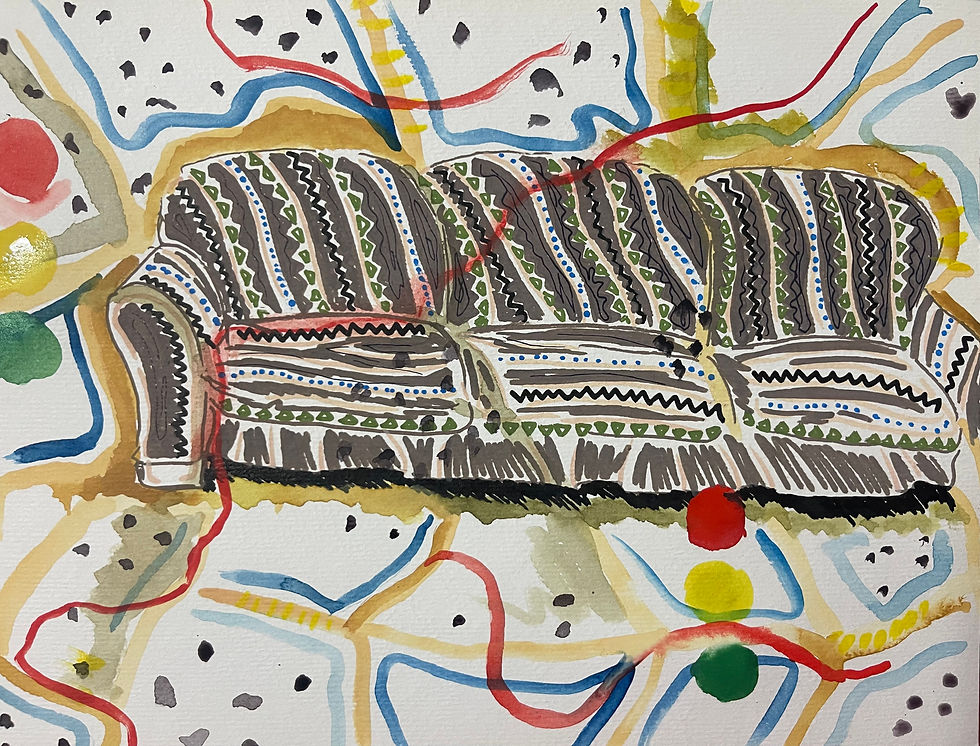
Fatima’s map provides a glimpse into her childhood memories of visiting her grandmother in the Bronx. She has painted the sofa to reflect the tenderness and warmth she felt during her visits. Through careful observation, we can see a vibrant pattern that symbolizes her Afrocentric heritage. A festive contour map of the Bronx is overlaid onto the image, guiding our eye across the composition. Fatima’s painting is a joyful internal map of memories past.
Fatima further explains that she “used layering and mapping—techniques encouraged for this project—to reflect on memories of her grandmother’s apartment and couch. While the furniture might now seem old-fashioned in hindsight, its patterned, Afrocentric design once served as a vibrant centerpiece of her grandmother’s home. Building on these memories, she layered watercolor in a map-like arrangement across the surface, echoing the patterns found throughout the house while thinking about landscapes of the Bronx and New York City in an abstract form.”
Dami creates a back-and-forth between image and emotion, guiding us on a slow journey from her home in California to her childhood vacation in Maryland. Collaged images of a home lit by a fireplace, holiday moments with family, and rolling fields of trees connect the space between California's roaring waves and Maryland's green forests. While the relaxation of vacation is appealing, long hours on the road can be tiring and draining, making one even more eager for a vacation!
Dami adds: “For me, this piece focuses on the meaning of belonging. Typically, I think of my Nigerian heritage. However, by thinking of a place that holds so much significance that you return to it on more than one occasion, my heart instantly thought of California. How does my Nigerian family connect after most have immigrated to different places? Growing up, my mother saved every penny and always planned a year in advance so we could see our many cousins, aunts, uncles, and Grandma for Christmas. Despite living on different coasts, we always found a way to connect. Even if the year was hard, it was always as if an invisible force was pushing and pulling us towards the west. This is a symbol of that. The interconnectedness that can be felt beyond countries—beyond state lines.”

Adji’s work evokes classical Greek vases decorated with ancient myths. The images layered on top resemble photos from a family album, serving as memories for the artists and mementos of lives once lived. The colored images and the people in them anchor the whimsical, free-flowing lines of the drawing. The overall composition is a poetic inner mapping of the artist's memories.
Adji reflects: “Maraya’s class was really challenging for me. I wanted to think of one location, but as I sat with it, I realized I’ve been shaped by the places I’ve lived in—whether I liked it or not. I started thinking of the commonalities of each place, and how to bridge them together to create a cohesive piece. One commonality was ceramics. The love, and the desire to work with clay has followed me from Senegal, to Reno, to NYC.”

Flo’s playful use of wire and tree branches skillfully frames the Klee-like painting inside. The grid-like structure reflects city planning and mapping. The architecture, shapes, and colors feel both grounded and floating. Loss, repair, and aftermath seem to appear within this cemetery-like scene. Yet there is something hopeful in the red moon shape at the top right of the composition, which recalls the hope one feels when looking at Etel Adnan's paintings.
Flo adds: “For this class I was reminiscing on when I lived and traveled around Yemen as a kid. I remember when we first arrived at my grandparents house, a traditional Yemeni tower house in the centre of the old town of Sana’a.
One of the first thing that captivated my attention were the stained glass windows called Qamariyas, that were present in almost every room of the house and would project beautiful mystical colours on the walls, mostly green red and yellow in my memory. The first layer of my map is inspired by these Qamariyas.
The second layer of my map is the frame made out of driftwood and thin wire (I believe it is copper). The inspiration behind this frame comes from the wire car toys that kids were playing with in some of the villages my grandad was working while we lived in Yemen.
The driftwood represents the constant movements during my childhood that felt very much out of my control and to which I learned to surrender. The second layer of my map (the driftwood frame) therefore also represents my last time back in Sana’a not knowing it would be my last time there, not really knowing where would be my next destination.”

Kevin’s memory map was shaped by his visits to Pebble Beach in Dumbo, Brooklyn, both alone and with his mom. The faint outline of the East River merges with the vibrant colors that evoke his happy memories of returning to the beach with his mother. The childlike watercolor style reflects the nostalgia of past times.

Cheyenne writes: “For my piece, I decided to make myself the map where I plan to include abstract and realistic symbols and the places I originate from, onto my body. My culture and ancestry (physically Puerto Rico and Finland, but also beyond the physical realm as well).”

Travis’s memory map is like a fairy tale of a youth who revisits their childhood home as an adult. We, the adults, are the giants looking into the treehouse structure that seems to precariously sit in limbo between childhood and maturity.
Travis explains: “Coming back to a “house” and realizing over time the “house” is too small, you don’t fit, and you find yourself forcing yourself back into a space that felt spacious once but now you’ve broke the house into pieces trying to stay in a space you longer can fit.”

Briana started her piece with a page from a coloring book. Her use of color and floral patterns reminds me of delicate plastic stained-glass craft projects for kids. I made one into a Christmas ornament for my mom when I was in elementary school. In class, Briana gently shared the memory of her uncle’s blue car and the happiness of visiting him. Additionally, I compared the color palette and materiality in Briana’s work to Golnar Adili’s piece, “A Thousand Pages of Chest in a Thousand Pages of Mirror,” 2012.

Leah’s memory map combines the shape of her home country, Barbados, with that of a sobbing American flag. Her deliberate inversion of the flag's colors cleverly challenges the current power imbalance of U.S. territorial dominance over Barbados. A childlike frustration appears in the piece, encouraging empathy in the viewer.

Aaron’s memory map originates from his visits to the sea in Jamaica. The bans of white and blue evoke space and water. The golden square could symbolize land or beach. Overall, the work is a poetic gesture toward the universal. This was Aaron’s first attempt at using watercolors!! (CLAP, CLAP!!!)

Meridith’s map links two locations: Her studio as artist in resident at The American Academy in Rome, Italy and her art studio in Brooklyn. The carnival-like sequined map of Rome second layer was hand-sewn during a subsequent residency. The blue cup is part of her series, “Magical Things,” which she also began in Rome. The doily trim around the cup is a cut map of her Brooklyn location becomes a pocket of her life sewn into the larger fabric.

Nayarit presented the class with two separate memory maps. She shared her experience of moving to multiple homes throughout her childhood in Queens, a direct result of gentrification. The first map, created with burns and other media, depicts the trauma she endured. Color flows in and out of, and around, the darkness. The piece is a relic of a childhood marked by challenges and perseverance. Her second memory map is an enigmatic symbol of hopeful resistance.
Nayarit Tineo, Home Visitor
Maraya sums up, “My piece reflects the experience of being both at ‘home’ and a visitor when I return to my home in Texas. I have been living in New York City for 16 years now. It is also a place I call home, yet I am also a visitor or foreigner, you might say. There is always a sense of loss and self-transformation when I go back to Texas and then return to NYC. It is a disorienting feeling I’ve learned to accept over time, but I still question it. I am in the habit of sending myself postcards when I visit any place, for memory’s sake and for artistic inspiration.”

This week in Advanced Studio in person at 180 Franklin Avenue AYB Artist Jules Lorenzo lead us on a deep dive into the works of Chiharu Shiota and piece together our “invisible bonds” through water color painting and red yarn.

For this week’s in person lesson, Invisible Lines, we covered the works of Chiharu Shiota. Shiota (b. 1972) is a contemporary artist best known for her site-specific, ephemeral installations in which fragments of memory are woven within webs of yarn that consume entire exhibition spaces. She studied painting in Japan before training in performance art in Berlin, where she continues to live and work today. Her performances often present her physical body as a canvas, coating it in red paint or smearing it with earth. In contrast, her yarn installations allude to an absent body, with lines of thread representing intangible emotions, memories, and human connections all tangled together (Japan Society).

“Strings break, get tangled or tied together just like people cut relationships.” Chiharu Shiota
Feeling more connected to string as a material than paint, which now have become a signature for the artist, Shiota started doing performance and installation art. “ I create in space” she says about her method and continues: “When you weave string, it’s a communication with the space. It’s like painting a picture in the air. Often the strings are intertwined but also connected to human objects such as shoes, suitcases, and old photographs that she finds at flea markets and antique shops (Louisiana Channel).

Objects like keys, shoes, dresses, chairs, and suitcases have played significant roles in Shiota’s installations.
“I cannot use new objects, because for me, each used or antique object carries its own memory. These objects aren’t just physical things; they hold memory, and the emotions. I can feel their history and the presence of the people they belonged to. It’s like they speak to me.
I’m not afraid of this connection because memory is vital—it’s what allows me to understand myself and explain who I am. Without memory, I would be lost, unable to connect with my own past or make sense of my present. Memory is what anchors us, giving meaning to our lives and to the things around us.” – Chiharu Shiota (Vivian Chow, Artnet News)
Red thread/chord is commonly used in her installations. It represents blood, and blood carries the essence of life. Shiota uses it to symbolize the inside of the body, and therefore, it represents human connections and relationships.

“My works’ theme is often about absence in existence,” Shiota explains. “What world will there be after your body has disappeared? When I die, and my thoughts and ideas are gone… I wonder what will become of me. I create my works searching for these answers.”
Participating artists were instructed to create two images of the same size, one depicting the first object that you can recall from memory, and the second being of a recent object that holds meaning to you. After doing so, the class would use red yarn to create a collaborative web, weaving together not only our memories but ourselves.

Maria’s piece was one of the class favorites of the night! Her triceratops stuffie (which is lavender scented mind you) evokes a tangible softness as well as nostalgia for one’s childhood toys. An additional toy that involved the same color scheme was Shellorne’s Barbie dress.
Maria Polonco, Invisible Bonds, and Shellorne Smith, Invisible Bonds
Maria, Fisola, and I (Jules) each shared first memories that were of hair tools. Maria’s piece depicted a red comb, including a strand of curls within the teeth. Fisola incorporated two brightly colored flower barrettes into her work while my piece was of my mother’s curling iron. The red yarn that ensnared our art almost gave the illusion of hair, giving functionality to each of the tools.
Maria Polonco, Invisible Bonds, Fisola Famuyiwa, Invisible Bonds, and Jules Lorenzo, Invisible Bonds
This class was Anthony’s first introduction to Art Yard, or as Reg (the king of puns) referred to it as “Art Yarn.” Anthony’s drawing of the first bedroom he had when he moved to New York drew many comparisons to Meridith’s recreation of her dollhouse project. There were vast similarities found in the color palette, window curtains, and flooring of each room.
Anthony Sutanto, Invisible Bonds, and Meridith McNeal, Invisible Bonds
Flo’s object was the only 3D model created that evening , which brought to mind previous works from AYB student Chace, who tends to create similar pieces that jump right off the page. Flo combined both his first memory and most recent through the depiction of his childhood Mickey Mouse bowl that he has now turned into an incense holder.

Leah and Reg both had food related imagery as their first memories. Lia’s bowl of snap peas invited you to take a seat at the table and dig in. Her food design was reminiscent of the meals found in various studio ghibli films: warm, cozy, and DELICIOUS! The orientation of Reg’s drumstick made it look like it was dangling from a string.
Leah Eliopulous, Invisible Bonds, and Reg Lewis, Invisible Bonds, and Studio Ghibi film still
We had a few repeating themes/imagery throughout the class. Dylan and JP’s endearing brown pups had many similarities. Dylan’s drawing was of a bed he frequently likes to rest on. When he realized he initially made the paws too small, he quickly remedied this by creating a bigger paw around it, simulating a little pawception. JP’s image was of his new puppy! When he attached the image into our class web, she ended up laying sideways, looking almost as if she was on her back waiting for a belly rub.
Dylan Gomez, Invisible Bonds, and JP Roemer, Invisible Bonds
Also we had not one but TWO Nintendo consoles made by Cheyenne. These pieces were very sentimental for me since not only was a Nintendo gameboy the first gaming console I ever had, but a Nintendo switch was the last!
Cheyenne Rivera, Invisible Bonds
Delanny’s Peppa Pig was immediately recognized by Fisola with a deep nostalgia.

Sebastian’s replica of his latest pack of American Spirits was one of the only works to contain lettering, alongside the recreation of the signs I made for my recent show.
Sebastian LaBossiere, Invisible Bonds and Jules Lorenzo, Invisible Bonds

Chiharu Shiota not only embraces memory, but pays homage to it in a way that is hauntingly beautiful. Her desire to explore the “invisible bonds between us” is what drew me towards her work, especially in relation to the bonds that tie us so closely together in our Art Yard community. In a world that sometimes strives to drive us apart, it’s nice to remember all the ways, subtle or blatant, that we are connected together.
AYB Teaching Artist Evelyn Beliveau summarizes: “At PS 17, AYB has been invited to participate in the school’s annual Women’s History Month celebration, so we are beginning a special project. Putting other lessons on hold for now, our classes will spend three weeks creating life-size puppets and portraits of historically significant women to be featured in the Women’s History Month event on March 25. Dennis, Simone and I (Evelyn) have put our heads together to guide our students to success.

Our classes in Grades 4 and 7 have been selected to create the puppets to be used during the event. These will be flat paper puppets, inspired by a lesson on Wayang puppets presented at another school last year by AYB Teaching Artist Lionel Emabat. For the Women’s History Month “wax museum” event, the puppets will be life-size, waist-up renderings of groundbreaking women from history and the present day. Starting with pencil on posterboard, the puppets will be finished in acrylic paint with cardboard and wood handles and movable joints for the presenting students to use.

Our students came to class on Wednesday with a diverse list of historical figures already assigned by their classroom teachers and research underway to better understand the impact of each inspiring woman. Working hard to make the best use of our short time with each class, we set out reference photos that Dennis had printed of each woman at students’ assigned seats. The list includes women across the fields of politics, sports, and entertainment, plus visual artists (many of whom have been featured in past AYB lesson cycles, like Georgia O’Keeffe and Yayoi Kusama), scientists, and other scholars.
These students learned the vocab words puppet, likeness, and template, since each will create a likeness of their assigned historical figure using the life-sized templates that Simone and I created and traced. We reviewed the concept of a wax museum and introduced the historical context for Wayang puppets, a traditional form of storytelling from the Indonesian island of Java. Then, I presented the basics of portrait drawing, including the placement of the eyes in the head and the importance of closely observing the reference photo to find the details that make a person’s face recognizable. A lot to do in one class period!

Students got right to work after the presentation and made great progress on their pencil outlines of facial features, hair, and clothing. Our team circulated throughout the room, offering assistance as students tackled the challenge of creating a likeness. Often, a fresh set of eyes or an encouraging word makes a big difference to a frustrated artist, or a quick demonstration can help simplify complicated forms. The angle of an eyebrow, the structure of a nose, and the proportions of an eye all contribute to a recognizable portrait, and those students who had time to add details of hairstyle and clothing took great strides toward emphasizing the time period of their historical figure.
With our students in Grades 1 and 2, we are working on portraits with patterned borders on watercolor paper. These students also started with pencils and reference photos of the women featured in the Women’s History Month event. They reviewed the vocabulary words outline and shading, then learned texture and border. We examined the work of two renowned artists, Elizabeth Catlett (1915–2012) and Amy Sherald (1973– ), with careful attention to the textured shading in Catlett’s prints and drawings and the bright colors in the backgrounds of Sherald’s painted portraits. Like our older classes, these students learned the basics of portrait drawing, starting with an oval for the basic head shape and the placement of eyes, nose, and mouth. Students took on this challenge at different paces, with some going on to add bedazzled outfits and patterned borders while others took their time mastering the details of facial features. Either way, we are excited to see these historic women honored in full color by the end of the project.”


Managing Director Dennis Buonagura writes from the Path Train: “In the final class of Teaching Artist Nick Tardiff's terrific lesson on migrating animals in motion, students at our partnership school in Jersey City, PS 6, finalized their pieces by adding backgrounds to their penguin, wildebeest, and dolphin pieces.
The backgrounds were done in oil pastels and/or colored pencils and were realistic (some) or fantastic (many). The students are chomping at the bit to see their works become animated - Nick will work his magic once we have every single piece ready for photographing (he already started photographing some during our break) and he'll send over the finished product for viewing in their classrooms. An advance sampling for class 309 is attached.

Of course, the very final animated piece will be on exhibit in the gallery near the end of the school year. Nick, Simone, and I are figuring out the best options - large screen monitor or ipad? The film will be shown on a continuous loop during the opening exhibition - and beyond!
When discussing animation and live action films, we got on the topic of the penguin dance from “Mary Poppins” and we showed the class a 3 minute video segment. The “penguin” group decided to mimic the dance - and, during critique, Yashira used the superlative (hmmm..might actually be a hyperbolic adjective?)
SUPERCALIFRAGALISTICEXPEALIDOCIOUS
to describe the lesson (referencing Mary Poppins) - and made a valiant attempt at sounding it out to spell and write it on the board.

Today was “Dress As Your Favorite Literary Character” day at PS 6 - I tried to guess who they all were but failed.
We conducted a very lively critique at the end of the class with lots of compliments and questions! Nick explained the applications that he uses and the process or techniques required - to our surprise, some students already knew these 'apps' (I was not among those in the know!). Actually, it should NOT have been to our surprise - these kids seem to be pretty advanced when it comes to technology.
On that note - an FYI: a 2nd grader from PS 6 (how old is a 2nd grader - about 7?), Paarth Pandey, was one the winners of the New Jersey Association of Gifted Children (NJAGC) Writing and Art Contest! A 2nd grader!!! Incredible!
Who knows - after completing the animation of their migratory animals project, our PS 6 students may be nominated for a Best Short Animated Film Academy Award! Time to get the tuxedo out of moth balls.”
Nick adds some thoughts on AYB Teacher Training: “In short, training at AYB has been simply amazing. Assisting in the class ahead of leading my own lesson was highly insightful and enjoyable, with the professionalism, patience and passion of the staff being equally so both in themselves fulfilling their roles and duties as well as guiding me through them. With that, our correspondence between and ahead of lessons was frequent, timely and clarifying, with any and all necessary preparations for lessons being adequately discussed and established lending to a more streamlined experience teaching.”
Other Art News
AYB Artist Jules Lorenzo shares photos from her new band Cigarette Vending Machine’s debut show at Berlin! Adding….“Stay tuned for updates of our next one!”
Concert images
This Thursday – Come on down to the metro-Philadelphia area and join me (Meridith) at Rutgers-Camden for an artists talk!
Artist talk invitation, and installation view. Photo by Abby Vanono.
Also on Thursday, March 12, AYB Teaching Artist Aisha Tandiwe Bell's solo exhibition ETHOS opens 6-8pm at Welancora Gallery, 33 Herkimer St, Brooklyn, NY 11216.

Congratulations to AYB Artist Mia Lew whose woven bag sculpture is included in This is the World (I Made It For You) at the Red Eye Gallery at RISD, Providence, Rhode Island.
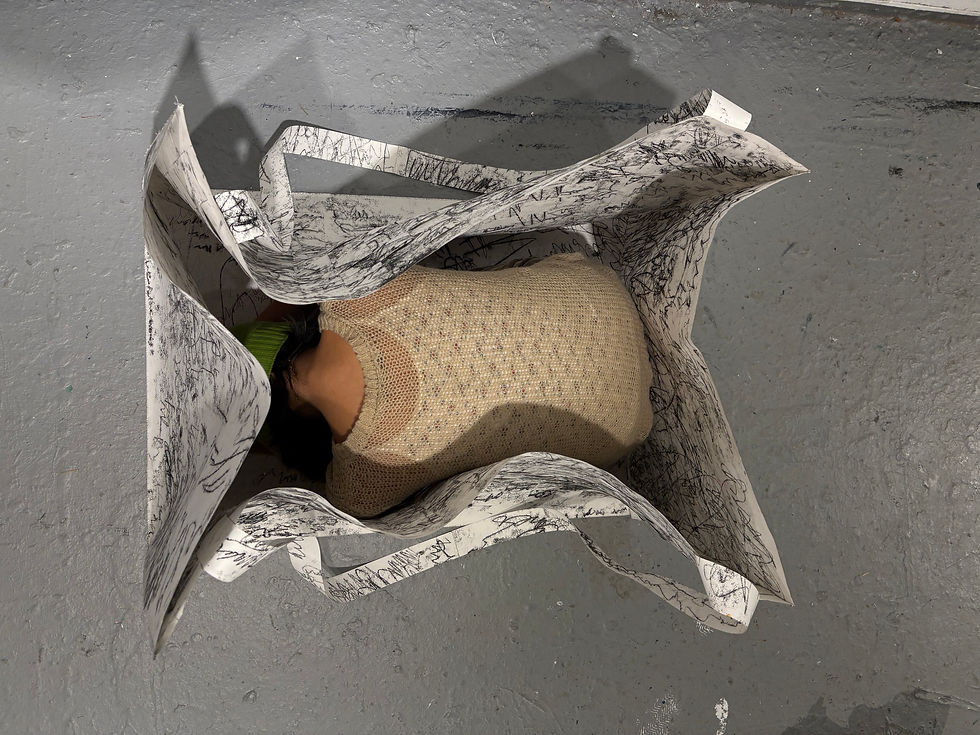
Mia writes: “Two photo grad students curated a group show at the Red Eye Gallery (a RISD student gallery) and my sculpture, Paper Bag, was selected for the exhibition. I dropped it off today. The show is titled This is the World (I Made it For You) and it features work across disciplines. The show explores interval worlds, anxiety, and prefixing the world or one’s body through distortion. I submitted Paper Bag for this show because I created it as an exploration of my anxiety that could hold me. It is made of trace monotype prints, exploring mark making and distorted, stream of consciousness text. I cut, woven, and hand sewed these prints together into this bag. The opening will be this Thursday and I’ll make sure to get some photos! I’m quite excited!”
AYB Artist Reg Lewis will be performing his long awaited spoken work poem: The Attention Wars (AKA) How Reality Crosses the Mind at The Tank 312 W 36th St, New York, NY on March 25 at 7 pm, March 27 at 7pm, March 28 at 3pm and March 30 at 7pm.

We will make a field trip to see Reg’s performance on Saturday, March 28 at 3pm. RSVP to me: once we have our head count, Reg will set us up to get discounted tickets!
💖♥️❤️❤️🔥



Wow - you guys are killing it this week! Great work.