
Never underestimate our roles as artists

Updated: Apr 11
This week ART YARD Art Matters partnership schools were on spring break. We were busy none-the-less!
In Advanced Studio in zoom we created painting & collage about community inspired by the work of Judy Bowman and Suzanne Jackson, and in person we celebrated Passover mulling over the Exodus story and the underground railroad.
We have been looking at art in person near and far, and share an invitation to a panel talk tonight!
This week in Advanced Studio on zoom with Adji Ngathe Kebe we delved into the visual story telling in the paintings of Suzanne Jackson and collages of Judy Bowman.
Artists Suzanne Jackson (left) and Judy Bowman (right)
Adji recaps: “For this class, we explored the work of Suzanne Jackson and Judy Bowman. Suzanne Jackson is a multi-media artist who works in layers, much like Judy Bowman. Both of their works seem different, but upon closer inspection they are quite similar. They both work in layers, exploring themes of Blackness, culture, and our connection to nature. Stories about their communities is emphasized through every art piece. We looked at many art pieces, including “Mom in Harlem,” by Judy Bowman.


One of the discussion questions was; what story is Bowman telling about her mother? Many talked about the “mother” as a central figure in the community, but not knowing which one was the mother because there were many female figures represented in the image. “Mother,” then becomes a stand in for any figure in the community who serves a central role of gathering, supporting, and maintaining the community. Irrespective of gender.


Karla writes: "I created my mixed media on paper collage using planning calendar page and cover, ledger entries, paper punch sheets from making confetti, graphite figure drawing, printed illustrations, acrylic paint, and bingo cards." Karla also compliments: "Meridith's piece was amazing. Love the interior scene and the way black lines created perspective and depth! Great figures and familiar postures! I really liked how Flo depicted family and the assemblage "retablo-esque" composition of symbolic objects and figurative narrative. It seemed to have a retro feel! I'm anxious to see how Richie's piece develops. Like the negative space and the gestural postures of the figures."


This was represented in the artwork created in class and in various capacities. Every artist depicted and told a story of the figure or figures in their community who hold significance.”


Tuesday we celebrated Passover in Advanced Studio in person at 180 Franklin Avenue with salted matzoh, rice salad and a thought provoking lesson about the Exodus story and the underground railroad lead by Jacob Rath.
Marc Chagall, Moses Crossing Red Sea, 1956, and Jacob Lawrence, Forward, 1967
Jacob sums up: “I began class by discussing a book nicknamed "The Slave Bible." This was a version of the bible that British slave owners created for enslaved people that had several parts redacted, including the book of Exodus. I then told the story of the Exodus, and we looked at artwork that portrayed the Exodus story. I then moved into a discussion on artwork relating to the Underground Railroad.
After looking at the artwork, everyone was asked to make artwork about either the Exodus story, or the Underground Railroad. We made artwork spanning a variety of topics. Some people, such as Kevin, Richie, Margaret, and Meridith, made artwork of scenes from the Exodus story.

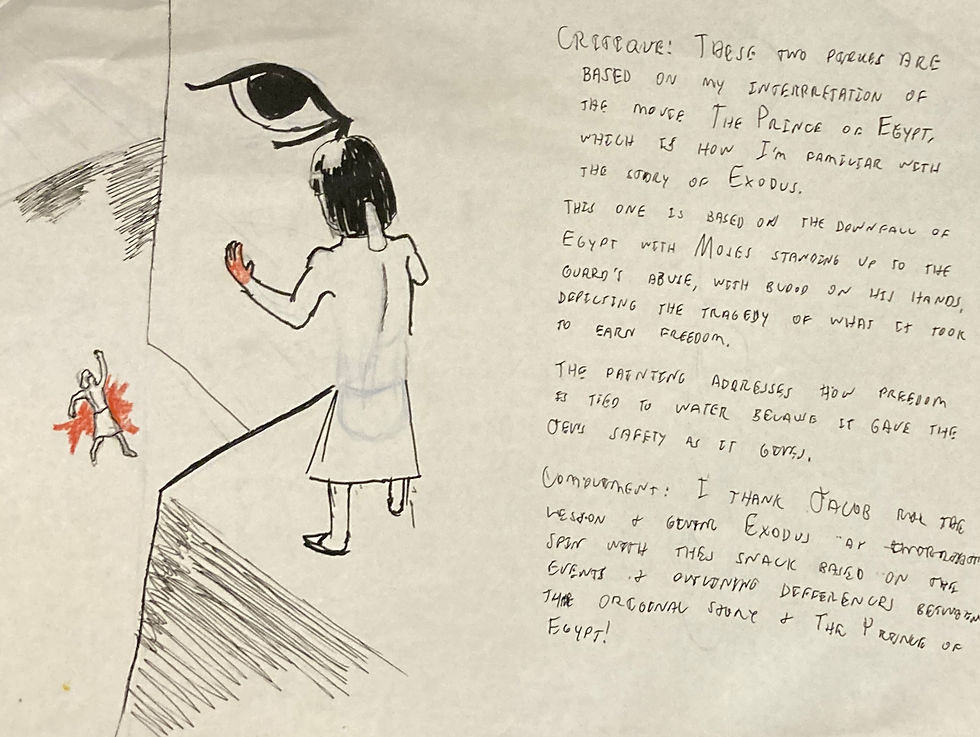


Maria made a painting imagining what happens to a place after people have abruptly left it.


Leah made a chilling painting of the middle passage, the last place that many enslaved Africans walked through before boarding the ships that brought them to the Americas.

Sebastian, on the other hand, made a painting about how water can be a place of healing and rejuvenation.

Fisola's piece showed an injured person, whose wound was able to heal after they connected with another person.
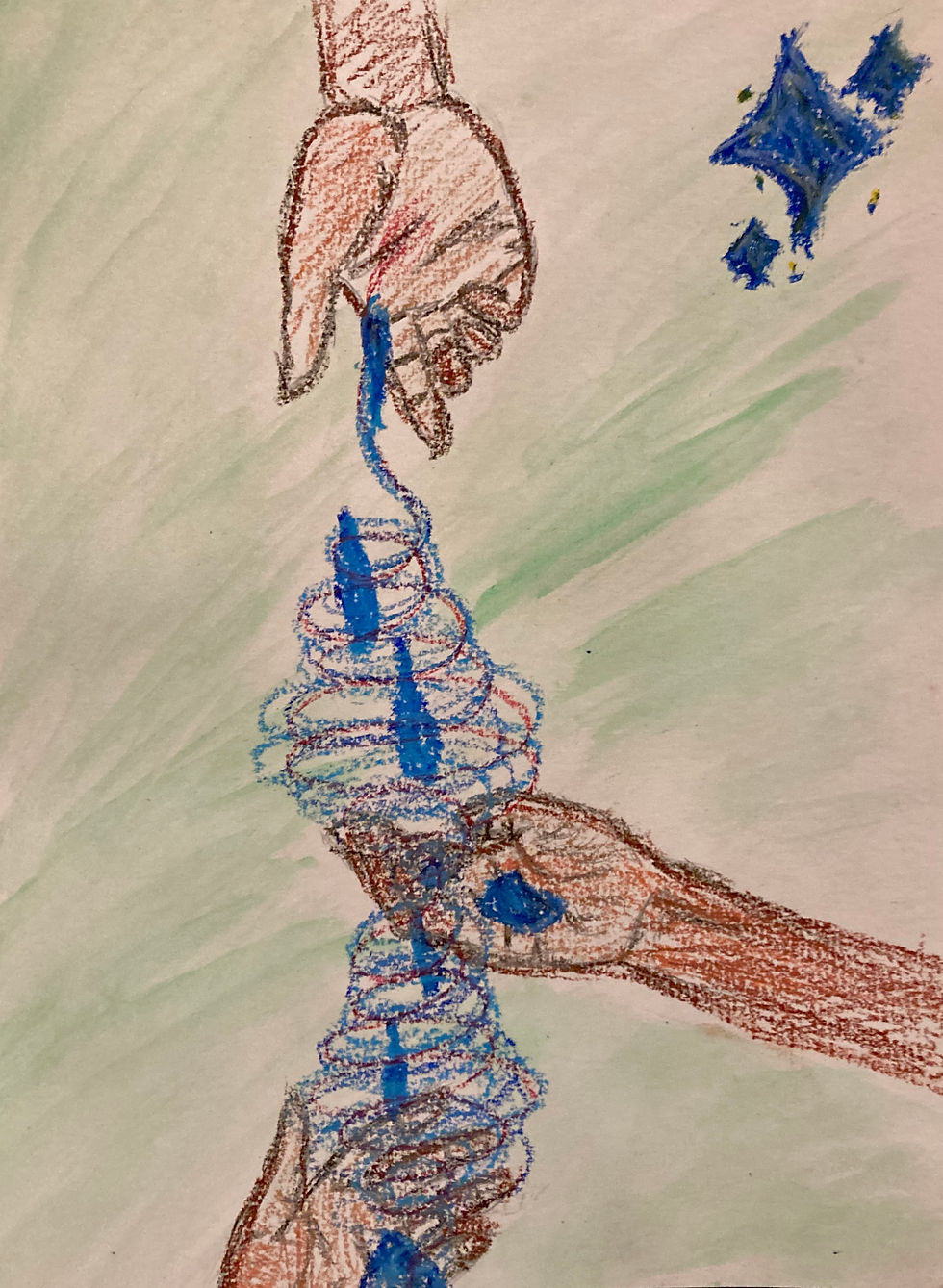

Ed and I (Jacob) both made artwork about the current political climate of the U.S.


During our time making art, we had an animated conversation about the struggles of our time, and how to deal with them. This discussion continued into critique, and we were left with some words of encouragement from Ed. He says that life is always a battle, and it especially feels like that when you're in your 20s and 30s, but you shouldn't give up! We should not underestimate our roles as artists. Politicians create their own rhetoric to gain power over others and ruin their lives, but as artists we have the power create artwork that challenges their narratives.”

Other Art News
AYB Artist Karla Prickett shares: “I joined a friend last week at the Museum of Art & Light in Manhattan, KS to see The Erosion of Time: A Digital Compilation of Works by Des Lucréce and Dean Mitchell, a compelling combination of contemporary digital expression. Gallery 1 featured immersive works referencing longing and displacement, while Gallery 2 offered digital translations of the realistic drawings and paintings of longtime regional artist Dean Mitchell.
Installation views. Photos by Karla Prickett
At one point, my tendencies toward vertigo dictated that I sit in the middle of the floor!
I’ve seen experiences like this offered elsewhere but had never attended one. I much prefer viewing ‘still work’ to being surrounded by entire walls of movement—imagery pulsing independently and spilling across the floor underfoot. That said, it was fascinating to witness how seamlessly it was all orchestrated.”

AYB Artist Adji Ngathe Kebe, currently traveling in Mexico, visited the Frida Kahlo Museum in Mexico City. She shares photos of Kahlo’s works, studio materials, and the mirror the artist famously used for her self-portraits.
Frida Kahlo, The Two Fridas (Las dos Fridas), 1939, and Viva la Vida, 1954 (on view in the museum)
Installation views from Frida Kahlo Museum. Photos by Adji Ngathe Kebe
A bit closer to home: Frida and Diego: The Last Dream is on view through September 12, 2026 at the Museum of Modern Art. The exhibition brings together works by Frida Kahlo and Diego Rivera within a theatrical installation designed by Jon Bausor, known for his work in opera and stage design.
The curatorial conceit leans heavily on set design: wall treatments in thick blue material evoke oversized IKEA bags, while Kahlo’s small painting Self-Portrait with Cropped Hair is hung so that the painted horizon line aligns with the two-tone brown/beige wall, and crisp black and white photographs are hung on unfinished wood slats. At times, the installation risks overshadowing the work.
Frida Kahlo, Self-Portrait with Cropped Hair, 1940
Diego Rivera, Tobacco - Cotton Costume design for the ballet H.P., 1927
What makes the exhibition worth seeing is the opportunity to spend time with the art in person. AYB Artist Cheyenne Rivera writes: “I’ve previously seen exhibits by Frida and Diego individually, but it was my first time seeing their work together. It was interesting to see how they inspired each other. Frida Kahlo has long been an inspiration for me, and I’m always in awe of her paintings—I love how powerful and vibrant they are, both in message and color.”
The exhibition is weighted more heavily toward Rivera in number of works. Among them, several drawings for theatrical designs are particularly engaging. There are also notable photographs of the pair, including works by Imogen Cunningham and Edward Weston. In the entrance gallery, a meticulously executed scale model of Bausor’s stage set is quite the miniature.

Whitney Biennial 2026, on view at the Whitney Museum of American Art through August 23, 2026. AYB Artist Abriel (bob) Gardner reflects on the exhibition: “The curation of the exhibition felt loosely structured, though the works themselves carried the exhibition. It reflected what it’s like to experience art in an era shaped by technology and social media—particularly the effects of overconsumption.


All of the AYB Artists who have visited the Biennial cite Emilie Louise Gossiaux as a stand out in the exhibition.
Excerpt from the artists website biography: “As a visual artist who is also blind, Emilie brings their inner worlds into the physical realm through drawings, ceramics, and sculptural installations. Creating works based on dreams, memories, and their sense of touch, Gossiaux explores themes relating to interdependence, Disability, and interspecies kinship that centers on the decade long relationship with their Guide Dog and animal companion, London.”
A range of paintings, videos, sculptures, and video games filled the two floors. I found myself thinking about what gets seen and what gets overlooked—what has the potential to endure, and what fades within rapid cycles of attention and trend.
In a system where attention operates as currency, there were moments where the show seemed to lean into that dynamic. At the same time, if you spent time with the work, there were pieces that pushed back against it.
For me, the show held both strengths and shortcomings, which is part of what I value in experiencing art. If you have the chance, it’s worth seeing.”

AYB Artist Ajani Russell invites us to attend Jupiter’s Friends 4 To Be Or Not To Be… A Narcissist, a panel discussion Friday April 17, 7-10pm at Silence Please, 132 Bowery, NYC. RSVP required.

🌼🤍🧡🌸💛


Comments