
Another Kind of Path

Updated: Apr 4
This week in Advanced Studio on zoom AYB Artist Assata Benoit lead us in an exploration of artistic representations of Orishas in the work of Harmonia Rosales, Yelaine Rodriguez, and Ever Velasquez on zoom.

Assata recaps: “Our lesson this week felt very powerful and concise. The Orishas are a subject that I did not appreciate fully until my 10 day trip to Brazil. While in Salvador da Bahia, the adaptation of the Orishas and Black Brazilian culture into everyday life was so astounding to me.

I have never seen anything like it in my life and think about my experience often. These people are free, happy, they prioritize human connection and above all, spirituality. Because there are so many Orisha, a person can be drawn to any one or multiple of them, for any number of reasons. The relationship is meant to be kept between the person and the spirit.
Harmonia Rosales, Eve & The Orishas, and Ever Velasquez, Oshune
Karla, Travis and Meridith worked with halo mask forms. Karla working in collage:

Travis's drawing mysteriously morphs from halo to afro, from locks to spider legs, and has wonderful regal cat Orisha's flanking the goddess!

Meridith, inspired by Yelaine Rodriguez video, created a small cut paper Orisha figurine:

Flo also worked sculpturally on a family tree which starts with his grandfather. We loved his choice to photograph is work above a door frame!

Briana and Aaron let the image emerge by responding to Assata's presentation on an emotional level, and then responding to their painted marks.
Briana Camacho, Orishas, and Aaron W., Orishas
Adji, Cheyenne, and Assata worked with particular Orisha's capturing character traits, and related symbols.


Assata explains: "Yemaya is a spirit of the ocean & Iansã rules over winds & thunder. These two women represent rebirth and rapid change, they also best reflect me at this point in my life & inspired the lesson"

This concept shone through in all of the work, as no two are the same, or even evoke the same emotion. They seem raw, like something otherworldly filtered through the artists’ hands.”
Ahoy, Matey!
On Tuesday Advanced Studio in person at 180 Franklin Avenue went to sea with AYB Artist Ajani Russell.

Drawing from historical sources and artworks, students examined imagery such as Benjamin Cole’s illustration of Anne Bonny and Mary Read from A General History of the Pyrates (1724), whaling logbook drawings like Acushnet (whaler) logbook, and sculptural works including a ceramic Jonah on the whale. These references put us in the right mindset to create.
Henry M. Johnson, Acushnet (whaler) logbook 1845-1847, Detail log 1234
Viktor Schreckengost, Jonah,1937, ceramic
Figurehead of the coal hulk Raupo in Lyttelton, 1930-1939, Te Uaka The Lyttelton Museum
We imagined what pirates might have longed for during life at sea. Reflecting upon themes of memory, survival, and adventure—considering what messages pirates might preserve: thoughts of home, encounters with sea creatures, maps of unknown territories, or records of their journeys.

Ajani explains: "We worked in monochrome on papers I aged with uneven umber washes in advanced.
Sudan’s piece features a ship in monochromatic red and a spirit with an Afro haunting the skies. Using blue undertones to deepen the red colors and themes of haunting - he addresses the lack of representation of colored people on ships.

Sebastien’s Kraken painting was inspired by a ring he was wearing. The depicted Kraken coming from the depths of the ocean, emerging from the darkness as if it is hiding in its ink. It created the sense of masking while wanting to be seen; shielding oneself from vulnerability. Mitch said it was both scary and inviting.

Mitch’s drawing features a view from a crows nest - the lookout point of a ship. It looks towards the back of the ship and the NYC skyline, seafoam spraying in the ships wake. The painting invokes feelings of new adventure and saying goodbye to the places one has been.

Jacob Rath combined two references of a light house the Mogadishu in Somalia and a modern day Somali pirate. Someone mentioned how contemporary pirates lacking the Aesthetic whimsy we associate pirates with and instead sport the attire of hardworking people that may live dangerous lives trying to just survive.

Meridith created two works for this lesson. One is a tiny book for our miniature 180 Franklin library featuring girl pirates. The other piece shows the silhouette is a cat pirate riding a shark holding a Jolly Rodger into the sunset.

Meridith McNeal, Adventures of A Lady Pirate, (tiny book for our AYB at 180 Dollhouse library)

Flow, inspired by scrimshaw and his childhood memory of dressing up as pirates, talked about his mother and receiving a pirate’s chest of treasure from his mother. His painting: A world inside of a sea shell - reminded the class of Shellorne's locket from last week that depicts the beach inside of a sea shell.

I (Ajani) drew Jules as a pirate in the likeness of Mary Read and Anne Bonny - two woman turned pirates who were introduced as the inspiration for the lesson. The images includes Jules touting an axe and a pistol infant of ships floating on the water.

Jules drew Ajani as a siren/ tentacle creature clambering over the prow of a ship. The line quality creates a sense of movement and urgency in the piece - the creatures massive limbs imposing and enveloping the ship.

Tia’s work was interpreted in a few different ways. Ajani read it as someone swimming down to explore a shipwreck in one orientation and as a person swimming up into the sky when turned upside-down. The piece has a radial balance that allows it to work from all angles. Tia recounted staying at a house boat in the Philippines and swimming to explore a ship wreck. She imagined the ship wreck was a pirate ship that had gone down. She also told the class about the folktales of some Filipino people being able to hold their breath so long it seems that they can breath under water.

Adji created a whimsical and fantastical tale in her image. It depicts a mermaid who has fallen in love with a ship figurehead come to life. The two woman lovers gaze longingly into each others eyes. This might leave the viewer wondering if the figurehead will ever be free of the ship to be with her lover.

Aaron did a delicate rendering of a message in a bottle floating through the water. The light brush quality really captured the way light shines through glass and the weightlessness of an object in water.

We were quite impressed at the strides our youngest Advanced Studio Artists have made with watercolor technique!
Dylan noticed that watercolor is see through, which is indeed its important attribute!!
We discussed Translucent (trans- moving through / lucent - light or shine) is color one can see through. He then compared that to that which is transparent or totally clear.

Delanny learned about controlling the amount of water or paint on the brush as a way to paint more precisely. Look at her napkin of carefully dabbed paint on her work surface.


This week ART YARD Art Matters in the School was in full swing at PS 17, and there were no sessions at PS 6, who are off for spring vacation.
AYB Artist Evelyn Beliveau gives a detailed rundown from a productive day at school: “At PS 17, we started the new month with a new set of lessons for the Year of Migration! Dennis and I (Evelyn) met with classes in Grades 4, 7, 1, and 2 and congratulated Grades 4 and 7 on their performances last week for the Women’s History Month project.

Grade 4 is learning about the gridding method, a centuries-old technique used by artists to break down complicated subject matter into smaller, less-intimidating pieces. We looked at an engraving by Abraham Bosse from the year 1737 that depicts a portrait artist using a grid, then introduced our project: shoes! Footwear is ubiquitous, helping us move through the world and telegraphing our aesthetic preferences to others wherever we go. Many students had strong opinions about favorite shoe brands and designs.

For this project, every student received a printout of one of several basic shoe designs superimposed with a grid, as well as a sheet of drawing paper with a matching grid in light pencil lines (drawn by me and Dennis before class). We instructed students to work slowly and carefully, one box at a time, to copy the contour lines visible within each box. Those who finished the basic drawing added personalized design elements to their sketches. Some found the project challenging, especially when they rushed ahead and became frustrated, but we worked with individual students to reinforce the technique and offer encouragement. In the next stages of the project, students will use Sharpies, paint markers, and cut-out silhouettes to make their designs pop in our end-of-year exhibition.
Grade 7 began a project called “Road to the Horizon,” all about linear perspective, another venerable technique that came into use during the Renaissance. Each student will create an acrylic painting on canvas panel of a road receding to a vanishing point on the horizon line. We started by defining some of these terms, looking at Camille Corot’s A Lane through the Trees (ca. 1870-73), oil on canvas. Students read aloud excerpts from the Encyclopedia Britannica article on linear perspective:
We passed out 8x10-inch canvas panels, pencils, and rulers. Students drew a horizontal line across the panel, then chose a vanishing point on the line and drew the edges of a road receding into the distance and meeting at the vanishing point. Each student then chose to add different details, depicting a paved road, railroad tracks, or another kind of path. I asked each student to choose one type of object (or person) to depict twice—once near the viewer, and once further back in the scene and proportionally smaller—to strengthen the sense of depth in the image. Several students wanted to draw trees, so I circled around the room offering tips and tricks to show roots embedded in the ground and branches disappearing into a canopy of leaves. Many students added mountains, clouds, buildings, vehicles, or animals to their scenes. Next time, we will bring out the acrylic paints (already familiar to these students from the previous project) and discuss atmospheric effects to further enhance the illusion of space and distance in their artworks.

Our classes in Grades 1 and 2 worked on “Jazz and Collage,” a lesson inspired by the collages of Romare Bearden. We looked at images of Bearden’s work from the Bearden Foundation website and discussed his deep involvement with jazz and friendships with legendary jazz musicians. We listened to some jazz so students could get familiar with the sounds and start to notice how the music connects to the visuals in Bearden’s collages (later, a jazz playlist provided the soundtrack for work time). We observed the use of repeating shapes (a vocab word we’ve introduced previously) and layering of paper pieces (a new vocab word), as well as bright colors, to visually suggest the rhythms that the musicians depicted might have been playing.
Romare Bearden, Guitar Magic, 1986, Carolina Shout, 1974, and Three Folk Musicians, 1967
Before class, Dennis and I had created stencils inspired by the figures and musical instruments in Bearden’s work—singing and smiling faces in profile, clapping hands, guitars and drums, half-length figures. We gave students the option to trace our stencils or draw their own musicians freehand on colorful construction paper. Students were eager to draw, trading different colors of paper and stencils back and forth with their classmates. Some students cut out their drawings, and Dennis and I helped those who weren’t comfortable using scissors. We stored each student’s cut-outs in envelopes for next time."
Other Art News
Shellorne Smith completed her locket which she began in Evelyn’s Advanced Studio in person session 2 weeks ago.
Shellorne Smith, Locket to the Beach, 2026, watercolor on paper (interior and exterior views)
I (Meridith) completed a new painting:

Artist Opportunities
If you haven’t already, be sure to sign up to be considered for inclusion in an exciting upcoming project!
Our friends Katie and Caroline at Valley Cottage Library invite artists to apply for their Banned Books Trading Card Project—a collaborative initiative highlighting challenged and banned literature through creative interpretation.

Applications are open through May 31st. On their website, you’ll find the application form, a list of already selected titles (duplicate books will not be accepted), and additional resources featuring banned and challenged books to inspire your submission.
Don’t miss the chance to contribute to this timely and meaningful project!
Exhibitions to See
Spring is a great time to see art in person! Here are some of our recommendations for Atlanta and Philadelphia!
AYB Artist TJ Edgar enthusiastically recommends Calida Rawles: Away with the Tides, now on view at the Spelman Museum. The exhibition is on view through April 26, 2026.
Featuring a series of monumental, hyper-detailed paintings, Spelman alumna Rawles’ work blurs the line between photography and painting—so much so that at first glance, one piece reads like a dramatically enlarged photograph. Up close, however, her meticulous brushwork reveals layered narratives around Black identity, water, and resilience. The scale of the works is striking, immersing viewers in luminous, rippling environments.


Sudan Green visited Philadelphia Museum of Art to see major retrospective of the work of Noah Davis -- exceptional painter, collage artist and co-founder of the Underground Noah Davis, Museum in LA. The exhibition is on view through April 26, 2026.
Sudan writes: “This past weekend I was able to spend some time with the late Noah Davis’ work at Philadelphia Museum of Art. I’ve always felt connected to his work because of the very visible commitment to community and preservation of ordinary black people.
Walking into the exhibition you’re greeted by ‘Mary Jane’. A young black girl wearing a bonnet, a blue dress with blush stripes, and some Mary Jane shoes; looking slightly somber but still sweet, against a leafy background.

Two paintings caught my spirit in a way most didn’t. Both were inspired by pictures of his wife, Karon Davis. The first was ‘Isis’, a painting of Karon depicted as the Egyptian goddess outside of their home. I really enjoyed how, at the top right, you can peer into the home that they were building together. In the window, you also see Noah’s reflection taking the picture of his love, as he saw her in that moment.

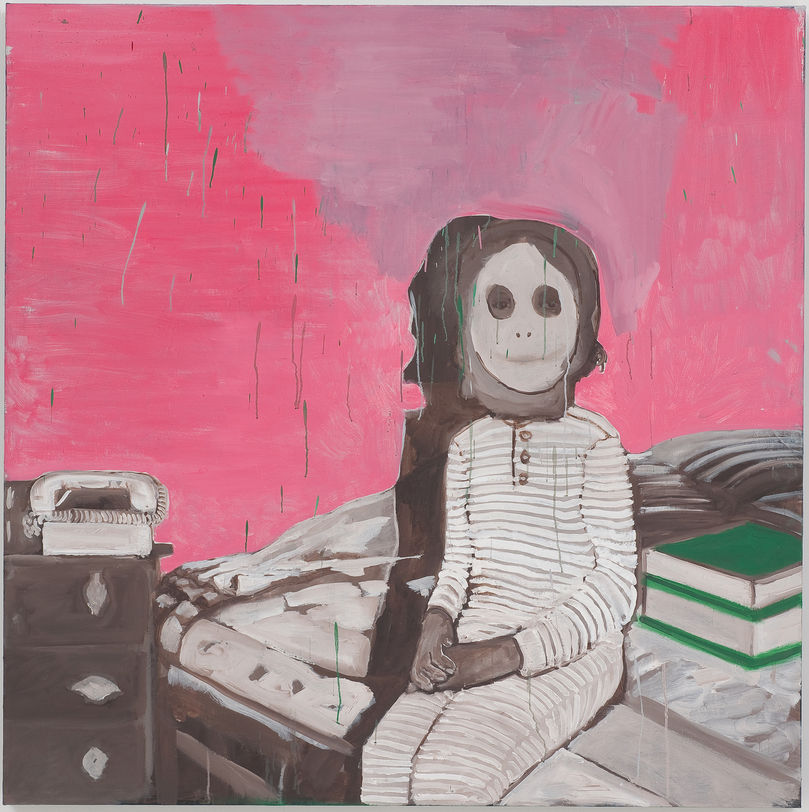
The last painting I’ll mention is ‘1984’, which is an eerie Halloween portrait of Karon when she was young. I tend to enjoy creepy things, so I love this for that reason alone. But I also love the detail in the eyes up close and how tired they felt. It reminded me of everyday people wearing masks that appear whole and smiling, but are quietly exhausted.”
🧜🏽♀️ 🏴☠️⚓️


Comments