
Art is Awesome!

Updated: May 23
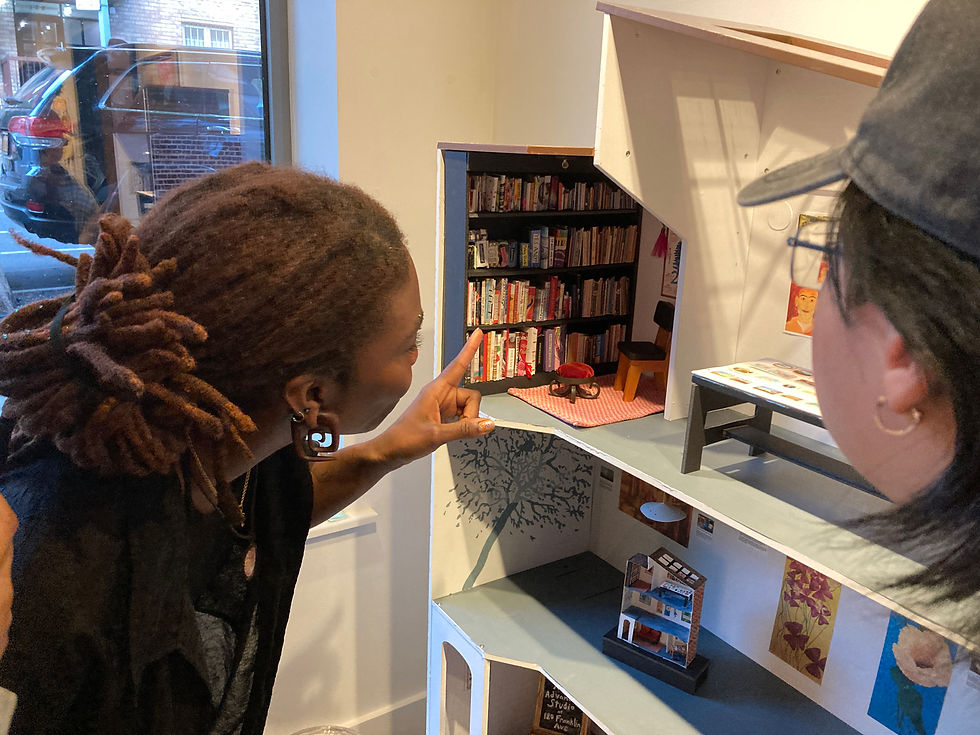
We are thrilled to report that Resized, our exhibition exploring the concept of scale through dollhouses, miniatures, paintings, sculpture, scale models, figurines, and installation, opened with great fanfare on Saturday.
The joyous party was attended by folks from the 180 Franklin community, AYB artists, board members, teachers, friends, families, and neighbors.


At the heart of the exhibition is a collaborative dollhouse-scale version of AYB at 180 Franklin Avenue—a deconstructed microcosm of the spaces where Advanced Studio gathers each week. Excitingly, after a successful run at Small House Gallery in London, AYB’s exhibition Hold Dear, Left Behind & Kept (what we carry and what we leave behind when we move) is represented through a selection of works and accompanying zine pages.
Resized installation view and Jacob with his self-portrait figurine
Jacob Rath, co-curator of Hold Dear, opines: “It was exciting to see Hold Dear come back to Brooklyn. These are all sculptures of objects that people either brought with them or left behind while moving, so it was exciting to see these objects migrate to England, and then return back to the city in which they were made. The painted windows of BWAC that are in the dollhouse prompted people to tell stories about their experience making those objects in the class, and to reminisce about BWAC in general. I enjoy the way that sharing stories from our lives can really encourage us to connect with each other.”
Resized installation view
Evelyn Beliveau, who curated work created in their session on view in the exhibition, shares: “I was delighted by the final presentation of the work done by Advanced Studio artists in my Lockets lesson. For this project, each artist created a larger-than-life rendition of a real or imagined locket, using folded and cut paper to create a hinged paper sculpture painted with watercolors. The artworks contain tributes to loved ones, pets, or special places within delicately decorated covers, which are installed with pins such that they can be carefully opened to reveal the images inside. I loved hearing the responses to this work, as viewers discovered the different facets of each piece. The installation takes the form of a gigantic charm bracelet with a “chain” painted in watercolor and painstakingly cut out with an x-acto blade. In a show about scale, this was one of few lessons to feature enlargement rather than miniaturization, creating a whimsical contrast with the thumbnail-sized artworks in the dollhouses nearby.
Dylan, Dellany, and Assata with raffle winning art. Juliet shows her locket.
Jazz Guillet, who taught the session on figurines and conceived of the windowsill mini-sculpture park, writes: “Having been in education for so many years there is a distinct thrill you get from seeing the kernel of an idea grow into such glorious fruit. Working on the self-portrait figurines was a practice in studying and recreating minuscule details using unique materials. It really forced me and everyone to get creative with what and how they portray themselves. Getting to see the way people took the prompt and lesson and vividly and boldly recreated themselves was a point of pride for me.”
The exhibition is up through September 15. You are welcome to come see the show in person, the best time would be Tuesday evenings 6-8pm when we are there for Advanced Studio!

We began the week with AYB Artist Assata Benoit leading the Advanced Studio session on Zoom, participants continued their exploration of astral projection and dream travel while looking at the artwork of Marcos Alvarado. AYB Artist Ajani Russell stepped in for Meridith to manage the session.

Assata reflects: “I think that I've been drawn to this theme of astral projection and dream travel because I am feeling a bit restricted in real life myself. I often dream, and I'll go to places that I wish I could be, or I'll feel something, and I'll know that it's close to me in the future. But I won't necessarily know how to get it.
I hope that when I go back to sleep, I can get back to where I was before. Oftentimes as we know, that is not easy at all. To even remember your dreams is something that is very difficult, as you try to remember, your brain will cause you to actively forget, almost as if it doesn't want you to know… which is kind of scary. So I thought it'd be pretty cool to try something where we are daydreaming and your mind will take you to a place, either that you've been before or not. It will show you something that you've imagined, somewhere that you've imagined, or give you strange images that you have never seen… at least not while awake.”
In addition to running all the tech aspects of a zoom session, Ajani took notes from critique notes which they pointed out dove into the many ways artists approached surrealism, dream imagery, memory, and transformation.
“Pat created drawings that emerged from a meditative near-sleep state. One image suggested a lion-like figure with an acorn-shaped face, while another revealed a softer portrait crowned with green leaves, a portrait of Bacchus, Roman god of wine and freedom. Pat reflected on the experience of discovering unexpected imagery through the process.”
Pat Larash, Astral Projection After Marcos Alvarado
Rashidah described vivid dream experiences and shifting realities that informed her work. Her piece explored multiple perspectives, reflections, spirit, and confusion through fragmented viewpoints and changing poses.

Travis drew inspiration from a story about a young girl traveling from Haiti to New York to reconnect with her mother after being raised by her aunt. His work imagined the girl as a mythic figure preparing for transition and travel. During critique, participants also discussed the softness of Travis’s drawing approach and recurring surrealist motifs such as checkered floor patterns.

Vee reflected on themes of confusion and self-negotiation, describing the work as an exploration of identity and psychological uncertainty through self-representation.

Aaron described a shadowed figure emerging into light, incorporating directional line work and elements of Ajani’s hair to create movement, mystery, and tension around the eyes.

Assata discussed the symbolic resonance of the color blue and its emotional and spiritual associations within surrealist imagery.

Cheyenne shared a mixed-media work in progress connected to a spiritual awakening that began in 2020.

Adji explored symbolism through the image of a bull inspired by a family story describing stubbornness and strength. The work balanced softness and hardness while drawing influence from Cézanne, cubism, and warm color palettes.

Karla incorporated body parts transformed into landscape, layered grids, star patterns, and natural forms. Her use of the checkered floor motif connected surrealist distortion with historical visual symbolism and compositional structure.
Karla writes: “The lesson was great and I especially liked the artists selected as examples of surrealist expression! I was not familiar with the work of Marcos Alvarado and was drawn to several images in which he incorporated skeletons! About my piece: After reading through the list of lesson prompts, ‘out of body’ called mind the skeleton as a cabinet for all humans' working parts! What makes people tick, what do we all have in common and why do we think and express differently?
I placed the figure/skeleton in an imaginary landscape where the night sky filled with planets and stars became background to re-imagined buildings and plant life (graph-charting illustration and old medical journal organ and cell illustrations). I've included the checkered panel as this compositional element is often incorporated in works from Egyptian to medieval to contemporary works. These contrasting light and dark squares frequently represented polarities: good and evil, the earthly realm versus the divine, or day and night. The geometric precision of the grid symbolized rational order, harmony, and the underlying structure of the universe. Surrealists often used this element to distort reality. It was so interesting to hear all the personal narratives and to see all the resulting images!”

Ajani sums up: “Throughout the discussion, artists returned to the idea of surrealism as something rooted in reality while simultaneously distorting and reshaping familiar experiences.”

Inspired by Assata’s prompt, not wanting to miss out, I (Meridith) completed the project on my own. The vision unfolded in a lush outdoor setting centered around an abandoned building remembered from an earlier time when it was still active and inhabited. To one side sat a row of tables and chairs where meetings seemed to take place. Over the course of a week in this imagined setting, handwritten love letters were delivered to me many times a day. A large beech tree beside the building became a central meeting place within the dreamlike landscape.

With AYB Artist Evelyn Beliveau in Advanced Studio in person at 180 Franklin Avenue, we explored the transformation of imagery through cutting and collaging along a rhythmic structure.
Evelyn recaps: We discussed the term “refracture,” coined by artist Jeni Bate as described in this quote in Kolaj Magazine:
“Bate will make up to five versions of a watercolor painting, varying color slightly, and then cut up the paintings and reassemble them as a collage. She defined refracturing as ‘cutting an entire photograph or painting, or multiple versions of them, and reassembling to create a new impressionistic version of the same scene."

We also viewed work by Jiří Kolář, an influential post-war Czech artist (), including a collage that appears woven, and Colleen Hammond, a Philadelphia-based collage artist who often employs alternating vertical strips of contrasting imagery. My research for the lesson was inspired by my own early-pandemic experiments with cutting and rearranging a pair of self portrait drawings, which we also examined during the session. I chose to show work by Bate, Kolář, and Hammond because of the way they impose a predetermined plan for cutting and rearranging on their material, leading to impressions of movement, stretching or warping of subject matter, or striking juxtapositions of source images. By obscuring or blending images, the images ask us to look more closely in order to figure them out, or simply to enjoy one’s eye jumping from one edge to another.


The varied works of Advanced Studio artists on Tuesday ask this of the viewer as well. I asked participants to choose two images—either two of their own drawings, a drawing and a found image from our trove of collage materials, or two found images—and recombine them in a predetermined structure. Before work time began, participants shared their intentions to use stripes (several participants), circles (Vee), weaving (Amelia), the letter W (Ed), or wavy lines (Lilo).
At critique, each artwork merited thoughtful attention. Amelia wove together two images of home—one of her college dorm room, the first space that has been entirely hers to design, and one of her family’s living room as it existed a few years ago—in a poignant rumination on the passage of time.

Shellorne created a low-relief sculpture, with strips of collage material folded into zig-zag patterns and pasted with points protruding outward, nearly obscuring a self-portrait drawn on the white paper support: a work that rewards close looking from multiple angles.
Shellorne Smith, Rhythmic Cutting Collage
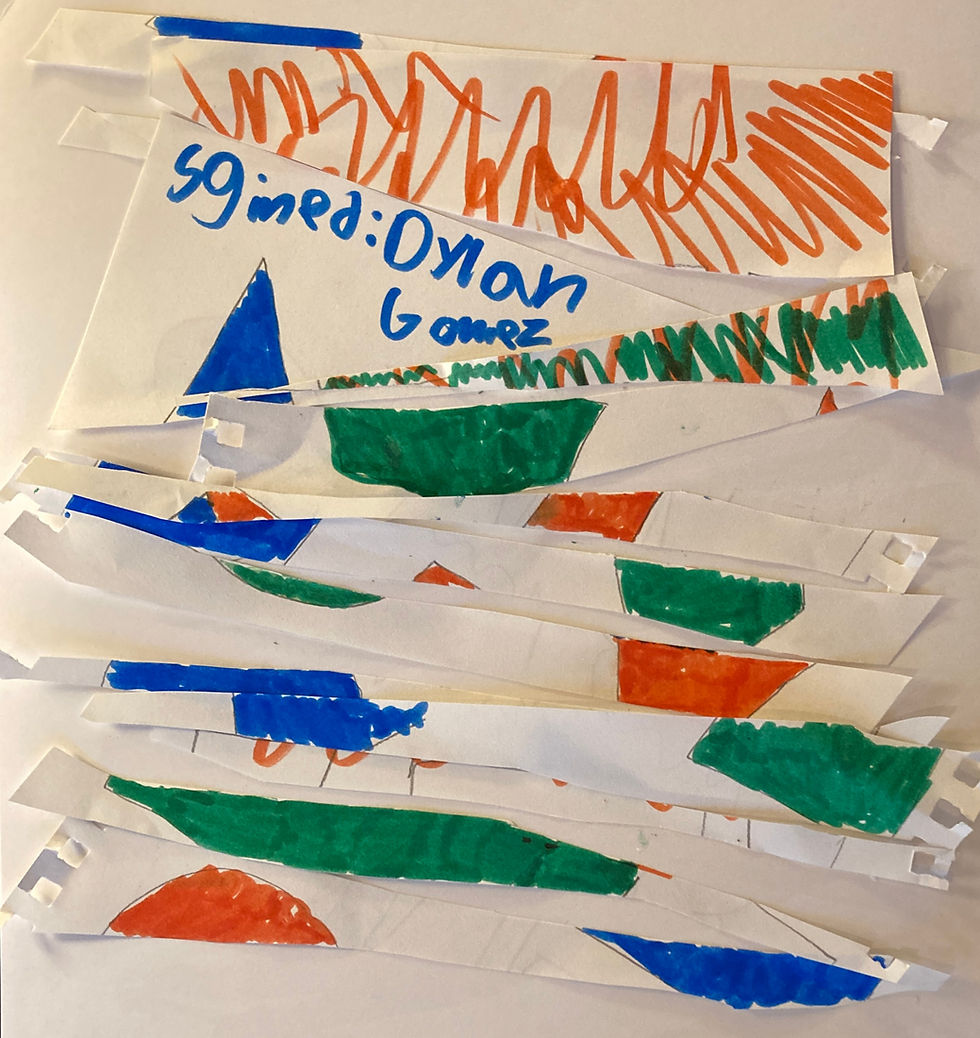
Dylan was one of few artists to use horizontal stripes and, like Sigrid, included the torn edge of the notebook paper in his colorful geometric piece.
Ed combined two drawings, cut along his chosen W structure, depicting a zebra with a vertical-striped background and a giraffe with a horizontal-striped background; the result shimmers with movement.

Estella combined pencil drawings of two stuffed animals cut into short strips and pasted in the center of a glossy black magazine page with a delicately torn white edge, creating a striking and mysterious effect.

Delanny also embedded her collage fragments at the center of the page, creating a whimsically rearranged unicorn and rainbow.

Adji combined a central pencil self-portrait drawing with stripes of magazine pages that add pops of color and glimpses of black-and-white photos of faces, enlarging the concept of the self-portrait to include changing and multiple selves.

Lilo’s larger-than-life drawing of their eye peers through wavy stripes of a magazine page, which I found to be a delightful commentary on how this session’s artworks foreground the act of perceiving.

Chace’s pencil self-portrait received compliments from Ed and Meridith during critique; as a work-in-progress at the end of class, it was cut in thin strips whose feather-like delicacy contrast compellingly with the solidity of the drawing.

Vee’s double-circle composition drew comparisons to different body parts and natural forms, and seems to crackle with its electric blue-orange contrast and sculptural effect as the concentric rings lift off the page; there is so much going on in the piece that it took us a few minutes to discern the double self-portraits (in orange) facing opposite directions.

My (Evelyn) drawing picks up where my 2020 experiments left off, combining two pencil self-portraits in a series of parallel stripes that imply a fractured glimpse of movement.

Meridith combined a portrait photo from a magazine with a found drawing, warping the figure in a horizontal expansion and creating an interplay between the forms of the face and the wavy lines in the drawing.

Sigrid created an intriguing combination of symbols, starting with two drawings based on familiar signs in the back room of our workspace at 180 Franklin (“PLEASE CLEAN UP AFTER YOURSELF THANKS” and “No Spray Painting”), then mingling them such that their urgent messages are difficult to parse.”

We had another wonderful Wednesday of artmaking in ART YARD Art Matters at PS 17!

Teaching Artist Evelyn Beliveau recaps: “Dennis, Chris, and I (Evelyn) were joined by artist, writer, and longtime friend of AYB Carrie Cooperider, who was a delightful addition to the classroom—cheerfully lending a hand with setup, cleanup, and supporting students at work. Carrie and Dennis also arrived early to begin deinstalling last year’s art show in the school library as we prepare for this year’s exhibition.
Back in the classroom, Chris and I set up for the next step of our Grade 4 sculpture project. Over the last two weeks, students have added layers of papier-mâché to goldfinch armatures made from Styrofoam and cardboard. This week, it was time to add color with acrylic paints, bringing New Jersey’s state bird to life. Students focused on the top side of the bird’s head, back, and wings, experimenting with stripes, dots, and blending to create individualized black, white, and yellow markings. Painting the textured sculptures was a very different experience from working on smooth paper.
Next, we finally met with our Grade 7 students after a few weeks of statewide testing. They began their final Year of Migration project, inspired by Jacob Lawrence’s Migration Series. Students brainstormed moments from migration stories — from family history, the Great Migration, or other meaningful historical migrations — and created thumbnail sketches using simplified shapes that will later become collages. We discussed the abstract quality of Lawrence’s work and how he used shape and color to tell stories.
Students in Grades 1 and 2 finished artworks inspired by AYB Artist Ed Rath, creating busy street scenes with acrylic paint markers. Many students completed a second piece, and we emphasized sharing supplies and helping with cleanup. One Grade 1 student came to class with a special surprise for me: a drawing of a paint palette with the message Art is awesome!”

Carrie observes: “I was lucky enough to observe and lend a hand at PS 17 this week. It was a vivid reminder of how much thought, planning, and labor go into making these classes possible. I arrived early to help teaching artists Evelyn Beliveau and Chris Allen, along with AYB co-founder Dennis Buonagura, prepare for the day. What a great team!
One thing that especially struck me was Evelyn’s thoughtful classroom management. Early in the residency, students created folded paper name cards that also function as portfolios for their flat work, helping everyone quickly settle in and get to work.
The fourth graders painted papier-mâché American goldfinch sculptures, and despite the unusual heat of the day, everyone stayed focused. Though united by the bird’s black, yellow, white, and orange palette, the variations in paint mixing and application made for a striking flock of goldfinches.

The seventh graders developed thumbnail sketches for collages inspired by Jacob Lawrence’s Migration Series, drawing from moments of migration, movement, and change. Some students had trouble beginning, but everyone had something down by the end of class. Phew!
The first and second grade classes created lively street scenes inspired by Ed Rath, filling their compositions with buildings, vehicles, people, plants, and animals. Students found inventive approaches to color, structure, and storytelling, and several completed second drawings.

It was a wonderful, if exhausting, day (it was SO hot!), and I thank everyone for welcoming me to be part of it.”
Artmaking and gallery preparation at ART YARD Art Matters at PS 6 today!

Dennis reports in from Jersey City: "Our students at PS 6, our partnership school in Jersey City, were on the homestretch of their project on Friday. Teaching Artist Christopher Allen smartly mapped out the 3 week lesson plan thereby creating a separate lesson for each week. This week's segment of the cycle included painting their paper mache sculptures (which were stored carefully for drying on wire racks - each resting on chopsticks over paper plates to prevent sticking!) using a variety of colors.
Chris recapped the lesson and hosted a well-participated round of discussions before painting began (which continued during art making) - and demonstrated acrylic paint techniques and how to mix some colors to avoid MUD. He also had plenty of beads and buttons on hand for decoration (where time permitted). Students loved critique, however short due to time, by showing their works, discussing their processes, and accepting compliments.


Simultaneously, an excellent AYB team (Simone, Indu, and Nick) painted our gallery in the library in preparation for next week's installation. They gave our gallery a needed facelift - taking every necessary step to keep the floor clean and brightening it all up!
After classes, Chris started preparing the paper mache shoes for installation by adding laces to some while we tossed around ideas for curating.
Chris, Simone and Indu (and Nick) ensconced in exhibition preparation
The school closed early in observance of the Memorial Day weekend (this did not affect our classes tho - the assistant principal is great about scheduling around such things for us) and we were granted permission to work later (in the gallery and in room 314), even after security left the building. The custodial staff graciously unlocked doors for us when we were done.
We invite you to join us for our upcoming exhibition at the ART YARD Gallery at PS 6!

Other Art News
AYB Artist Mia Lew shared what she considers her most successful final project of the semester — a striking series of 67 small-scale drawings featuring a younger, avatar-like version of herself interacting with reproductive and ovarian imagery inspired by the drawings of Louise Bourgeois.

“The prompt was 4–6 large drawings or 6–10 small ones, but I worked so quickly that I felt like I had to make a million,” Mia shared.
This fantastic series is the perfect springboard for our upcoming Drawing the Line theme.
AYB Artist Sigrid Dolan’s No Spray Painting collage from Tuesday’s Advanced Studio session was such a design winner, we made it available as a tote bag or notebook on our RedBubble page!
There’s still time to apply for this year’s Valley Cottage Library’s Banned Book Trading Card Project through May 31.
AYB artists have participated in past years, and it’s a wonderful opportunity to exhibit your work as part of the September exhibition while engaging with important conversations around banned and challenged books. Participating artists receive a deck of the completed trading cards, with the exhibition opening September 12, 2026.
Learn more and apply here!
Preview!! Meridith's piece for Banned Book Trading Card Project 2026:

🧡💛💗💜❤️💙🩵


Comments