
Experiment, create, and invent

Updated: Jul 4
AYB Summer Session 2026 begins on Monday! All sessions are fully booked. Please sign up for the waiting list on any sessions for which you would like to be contacted if a space becomes available.

We took two weeks off from programming as we prepare for Summer Session—lesson planning, ordering supplies, and organizing in general. Of course, our artmaking does not stop during that time, and neither does our dialogue and camaraderie.
To give you an example, early this week Travis Pereira sent an updated image of his painting in progress, writing:

Travis: "I wanted to say hey and share something I’m still working on to get your thoughts. I’m having trouble appreciating the composition for what it is. I feel it’s too literal, and I want it to be even more mysterious."
Meridith: “Your piece is looking great! The figures are mysterious, simultaneously dark and airy. I love how you are handling the surrounding color. And the flitting insects or fairies bring a nice sense of movement!
Travis: “Thanks so much. I’m having trouble appreciating the composition for what it is.”
Meridith: "That could be that the darkness of the figures gives the main attraction status. You could try Ed’s trick – from a different paper cut out a form which will allow you to cover over the figures and see what happens. You can move around the cut shapes to view the options without making any real changes.
Travis: "Right, the darkness is a thing, right? I’m going to try the Ed trick and see what comes up. Thanks!”
Meridith: "I sent your painting around to get more feedback.”
Ajani: “It is mysterious and I really like it! You might try another version in acrylic with a palette knife. Try working with your non-dominant hand.”
Cheyenne: "I love where you going with the colors. I would say walk away for a bit first—that’s what I do when I’m stuck or frustrated. And then maybe try layering with another medium like pastel, acrylic, or even colored pencils."
Travis: "This is all great feedback. Thanks so much! I will definitely keep all of these in mind! The left-hand trick sounds fun. Lmao. 🤣"
Ed: "I like it a lot. Great color, and the figure is something between a rodent and an angel. The dark shadow covering the figure is very effective."
Meridith: “Try ignoring your initial drawing, painting a new layer intuitively.”
Travis: "Ignoring the pencil...and just straight watercolor?"
Meridith: "That’s what I do."
Ed: “To add more mystery I would add an object that is totally unrelated to the scene. A human thing, say, a tiny doll, a hatchet, an open-end wrench, a wheel? The contrast of something familiar with something strange is a trick the Surrealists used a lot. Even an airplane flying in the distance would create a jarring effect. I love the dandelions blowing to seed. Great image, delicate and symbolic of the fragility of life, the passing of time... Bravo!
Sometimes one can get totally lost in a painting and completely lose how it feels. That’s when you should take it down, face it to the wall, and go away from it for a while. One time I stuck a painting in the rack that I thought was terrible and completely forgot about it. Four years later I was looking for something else, pulled it out, and saw it was very good but was missing something. I made a small change, and then it looked great, and I was glad I kept it around. Never give up.'"
Karla: "I do not find it literal at all because it is not identifiable at all. It seems more ethereal, otherworldly. I think he’s achieving the mystery! I like it, and especially those black burst marks that could be who knows what. The way the paint is applied also makes me wonder even more. The erratic strokes and layering are reasons to keep staring into it!"
Sudan: "Remind yourself of that Post-it note and go watch a fantastical fantasy film. Like The NeverEnding Story or Legend with Tom Cruise. 😂"
Adji: “This piece looks like a Wangechi Mutu.
Wangechi Mutu, Pretty Double-Head, 2010, and Lizard Love (2006)
Maybe you would like to add some collage elements.
It’s a stunning piece, very vibrant in color and expression!"
Travis: "This feedback really is helping me build confidence and strength. I’m going to keep at this piece and share some updates over the next few days. ;)
I plan to review these notes and see where it takes me! Thank you a million times."
Cheyenne: "I’m so glad!!!! I love that you reached out to the community 💕💕 I was missing AYB this week too 🫶🏼"
What We Are Reading
I (Meridith) have three books to recommend this week: David Hammons: Bliz-aard Ball Sale by Elena Filipovic (Afterall Books, 2017), The Invention of Hugo Cabret by Brian Selznick (Scholastic, 2007), and Teaching to Transgress: Education as the Practice of Freedom by bell hooks (Routledge, 1994).
Each of these books approaches creativity from a different direction. One takes a deep dive into a single conceptual artwork, another tells an inventive story through both words and drawings, and the third challenges us to think more deeply about teaching, learning, and the role of education. I found all three engaging and think you will too.

It is really compelling to dive deeply into a particular work by an artist you admire, which is exactly the approach Elena Filipovic takes in David Hammons: Bliz-aard Ball Sale. Generously illustrated with remarkable photographs by Dawoud Bey, the book explores Hammons' vision, his relationship to the art world, and the enduring mystery surrounding one of his best-known works.
The book focuses on Hammons' 1983 street performance in which he sold snowballs on a New York City sidewalk the day after a major blizzard. Through photographs, interviews, and archival research, Filipovic reconstructs the event while showing that part of its power lies in its refusal to be fully explained. It's a thoughtful, engaging read that demonstrates how a single artwork can continue to generate questions and conversation more than forty years later.

A couple of weeks ago, Jacob mentioned that timelines will be one of the concepts explored in his Drawing the Line lessons this year. That came to mind as I perused—looked at as much as read—Brian Selznick's The Invention of Hugo Cabret.
Set in 1930s Paris and inspired by the life of pioneering filmmaker Georges Méliès, this remarkable graphic novel unfolds through both words and richly detailed drawings. The illustrations don't simply accompany the story—they propel it forward, pulling the reader into Hugo's mysterious world of clocks, trains, inventions, and early cinema. It is a wonderful reminder of how images can tell a story every bit as powerfully as words.

On Independence Day eve, Teaching to Transgress: Education as the Practice of Freedom by bell hooks feels especially timely. hooks argues for an education that moves beyond rote learning toward dialogue, critical thinking, and personal connection—education as a practice of freedom.
Written through a blend of personal narrative and theory, the book challenges teachers and students to bring lived experience into the classroom and to see learning as something active, engaged, and deeply human. It offers both reflection and practical direction, and remains a powerful reminder of how teaching can open space for transformation, curiosity, and connection.
Other Art News
Kevin Anderson, whose family is from Jamaica, recently traveled there for the first time.
Kevin writes: "I have been told that Jamaica doesn’t feel like a real place, and now I can see why. It's so magical that after spending a little over a week there, I did not want to leave.
The lush green landscape, the food, and the people—it was all so beautiful.
I met my cousin Danielle and her 8 year old nephew Shawn, who both love to paint. Below are a few of their paintings, and one that I made to help preserve the memories of my fantastic trip."
Paintings by Kevin's cousin Danielle and her nephew Shawn, and Kevin Anderson, Jamaica Memory, 2026
Sudan Green shared progress photos and a video of his current large-scale ceramic vessel. The video, with Sudan's hand in the frame, really gives a sense of the work's impressive scale. We can't wait to see this piece finished!
Sudan Green, Ceramics in progress, 2026
Abriel (Bob) Gardner writes: "Tuesday night Ajani and I gathered our old socks, cut them in half, and sewed them all together. We didn't plan much of the construction of the piece and instead followed our intuition.

Our initial vision for the work was to make a blanket, but as we began sewing the socks together, we realized the sock shape made it difficult to create a uniform look. So we leaned into the chaos and let the material free-flow. By the end we had something that looked like, well... a pile of socks sewn together.
Conceptually, this project felt like a study of process and follow-through. We had been collecting our socks for a while and knew we wanted to upcycle them in some way. At first, seeing all the socks together was daunting, and we weren't sure how it would all connect. But like true artists, we trusted the vision and committed to our inspiration and instinct.

We still have more socks to sew, and I am definitely seeing some sort of wearable garment as an outcome for this project.
Sometimes when you make art, you don't have an explanation or reason. You just have to experiment, create, and invent. I'm excited to see where and how this project develops."
Karla Prickett is finishing up the installation of her solo exhibition “Two Studios” which run till the end of August at the Lobby Gallery, Peaceful Body and Wellness, 148 S Santa Fe, downtown Salina, Kansas. Included will be pieces Karla made in AYB Advanced Studio along with two large collages.
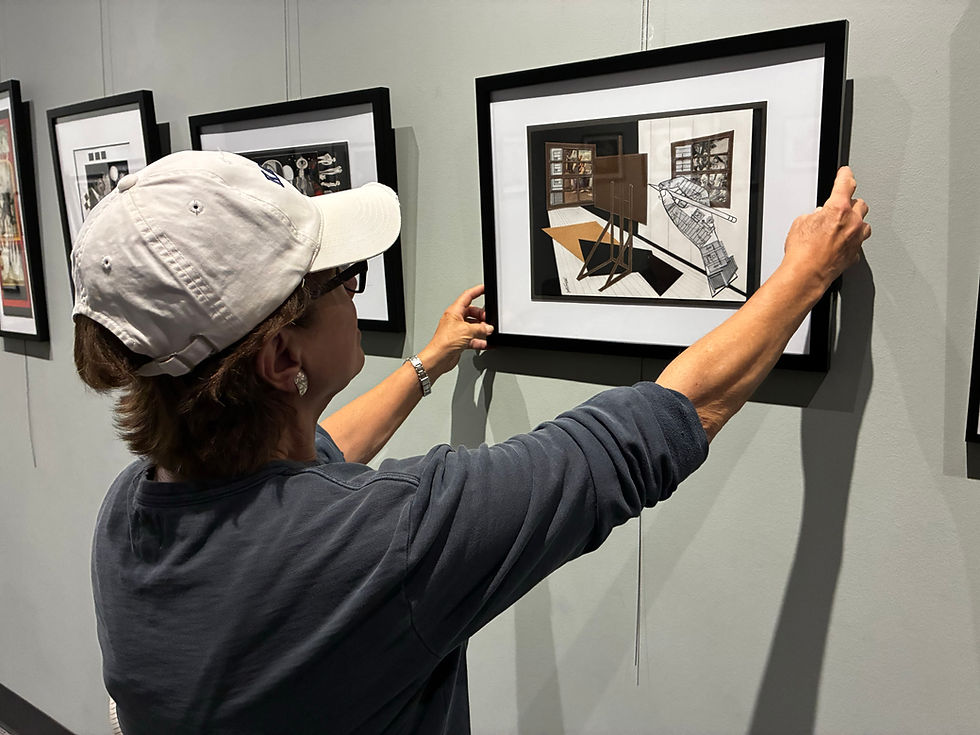
I (Meridith) wrote a blurb for the exhibition wall signage:
Over twenty years ago, I was leading a public art tour in Brooklyn for a national Public Art conference when I met Karla. We quickly discovered we shared a similar path, balancing our lives as both practicing artists and arts administrators.
During the tour, Karla said, a bit hesitantly, "I know Brooklyn is a big place, but I know one artist from Brooklyn—you might know him." The artist was Ed Rath, a dear friend and colleague. It was an unexpected connection and the beginning of a friendship that has continued ever since.
When I co-founded ART YARD BKLYN (AYB) to provide contemporary visual art education for underserved and often marginalized people of all ages, in 2018, Karla was among the artists I invited to join. During the pandemic, our Advanced Studio evolved into an ongoing online program that brought together artists from New York, across the country, and abroad. What began as a response to extraordinary circumstances became a vibrant creative community that continues to meet each week.
Karla is an integral part of that community. She brings a distinct artistic voice shaped by her life in Kansas, along with generosity, insight, and an infectious enthusiasm for the creative process. Her wise perspective has enriched every conversation and reminds us that meaningful artistic exchange is not limited by geography.
This exhibition, Two Studios, beautifully embodies that spirit. The work on view reflects both Karla's independent studio practice and the body of work developed in AYB sessions. Together, these works reveal the dynamic relationship between individual exploration and collective dialogue—how artists challenge, encourage, and inspire one another while remaining true to their own unique vision.
To close out this week's recap with some weather-appropriate art...
Maria Polanco and her girlfriend, Kamilla, collaborated on this fan! During this heat wave, it definitely qualifies as usable art.

Stay cool, and see you on Monday!
🪭



Comments