
Feels like the first time

Updated: Jul 11
The first week of ART YARD BKLYN Summer Session 2026 was an overwhelming success!

Yes, it was hot, and there were tropical monsoon-like downpours, but for the intrepid AYB artists, this was no obstacle to looking at, thinking about, discussing, and making art. Sessions are at least four hours long—double our usual studio time—allowing us to really explore topics and materials while spending dedicated time on our artmaking.
During my first artist residency at the American Academy in Rome, I realized that devoting that sort of time and effort—residency time—to making work in a community of artists is life-changing. In my opinion, AYB Summer Session does exactly that for all of us who participate.
Monday, our inaugural session for the AYB Year of Drawing was taught by Ajani Russell. A marvel of challenging prompts kept us alert and focused, and we made over 100 drawings in the four-hour session!
In her very first session as an AYB Teaching Artist (and high school junior), Delphine Levenson presented Writing The Line, combining visual art and poetry. We shared our relationship to the written word and text (now that was a wonderful discussion!), then focused on LOVE!
In the award-winning outfit of the week, Jacob Rath devised a spectacular field trip: MTA – Art on the Rails. Across four subway lines, with public art spanning over a century, we opened our eyes to the abbondanza of public art available to New Yorkers.
Rounding out this inspiring week, Ajani Russell was back to lead us on a field trip to the Metropolitan Museum of Art.
Our new theme Drawing the Line has officially begun. Ajani Russell ushered us in with a rigorous and fun-filled session!

Ajani sums up the session: "We started class by exploring a variety of drawing techniques. I wanted this first session to focus on exploration and process, with less attention placed on the aesthetic qualities of the finished work. I introduced three different types of pens—a fountain pen, a ballpoint pen, and a dual-sided brush pen—and invited the class to experiment with mark-making and value. I also shared reference images demonstrating different shading techniques, including cross-hatching and stippling.

We then moved into portraiture, creating multiple contour line drawings using different approaches: drawing without looking at the paper, drawing with our non-dominant hand, and other variations. Contour line drawing helps train artists to observe their subject more carefully and strengthen the connection between the eye and the hand.
Blind contour drawings, in particular, allow artists to let go of the pressure of creating a polished final product and instead focus on the experience of observing and drawing.
Jacob and TJ made great use of the two-tier table in the room, using the lower shelf as their drawing surface so they couldn't see the paper while they worked.
Although these drawings didn't necessarily resemble their subjects in a realistic way, each portrait clearly captured the person's likeness, and we could easily recognize who was being depicted.
Use arrows to scroll through photos of artists at work!
Next, I introduced the artist Al Hirschfeld, a 'characterist' whose drawings appeared in New York publications for more than 75 years. I asked the class to create caricatures, focusing on the features and characteristics that could be exaggerated.


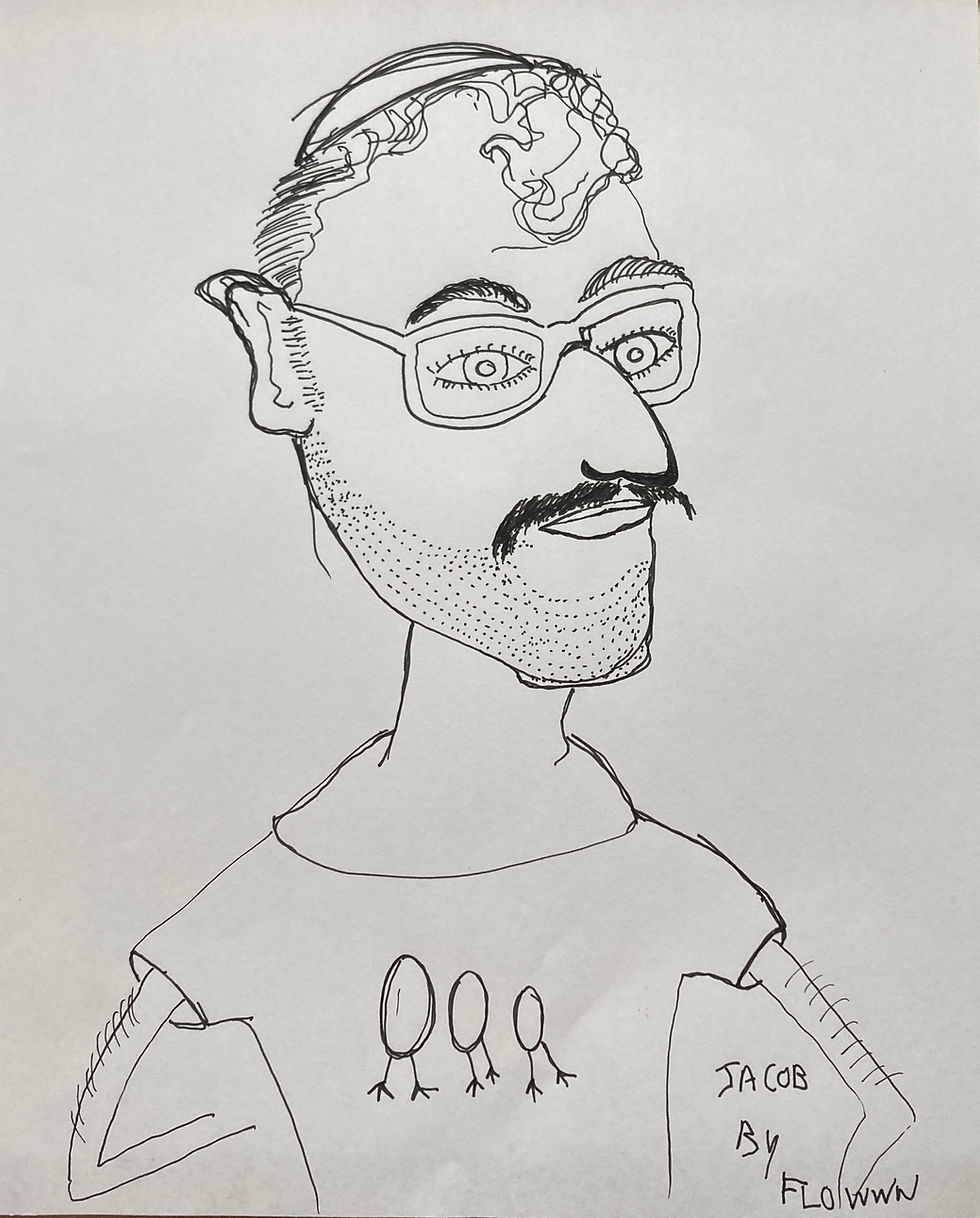


By the time we reached the final caricature drawing, everyone's individual style had become much more defined. Many participants who began by drawing small portraits had expanded to fill most of the page by the end of the session. Flo's portraits of Jacob and Evelyn's portrait of Leah were especially lively and captured the energy of their subjects. Evelyn also created additional depth by combining different pens within a single drawing. I especially enjoyed drawing Sigrid because her face is so expressive while she works.


It was also interesting to see how framing choices evolved throughout the exercises. Some artists focused closely on facial features, while others zoomed out to include more of the scene, even incorporating the table where their partners were drawing."
Tuesday’s session Writing The Line was a testament to the power of AYB Teacher Training, an integral part of what we do. Delphine Levenson, who joined AYB as an elementary-aged artmaker, has grown into a sophisticated teen artist. She is both a poet and visual artist, a thoughtful and organized person, and, luckily for us, our Summer Session Intern (for the third year running!).

Delphine prepared a well-written and thoughtfully organized lesson plan for her first teaching experience. As usual, she arrived early to set up the room and organize supplies. Once we had a full house, Delphine began by having each of us introduce ourselves and share our relationship to reading, writing, and text. Ranging from avid readers to recipe writers, poets, font designers, and visual artists who incorporate text into their work, this made for a wonderful conversation!
Delphine recaps: “For this session, we took a deep dive into the topic of love. What does love mean to you? What do you visualize when you think of love? What different types of love come to mind? These were the questions artists were asked at the beginning of the lesson to spark inspiration for their visual pieces and guide meaningful conversation throughout the session.


Eden-Nicole Moore, Love Buzz and Thick Love


This lesson was meant to break through the boundaries of commercialized love in our world today and explore what love means to people on a personal level. It also encouraged artists to use both their visual artmaking skills and their writing to create a single piece.


At the beginning of the lesson, artists opened their minds and engaged in thoughtful discussions about their relationships with writing and how they could incorporate words into their visual pieces. Throughout the session, with the help of Eden and their carefully curated playlist that helped set the mood, artists were able to talk among themselves while also maintaining a space for careful concentration.

During the final critique, artists had the opportunity to read their poetry aloud and speak about the context of their work. Even as personal anecdotes, experiences, and stories were shared, the space continued to foster a strong sense of community and love.”

Jacob Rath is one of the most avid NYC subway enthusiasts I have ever met. Combining that knowledge with his artistic understanding and talent, he led us on a remarkable Public Art focused MTA field trip on Wednesday. Ranging from early 20th century sculpture to currently active installation, the art works Jacob presented were engaging, well crafted, intelligent, funny and can be enjoyed by everyone!

Jacob writes: “We began our lesson at the Bailey Fountain near Grand Army Plaza. After a brief discussion of the fountain, we descended into the subway. Along the way, we visited Dinosaur at Grand Army Plaza, the MassTransiscope on an abandoned subway platform along the B/Q line, Chuck Close's mosaics at 86th Street, artwork by six artists in Times Square (not even all of them!), and the Christopher Street murals.
Photos of the day.
We concluded our tour by discussing Sheridan Square and the Stonewall Inn before ending a little ahead of schedule for critique at Moustache Restaurant and to celebrate Sigrid's birthday.
Sketches from the day
Lunch at Moustache and Sigrid making a birthday wish
Overall, everyone enjoyed the lesson. Many attendees said they appreciated taking the time to stop, really look at, and appreciate artwork they usually hurry past during their daily commute. Moving throughout the city also gave people the opportunity to sit with and engage in conversation with different members of the group. Many participants contributed their own knowledge of particular artists and local history, including a woman who approached Meridith while she was looking at a Chuck Close mosaic to tell her that Chuck Close was a disabled artist.

I want to talk a little more about Christopher Street–Stonewall Station, our final stop. The station contains four mosaic triptychs known as the Christopher Street Murals. Artist Lee Brozgol worked with nine students from the Greenwich Village School to create these works. They showcase the history of Greenwich Village, with the triptychs honoring the Rebels, the Bohemians, the Providers, and the Founders. You can learn more about the murals and the people represented in them at the link below.
Christopher Street Murals: https://walkaboutny.com/2019/03/28/subway-art-the-greenwich-village-murals/
I think every teaching artist should visit the Christopher Street station because it is an excellent example of art made in collaboration with students. The work addresses important political and historical figures of the West Village. I am amazed that artwork depicting anarchist Emma Goldman and the Stonewall riots became part of a public art project in the 1990s. I'm impressed that these subjects were approved and not deemed too radical. The combination of meaningful subject matter, thoughtful execution, and a collaborative approach inspires me and reflects the kind of work we should strive for in our own art lessons. There is a great deal to learn from these murals, both about the history of the West Village and about designing an art lesson."

For those interested in exploring further, Jacob also recommends the MTA Arts & Design website and the MTA's official list of subway station bathrooms:
MTA Arts & Design: https://www.mta.info/agency/arts-design
Subway Station Bathrooms:https://www.mta.info/agency/new-york-city-transit/bathrooms
We finished up the tour looking at George Segal's Gay Liberation a bronze sculpture located in Christopher Park, across the street from the historic Stonewall Inn. Installed in 1992, it depicts two standing men and two seated women, and was the first piece of public art commissioned to honor the LGBTQ+ rights movement.

As we turned to head for lunch, Ed pointed out: "Look! The Mona Lisa." ...

What a treat to peruse the Metropolitan Museum of Art with a group of brilliant artists! Ajani Russell led us through the museum collections on a real artistic treasure hunt.

We began with a deep dive into the exhibition Gothic by Design: The Dawn of Architectural Draftsmanship.
Then we meandered through meditative, temple-like installations, past ancient Chinese ceramics, stumbled upon art restoration in progress, through classical sculptures, and visited the Musical Bodies exhibition, finishing up next to an ancient Roman chariot on an out-of-the-way mezzanine for critique.
Photos from our wandering at the Met
Ajani describes the work created and recaps the discussion. "Delphine focused on crosshatching. She was inspired by the intense crosshatching in the exhibition and how layering lines of varying weights can affect the light. Delphine also drew a Zentangle, a repeating pattern that gets smaller, inspired by the shapes and patterns in the exhibition. Evelyn said it reminded them of looking up at the ceiling in the Iranian tapestry room we passed through on the way to the Gothic architecture exhibit.
Delphine Levenson and Briana Camacho, Sketch from Trip to the Met
Briana drew from an image on the other side of the room to get a different perspective. She started with the overall shape and composition but realized how different the image was once she approached it and had to adjust her drawing.
One thing many people found in common was how much subtle spacing differences in the line work changed the lighting in the image.
Florian Kiniffo-Neven du Mont and Jacob Rath, Sketches from Trip to the Met
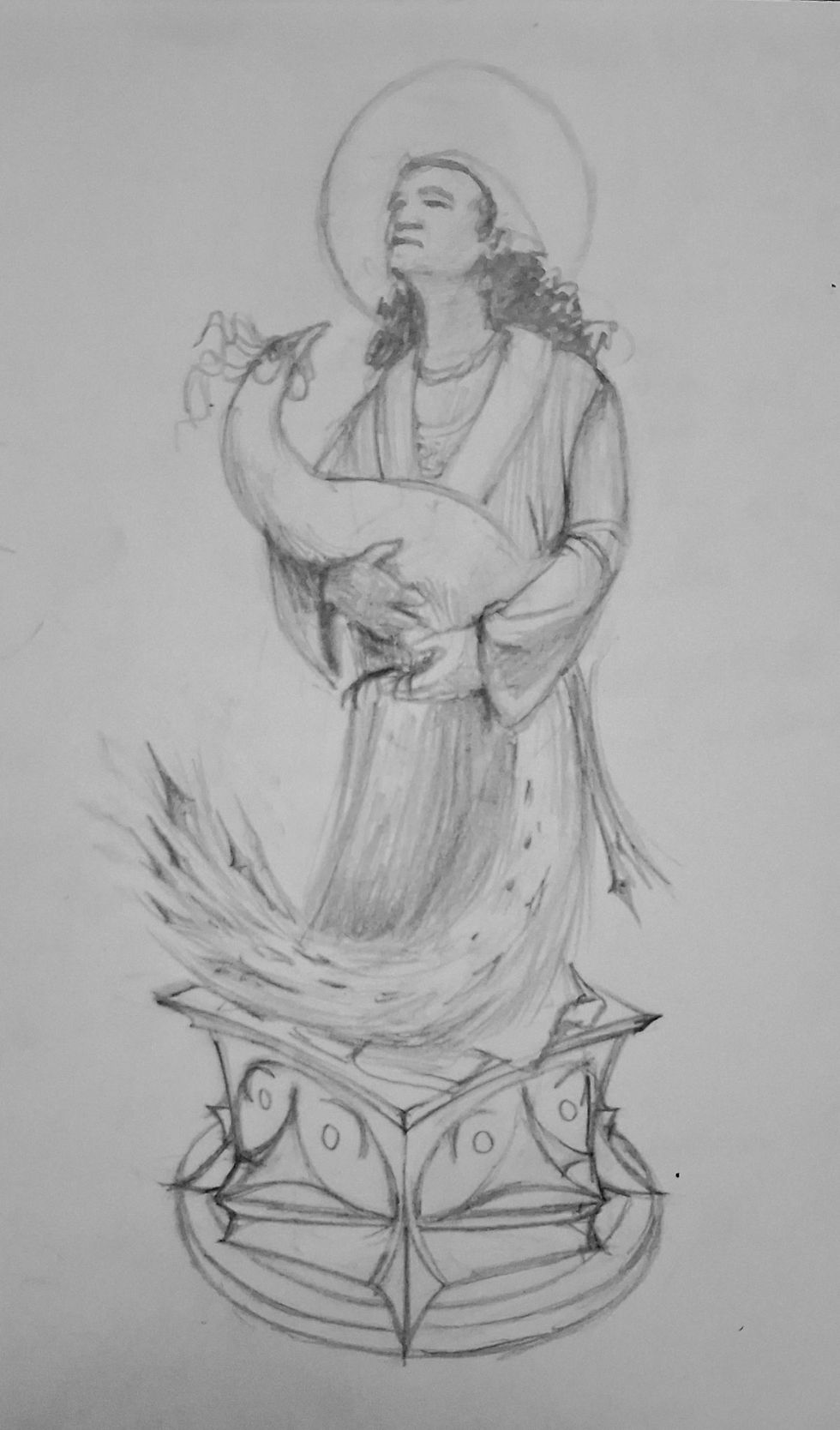
Alex was drawn to a drawing of a saint on a pedestal. He created his own interpretation of the original work, imbuing it with his own personal symbolism. He drew the male saint in the likeness of his grandmother and changed the accompanying animal into a hybrid bird creature. He mentioned his interest in the relationship between the geometrical aspects of the work and its religious themes. Flo noted the different directional lines within the hatching and how the spacing between the lines controlled value. He spoke of the juxtaposition of curved and straight lines to create form.
Eden spoke about the religious aspects of the architecture, noting that the spires and heights the architects aimed for were attempts at reaching God and greater heights.
Sanjay Velayandom Neven du Mont and Leah Eliopulous, Sketchs from Trip to the Met
Delphine compared Kevin and Sanjay's pieces for their composition—both were framed within a circle. This invoked the feeling of portals and portholes.
Ariel did a line exploration in red ink, focusing on drawing the font used on the vinyl labels in the title of the exhibition. We noticed how the font alluded to the geometric shapes in the architectural drawings. This led to a conversation on accessibility, thinking about the international crowd at the Met and the need to use fonts that are easier to read.

Evelyn meandered through the exhibition until they were struck by something compelling enough to draw. Evelyn did several drawings focusing on the patterns within the schematic floor plans. They achieved a flowiness through the geometric formations they depicted. They found that attempting to draw the entire images was a little intimidating, but by honing in on specific details they could get into a rhythm. They focused on the embellishments, naturalistic details, and ornamentation.
Evelyn Beliveau, Sketches from Trip to the Met
Kevin drew a wooden sculpture in pastels. He worked with negative space, leaving the white of the paper to create highlights. He was interested in the symmetry and the correlations between the angels' wings, leaves, and other natural, organic shapes within the work.

Eden chose to focus on texture and "Auszug"—a German word that means pulling out, or extrapolating 3D information from a 2D floor plan.
Evelyn compared the drawings that included figures with the architecturally focused works, noting the contrast between zooming in on fragments of the exhibited works and taking a more holistic view.

Alex's work was particularly inspiring because he was able to see himself in the context of work that's over 500 years old, bringing his loved ones (depicting his grandmother) into the context of Gothic artworks.
The group trip was overall very fulfilling. I had seen the exhibition before, but going with the ART YARD group made me feel like it was the first time I was seeing the work. It inspired engaging conversation and thought-provoking interactions. Drawing directly from live references is very different from drawing from a photograph. It felt much more enriching for me to be there with such a wonderful group of people."

What We Have Read, and you might enjoy too!
During our trip to the Met those of us who had read E. L. Konigsburg, From The Mixed-Up Files of Mrs. Basel E. Frankweiler (Atheneum, 1968) enthusiastically encouraged those who had not to do so! A wonderful YA novel about a sister and brother duo who pack their instrument cases as overnight bags and stow away in the Met! There is even a mystery to unravel.

Other Art News
I started a Magical Things July series. The first is completed:

Jacob adds a note for all AYB Artists attending his session Monday July 13: Please bring any mirrors that you have. The more mirrors that we have in the lesson, the better it will be.
See you on Monday,



Comments