
The freedom to draw inspiration

This week in Advanced Studio on zoom AYB Artist Neah Gray introduced us to the Maroon people of Jamaica, their migration into the Blue Mountains, and their resilience. This fascinating investigation paved the way for a splendid art making session!
Neah with one of her AYB paintings and Blue Mountains, Jamaica
Neah recaps: “We packed up our art materials and took a virtual trip to the beautiful and well-loved island of Jamaica. Although I've never been to Jamaica (yet!), it was heart-warming to both "visit" and teach about my Jamaican Maroon roots, and the important legacy of the Maroon people. Descendants of the Arawakan people and enslaved Africans, a strong trait of the Maroon Jamaicans were their active resistance against enslavement, colonization and colonialism. Equipped with expansive knowledge of the landscape and geography of Jamaica, Maroons fled slavery and established communities of free men and women in the most mountainous parts of the island, making it hard for white settlers to find, "capture", and fight these strong knit communities.
My favorite part of ART YARD BKLYN is not only the beautiful art that arises from our sessions, but also the deep conversations, analysis, personal stories, and attention to detail that follows. Inspired by brilliant Jamaican visual artists like Barrington Watson and Everald Brown (aka Brother Brown), participants were prompted to create an artwork/"suitcase" that reflects the travel stories of themselves, their family, or their ancestors/country. Left open ended, participants had the freedom to draw inspiration from anywhere in their lives that resonated with the lesson.


Marilyn created collage using a postcard envelope that also resembled a suitcase. She included flags like Austria and France, which highlights an important truth: Our travels around the world ultimately help to shape who we are.

Meridith's functional mini-roller-bag, with personal, small artworks inside, was a brilliant piece that helped to capture the essence of this lesson.
Meridith McNeal, Familial Suitcase
Although completely different, her piece reminds me of Flo's artwork from class, where he drew a person who was also a suitcase and included the label "This body is a suitcase". Our bodies, in a sense, are suitcases; they’re filled with memories, stories and history that we pack up, take all over the world, and share, hold, exchange, and expand.

We were thrilled that Flo's sister Sounya, all the way from Paris, joined us on zoom for the first time!

Leah’s piece was an amazing watercolor painting of her family home, delicacies from Barbados spread out on the table, and the beautiful stories she shared of long phone conversations with distant family triggered happy and nostalgic memories of my own Caribbean family dynamics.

With delicate watercolor painting, Rashidah captured the delicious flavors of her ancestral country: Dominica.

From Adji's and Richie's intricate and beautifully drawn fine details, to Ty's cut paper conceptual luggage tags piece is still in progress (and the album cover by SiR which served as his inspiration), and Lila's amazing postcard of her travels, to Aaron's must-have IRL green suitcase and Margaret's spot on marker drawing of her red & white horse trinket, I loved everyone's artwork, and appreciate the thought and care everyone added to them that made it even more special.
Familial Suitcases by Adji Ngathe Kebe, Richard Lee Chong, inspirational album cover: Chasing Summer by SiR , Ty Fletcher, Lila Green, Aaron W., and Margaret Hardigg.
Karla ruminates: “What an interesting lesson for a land-locked individual such as myself!! Most times, travel/journey for me is to the east "coast" of Kansas by car! A suitcase is such a great symbol! This piece employs the symbol as container, transporting my inherited history and traditions...bringing who I am to each new adventure or experience. The works Neah presented in the lesson Shared a beautiful pallet of yellows, reds, blues and soft earthtones. I loved the spirit in all the works. I placed my suitcase in the landscape, which is so dominant in Kansas. The yellow, golds and reds of our recent sunsets have been spectacular! The tree and the left of my work is cut from a maze puzzle page, symbolizing journey, goals, and adventures. The grasses growing out of the suitcase (drawn with charcoal pencil) are cut from my father's bookkeeping, a memento to family. The red printed background is a discarded print. I like to think we are each a wonderful suitcase as Flo spoke of in critique!”

Neah summarizes: “It's important to know, understand and research your familial roots to better understand yourself and those who came before you. Categorized as the "fiery" or "fight the power" kind-of-person in my family, I'm glad to know that my "rebellious" nature against injustice and oppressive systems isn't in vain; it comes from the strong-minded and tenacious Jamaican Maroons in my family line who persevered and did everything in their power to remain free in mind, body and spirit.”

On Tuesday, AYB Artist Evelyn Beliveau led an Advanced Studio lesson in person at 180 Franklin Avenue which brought us a new approach to our Migration theme!
Evelyn writes: “I’ve been excited to teach ever since reading this interview with sculptor Diana Al-Hadid last summer. The interview weaves together information about Al-Hadid’s materials and process with the rich and varied mythic and cultural reference points that feed her work, providing plenty of jumping-off points for participants. During the lesson, “After Diana Al-Hadid: Sculpture from Movement and Accretion,” we created sculptures from cardboard, paper, and glue.
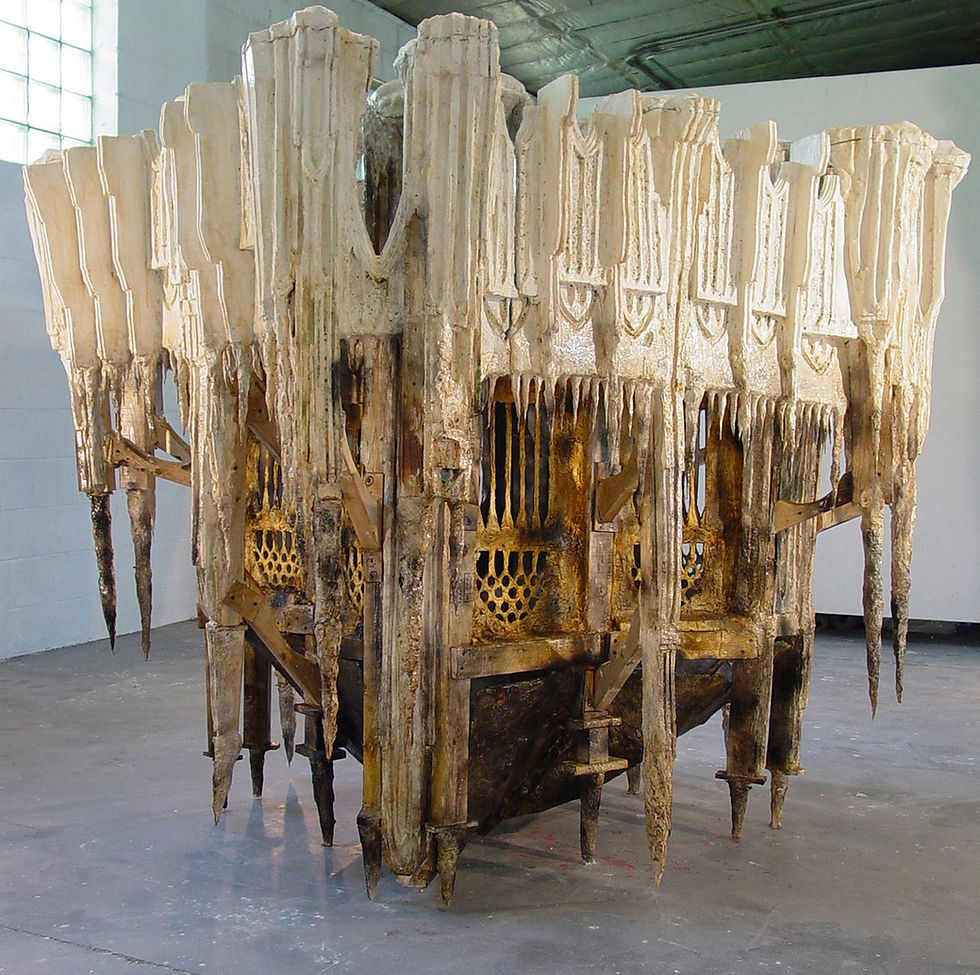
I began by reading aloud several lines from the interview, in which Al-Hadid describes the making of the piece.
“I put paint on the soles of my feet and I danced the waltz in my studio.
And wherever my feet left footprints on the ground, those footprints became the blueprint for the spires of the cathedral.
It’s made with really small marks that accumulate. And this piece in particular holds the core tenets of my practice, which are, you know, movement and motion and fluidity.”

As we began to discuss the sculpture and the interview, Meridith pointed out that Spun of the Limits of my Lonely Waltz connects the medium of sculpture both to one of the most ephemeral art forms, dance, and one of the most permanent, architecture.
For our project, we worked at a smaller scale and with humbler materials than does Al-Hadid, but we emulated her by using movement and accretion as the source of the work. Discussing participants’ past experiences (some limited, others extensive) with sculpture, we hit upon the topic of Legos, an excellent example of creating via accretion: growth by gradual addition or buildup. This was a useful touchpoint for our youngest participants, Dylan and Delanny.
Ariel, Dylan, Delanny and Ajani at work in our inter-generational studio
We began with a flat cardboard base, dipping our hands in water and moving them across the cardboard to leave a trace of where they had been. Outlining the water-stain in pencil, each artist now had a two-dimensional map from which to build up, like Al-Hadid’s painted footprints. Participants used a variety of papers (from brown paper shopping bags to magazines), Elmer’s glue, and optional surface treatments (pastels, markers) to build up their sculptures piece by piece. For my demonstration, I showed a technique I’ve used in the past to turn paper into a relatively sturdy structure—first softening the paper by crumpling, then twisting it into long pieces, and finally gluing them one on top of another—which Ajani (an experienced ceramicist) compared to coil pottery. Some participants used a similar treatment of the material to mine, and others took it in different directions.
When we reconvened around the coffee table for critique, Kevin observed that the collection of small sculptures on the surface seemed like a new location, and Jazz and Ariel compared the overall effect to that of a miniature theme park or sculpture park. We all agreed that these pieces seemed like maquettes for grand-scale sculptures.

At JP’s prompting, we began critique by having an artist choose another’s work to respond to—guessing at the artist’s intentions, making comparisons to real-world phenomena, and describing its sensory effect—then hearing that artist’s own description or context for the work, and popcorning around the room till each piece was discussed.
Dylan and Delanny departed for bedtime before critique began, but their pieces were much admired by the group. Meridith compared Dylan’s work to a topographical map, with a subtly undulating surface colored in vibrant blues and greens. Keeping with the geographic theme, Jazz compared Delanny’s piece to a miniature Prospect Park, complete with birds and a lake. Very impressive, considering neither sibling had made a sculpture before outside of Legos!
Dylan and Delanny Gomez, Spun of the Limits of my Lonely Waltz
Kevin admired the wild feeling in the colors and loops of Jazz’s piece, and the inclusion of text (the words “REBEL” and “EXPECTATION” cut from a magazine). Ajani agreed that the contrast between different ways of handling the paper—smooth curves vs. more heavily manipulated texture—and complementary colors made the piece stand out.

Jazz pointed out Maya’s piece, one of the few to reference human forms, admiring its structure and doll-like appearance and comparing the skirt to an ocean. Ajani made a comparison to Vermeer’s Girl with a Pearl Earring.
Maya Quinanola, Spun of the Limits of my Lonely Waltz, and Vermeer’s Girl with a Pearl Earring
Maya went on to explore Ajani’s work, admiring the earthy colors and green; Ajani revealed that they began with no plan except to include two connected arches and improvised from there, confirming that the torn pieces of magazine pages depicting grass suggests the piece existing within a sculpture garden.

Ajani compared Sebastian’s piece to Roy Lichtenstein’s, Brush Stroke, 1996, a sculpture they saw on Wall Street, which they described as both sturdy and wispy, as well as the spider sculptures of Louise Bourgeois. Flo also compared the pale gray color to ashes, the organic forms suggesting burned wood. Having created the tallest of the sculptures, Sebastian described the experience of trying to build upward without destabilizing the piece, a valuable lesson in balance.
Sebastian laBossiere, Spun of the Limits of my Lonely Waltz, Roy Lichtenstein’s, Brush Stroke, and Louise Bourgeois, Spider
Sebastian drew attention to TJ’s work, which we all agreed was a complete transformation of the starting material—Sebastian compared the almost slimy texture to Venom from Spider-Man, while others brought up gemstones or marble. TJ explained the process: starting with a structure of twisted pieces from a brown paper bag, like my demo, then covering these forms with torn and crumpled pieces of deep blue magazine paper, with veins of white showing at the torn and folded edges.
TJ Edgar, Spun of the Limits of my Lonely Waltz
TJ turned to Kevin’s work, comparing its organic tube-shapes to Michelle Laxalt’s, Walk Sculpture (Heartroot), 2025, an artist who works with sticks and other found organic materials found on their walks. Ajani also compared the piece to Frank Stella’s high-relief wall-mounted sculpture collages. Kevin shared with us that he didn’t have a plan, just worked from a place of great calm and took inspiration from others’ work, such as Ajani’s loops and other artists’ use of magazine imagery.
Kevin Anderson, Spun of the Limits of my Lonely Waltz, Michelle Laxalt’s, Walk Sculpture (Heartroot),
and Frank Stella, detail of “‘At Sainte Luce!
Kevin pointed out that Flo’s work was the only one to include facial features, describing the piece as a bodiless man or floating head. The work takes on the quality of a memorial.

Flo compared Arielle’s work to a chrysalis or fish, and Arielle confirmed her intention to depict a fish. She described wetting the paper thoroughly to create a shinier texture; though the paper absorbed the moisture, Kevin observed that the still-visible glue residue creates a texture as well.

Arielle noted JP’s work as the only cubic form, thus sturdier and more static-feeling than other artworks on the table; Meridith added that it was also the only piece that, representing a real-world object, could be life-size.

My demo piece, to which I added during the session, was compared to a basket (Ariel), an igloo (Jazz) and a rollercoaster (Flo)—the latter leading to a rollicking discussion of the Cyclone at Coney Island.

By the end of the night, Jazz had the idea to install these works as a miniature sculpture garden alongside other miniature-scale works in AYB’s next exhibition at 180 Franklin Avenue. All in all, I'm delighted by the variety of interpretations the group of participants took from the prompt, and by the prospect of seeing these homages to motion and organic growth on view in the gallery.
Onward with our special project at ART YARD Art Matters at PS 17!
Evelyn, who kept busy this week at AYB!, recaps: “As we have been invited to participate in this school’s annual Women’s History Month Wax Museum event, the AYB team at PS 17 (Dennis, Simone, and I (Evelyn)) is spearheading the creation of portraits and paper puppets celebrating influential women from history and the present day. Students began working on this project last week, and all must be finished by the end of next Wednesday, so our classes are quite busy.

Students in Grades 4 and 7 are creating paper puppets inspired by the Indonesian tradition of Wayang puppetry, with movable arm joints and handles to be used by the students presenting the Wax Museum event. Working in pencil and acrylic paint on posterboard, they are using printed reference photos to create likenesses of the women who were assigned to them by their teachers (and whose historical context and influence they are also researching outside of art class). They started last week with head-and-shoulders templates traced by me and Simone, using pencil to create portrait drawings based on the reference photos.

Today, we started with an acrylic painting demo for those who were new to this medium. I demonstrated the proportion of water-to-paint that allows the paint to flow without soaking the paper and advised students to keep their paint thin to minimize warping. We provided a variety of earth tones—warm browns and tans—to mix the many shades of skin, plus brighter colors for clothing. Dennis and Simone heroically matched students with their artworks and reference photos—not so simple a task, as some students had forgotten to write their names and historical figures’ names on their artworks last week. Students finished up drawing the trickier facial features, asking for feedback or demonstrations when needed, and many began adding paint to their artworks. Class time flew by!
Students work on acrylic painting
Our Grade 1 and 2 classes are making great progress on their portraits of inspiring women from history and today. Last week, they made pencil outlines on watercolor paper, using reference photos and a step-by-step process to build a portrait from the basic shapes of the head and facial features. Many students were ready to jump into color today, for which we are using colored pencils. Since the reference photos are printed in black and white, students used their imaginations to choose the colors of clothing, extrapolated from the darkness of shadows and brightness of highlights to choose shades of brown and tan for skin tones, and some asked Dennis to look up a photo online to match the eye color. Those that finished their portraits added colorful borders filled with patterns, building on our very first project, which introduced the idea of pattern as an element that creates motion in an artwork.
At the end of the day, Dennis, Simone, and I put our heads together to update our game plan, listing additional supplies and the exact order of operations for our periods before and after classes next Wednesday for the most efficient workflow. Our top priority is nurturing and engaging our students with care for their different paces and needs, as they tackle a project with a lot of moving parts (pun intended!), and we’re prepared to go the extra mile to ensure a full set of completed of puppets at the end of next Wednesday.
This week, we began a three-week lesson cycle entitled “Echoes of P.S. 6,” inspired by Faith Ringgold’s 1980 quilt, Echoes of Harlem.
Evelyn explains: "Dennis and I (Evelyn) worked with a Grade 1 class, a Grade 3 class, and a class of mixed Grades 3, 4, and 5 on the beginning stages of a collaborative paper “quilt” of students’ self portraits.

Ringgold’s quilt depicts her friends and neighbors in Harlem, the NYC neighborhood where she lived, as a grid of portraits interspersed with strips of pattern. As part of our Year of Migration, we’re inviting students to use this artwork as a starting point to consider their own journey to arrive at P.S. 6, the time they’re sharing here with their classmates, and where they may go next.

With each class, we viewed Echoes of Harlem and asked students to respond to what they saw, with some students noticing the variety among the faces and others supposing the quilt holds happy memories. Then, we went over four art vocab words: quilt, pattern, collaborative, and self portrait. Like our project, Ringgold’s quilt was a collaborative work, as she worked with her mother, Willi Posey, to complete the work.
As art-making time began, we supplied each student with a bright fuchsia AYB pencil, a mirror (each with a plastic cup as a stand, affixed by Dennis earlier), and a sheet of 9x12-inch watercolor paper with borders I pre-traced. We instructed students to stick with outlines today, rather than shading or coloring in with pencil, since we will ultimately paint with watercolors.
Then, we dove into drawing self portraits. Working in a step-by-step process, students carefully studied their facial features in the mirrors at each stage to try to capture the details that make a likeness. We started with the shape of the head: an oval with a round, pointy, or square chin, filling most of the inner rectangle on the paper. Then, with demonstrations on the board and plenty of individual assistance at each step, we added the eyes; nose and eyebrows (and glasses, for some); mouth; neck, shirt collar, and shoulders; and ears and hair. Students listened carefully, followed instructions, and made the drawings their own with minute details of hairstyles and jewelry.
Self portraits by PS 6 First Graders
Those that finished the entire drawing went on to add patterns to the borders of the page. Most stuck to geometric shapes, similar to the patterns in Echoes of Harlem, while others brought in a contemporary twist with emoji-like symbols or the numbers “6 7.” All in all, most students are ready to jump right into painting when they arrive in class next week.
Self portraits by PS 6 Third Graders
At a preliminary work-in-progress critique at the end of each class, students gave compliments to each other for the facial features they drew particularly well, and reflected on the easier and more difficult aspects of the lesson. We were glad to hear from quite a few students that they had fun. Plus, one of our third graders, Jayla, was having a tough morning, but we were told she felt much better just by coming to AYB!
Self portraits by PS 6 Third & Fifth Graders

Other Art News
AYB is now on view in the Art of Free Assembly at The National Liberty Museum, Philadelphia, PA!
Art of Free Assembly at The National Liberty Museum, installation photos by Sudan Green.
Art Opportunities
Our friends Katie and Caroline at The Valley Cottage Library invite us to apply to participate in their Banned Books Trading Card Project.

Applications are open through May 31st. You can find more info, the application form, the list of books that have already been selected (we will not accept duplicate titles), and several lists of banned and challenged books on their website.

Reminder!
We will make a field trip to see Reg’s performance on Saturday, March 28 at 3pm. RSVP to me: once we have our head count, Reg will set us up to get discounted tickets!
AYB Artist Reg Lewis will be performing his long awaited spoken work poem: The Attention Wars (AKA) How Reality Crosses the Mind at The Tank 312 W 36th St, New York, NY on March 25 at 7 pm, March 27 at 7pm, March 28 at 3pm and March 30 at 7pm.



I agree with you Ed!
Nice portrait work at P.S. 17. Some even drew the philtrum, clearly observing what they saw.
Bravo, students, future artists of America!