
Abbondanza

Updated: Feb 7
With two ART YARD Art Matters in the School programs in action — Evelyn Beliveau at PS 17 and Travis Cinco at PS 6 — as well as a most excellent week of Advanced Studio on Zoom with Ajani Russell and in person with Jules Lorenzo, this week was a full-on artful abbondanza!
In other art news: Meridith McNeal on view at Rutgers & giving an artist talk, AYB Artist Karla Prickett checks in from an artist residency at the Lester Raymer Red Barn Studio Museum, and AYB Artists Jules Lorenzo and Gem Mercato give us a heads-up on their debut concert as CVM at Berlin.
Monday night in Advanced Studio on Zoom, AYB Artist Ajani Russell had us thinking about Food Migration — how dishes from all over the world made their way to NYC. The session was joyful and opened up conversations around fascinating cultural habits and delicious recipes!
Our sessions fly by, and often during critique a few pieces are still in progress. For example, Fatima Traore shared her pencil drawing during critique. She then worked over the drawing with ink late into the evening after class, and painted it to spectacular results by the morning.
Fatima Traore, Food Migration, in progression (detail) l, ll, & lll
I forwarded a photo of Fatima’s completed painting to the other artists from the session, who replied:
Ajani: “Omg incredible”
Cheyenne: “STUNNINGGGGG. One of my favorites from her!! So meaningful 💕”
Adji: “I’m obsessed!!! I knew it was going to look incredible. I love her use of color and I couldn’t wait for the outcome!”
Aaron: “Very strong. The different possible interpretations of the fork and knife on the shirt straps is interesting, too.”
Briana: “Love!!! Such a cool POV”
Dami: “Oh my gosh that’s incredible!!”
Marilyn: “Gorgeous! Thanks for sending.”
Flo: “Woooow — this is such a powerful piece”
Ajani reports: “For this session, I asked students to create works exploring the origins of cuisines that have made large impacts in their personal lives and their respective geographical locations.
Leah, located in New York City, painted a bacon, egg, and cheese and coffee in a blue, Greek paper coffee cup. These two items deeply represent NYC and are an essential part of many locals’ morning routines. “Everyone from everywhere coming to the city has had this meal.” Meridith highlighted how the color choice and composition create “depth of the picture plane” in Leah’s work.

Briana’s work depicted guinea pigs native to her country, Ecuador, and the Chimborazo volcano the guinea pigs live near. She explained how Gen Z in that area now worship guinea pigs and will no longer eat this local delicacy. This is due to the rise in popularity of the capybara—the cousin of the guinea pig—via social media. The connection between these creatures has pushed them into a higher status where they are revered rather than seen as food. Leah points out the softness in Briana’s pastel work, which makes it dreamlike.

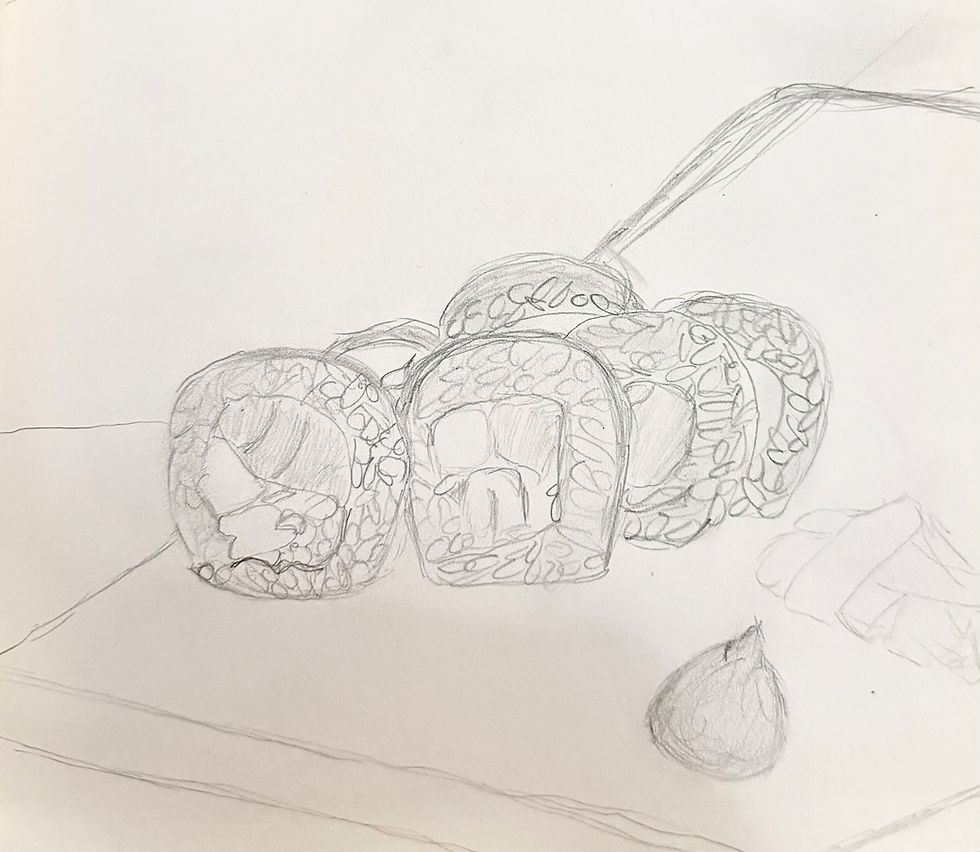
Richie’s illustration of onigiri, or Japanese rice balls, was very effective in rendering texture. Briana said there is a simplicity to the line quality of the onigiri that she just loves. Conversely, Felicia’s roll of sushi with wasabi and ginger also created wonderful texture in the rice through shading.

The steam coming from Marilyn’s matzo ball chicken soup painting was captivating. She and Meridith, who painted a bowl of clam chowder, both depicted family soup recipes that have been passed down to them.

Marilyn adds: "Ajani’s lesson on food and migration took us on a delicious tour around the world, evoking wonderful stories and images of particular food memories. What a great way to learn about so many different traditions!
In my family, on Jewish holidays the dinner often started with a steaming bowl of chicken soup with matzoh balls. This lesson brought back happy memories of lively meals with my family and cousins.

Flo and Fatima both included the methods of transportation used to bring the food over from their origins.
Flo’s grandmother was a flight attendant at Afrique Airlines who brought food from Senegal in her Afrique suitcase. In the suitcase were peanuts roasted in burning sand, spring rolls, mangos, etc.

Fatima was inspired by Black History Month and the roots of Black cuisine. She references the way African people would braid beans, grains of rice, seeds, etc. into their hair to bring some of their lands with them when they were taken away from their homes and enslaved. This acted as a way of preserving their culture. She also included other Southern dishes, including okra and cornbread. The food items they depicted both have sentimental and deep cultural importance.

Fatima mentioned the different perspectives the artists chose to draw from—POV vs. still life. Are you looking down at the dish? Is it plated? Is the food in your hand? Her piece looks down upon the braided head as a person that doubles as a plate, which is both incredible and political, as this nods to the history of slavery and the cultural significance of these dishes in Black culture.
Cheyenne painted a pastelito in her hand on the beach in Puerto Rico, creating the scene of enjoying this dish where she’s from. It was mentioned that both Cheyenne and Briana incorporated attributes of the place the food is from in their pieces.

Dami’s Nigerian jollof rice with orange skin, chicken, and plantain gained a lot of praise for its color scheme. Someone described it as very warm and inviting, like the place it’s from, and also noted that it invoked nostalgia.

Adji depicted a Senegalese dish in pencil. They noted that the piece included hints at the traditional eating etiquette practiced there. Fatima loved how Adji’s piece expressed the manner you’re supposed to eat with, and how meals become political if you do it incorrectly.

During our discussion Cheyenne mentioned the inclusion, as in mine (Ajani) of plátanos, or plantains, in pieces representing food from very different countries—for example, Puerto Rico and Nigeria.

Aaron depicted breadfruit—a Jamaican fruit—in three stages of preparation. It was compared to the botanical illustrations of Hilma af Klint for its line quality.

There was a generally delicate and limited color palette throughout the group that created an overall feeling of care and tenderness in the works. Meridith said this aspect of the work created implies a “reverence towards the food.”
At Advanced Studio in person at 180 Franklin Avenue, we had a great session entitled Everyone’s Home: Quiltmakers and Memory Keepers, in which AYB Artist Jules Lorenzo had us looking at the work of Sylvia Hernandez, Faith Ringgold, and Gee’s Bend quilters Loretta Pettway, Lucy Mingo, and Mary Lee Bendolph for inspiration.
Faith Ringgold, Woman on a Bridge #1 of 5:Tar Beach, 1988, Sylvia Hernandez, Café Bustelo, 2013, and
Loretta Pettway, Blocks and Strips, 2003
Jules recaps: “For this week’s lesson, “Everybody’s Home”, we focused on the art of quilt making. We covered works from the quilt makers of Gee’s Bend, Sylvia Hernandez, and Faith Ringgold to understand some of the different styles and history found in this particular textile art.
Loretta Pettway, Lucy Mingo, and Mary Lee Bendolph, and Lucy Mingo, Log Cabin, Straight Furrows, 1962
When enslaved women from the rural, isolated community of Boykin, Alabama—better known as Gee’s Bend— began quilting in the 19th century, it arose from a physical need for warmth rather than a quest to reinvent an art form. Yet by piecing together scraps of fabric and clothing, they were creating abstract designs that had never before been expressed on quilts. Despite a wider variety of cheap fabric becoming available in the second half of the twentieth century, the recycling of old materials continues to be a central tenet of quilting in Gee's Bend. These patterns and piecing styles were passed down over generations, surviving slavery, the antebellum South, and Jim Crow. (Rebecca Gross, The Quilts of Gee’s Bend, Arts.org)
Sylvia Hernandez, aka Brooklyn Quilt Girl, is a self-taught master quilter who creates handcrafted works addressing community and human rights issues, as well as highlighting her Puerto Rican heritage and culture.
Sylvia Hernandez, and Sylvia Hernandez, Postcards from the Ancestors #2” (2016).
“Each quilt takes Hernandez days or sometimes weeks to complete, and they are all lively with color of various hues, but mostly bright and bold — sunny yellows, rich reds, and succulent shades of violet. They seem to me formed by Hernandez’s desire to stitch herself into a cultural and historical scheme, to make the recognition of ancestral connections as instinctual as sipping one’s morning coffee.” (Seph Rodney, Hyperallergic)
Of course we can’t forget Faith Ringgold, who was the initial inspiration for this lesson. I was enamored by her triptych “Street Story Quilt” which depicts the same building in Harlem over three periods of time— The Accident, The Fire, and The Homecoming. Stories from different characters are stitched into the fabric to aid in the retelling of events.

“Just as stories evoke the Black tradition of folk tales both written and oral, quilting has long been associated with domestic labor, women’s work, and African American craft (including her mother’s and grandmother’s), all of which Ringgold embraces, thereby expanding the category of fine art. Indeed, the artist was adamant in calling her story quilts "paintings" made "in the medium of quilting.” (The Met.org)


Participating artists were instructed to create a 9” x 12” panel for our class quilt that was representative of themselves. They were encouraged to include aspects of their past or present, as well as any symbols or colors that resonate with them.
Dylan took this prompt in stride! He quickly decided on an abstract approach for his quilt panel where he expressed the retelling of himself through various shades of the color blue. He mentioned to Meridith how proud he was of the tree he made, which was a wonderful reminder to the class how important it is to take a step back and appreciate not only your work but your growth.
As an artist it’s easy to be your first and harshest critic. While constructively we can use that to grow, we can sometimes forget to give ourselves credit for what we’ve accomplished and learned along the way. Dylan’s compliment to himself was a refreshing exercise in giving yourself flowers when they are due.

There was a noticeable use of pinks and greens throughout many of the panels created that evening. Simone said, “Maybe it’s because so many of us are longing for spring.”
Evelyn’s piece was in many ways a dedication to their parents as it was to their place of birth, Massachusetts and hometown in Vermont. A cape rose is the centerpiece of their work, which is a reference not only to their middle name, but also to the flower that was their mother’s inspiration for it. The mountains and greenery signify the various hiking trails they would go on with their dad.
Evelyn Beliveau, Self Portrait Quilt Panel, and Simone Awor, Self Portrait Quilt Panel
Simone’s work drew many comparisons to Andy Warhol’s Pop Art, as well as being similar to a roll of film. She featured various plant imagery to represent all the nature she grew up with in Uganda. The pink ribbons attached to every cut out were a callback to her being a cancer survivor. She also included stars in her work to depict her connection to her faith.
Briana’s piece was a lovely commentary on childhood nostalgia. Soup was a recurring dish for her growing up, which was the central focus of her piece. Inside we see figures sprawled out and sleeping inside the bowl which is how she’d usually feel after a meal. The flowers that embrace both sides of the image are meant to depict the rose bush that grew behind her home.
Briana Camacho, Self Portrait Quilt Panel and Ajani Russell, Self Portrait Quilt Panel
Ajani’s work had a labyrinthine quality to it, which touched on the complexities of family relationships. Flowers were a popular theme in many of the panels, Ajani’s included. We see a rose bush delicately tucked inside which represents the one their grandma used to have. They recounted their experience of being torn over having to cut off the roses that were overcrowding the bush, while admiring and wanting to preserve its beauty.
Ashika’s work not only resonates with our theme of migration, but with everyone who’s ever felt not at home, even in their own home. This piece is a commentary on their experience of feeling othered, depicted through city blues (literally) and a topsy-turvy palm tree which adds to their physical and emotional dissonance.
Flo’s panel was a very intimate piece that included the names of everyone in his life that he knows and is dear to him. In the center of the frame we see a bucket which he told the class was what his mom used to wash him as a kid after many trips to the beach. The multiple buckets scattered about are in reference to these memories.
Ashika Kuruvilla, Self Portrait Quilt Panel and Florian Velayandom Neven du Mont, Self Portrait Quilt Panel
Self Portrait Quilt Panels by Jesse Pierce, Jules Lorenzo, Delanny Gomez, Sebastian LaBossiere, Fisola Famuyiwa, and Lilo Lewis (in that order):
Faith Ringgold says, “We must speak or our ideas and ourselves will remain unheard and unknown.” We are memory keepers. Our ancestors, families, friends, and ourselves are made immortal through multiple mediums, whether that be art, stories, pictures, or music. Quilt making is a time honored tradition that carries memories and history in every stitch. It’s undeniable that our art yard community is intertwined and sewn together, intrinsically and now tangibly so.
The work created in this session will be presented collectively as an AYB Quilt, designed and assembled by Jules, and will be on display in our spring exhibition So Moved at The Gallery at 180 Franklin.
AYB Teaching Artist Evelyn Beliveau reports from Jersey City: “”We are delighted to be back in action at ART YARD Art Matters PS 17! Dennis, Simone, and I (Evelyn) are working with students in Grades 4, 7, 1, and 2.
We’re starting out with an introductory two-week lesson cycle to establish expectations, get to know our classes, and dive into art-making. Titled “Names in Motion,” the lesson’s goal is to create a folding name card that will be used on the tables for the rest of the year. We’re focusing on lettering, pattern, and composition to connect to AYB’s annual theme of Migration, exploring how elements can be arranged in an artwork to suggest movement.

We took inspiration from the pen drawings of artist Sanou Oumar, born in Burkina Faso and currently living in NYC. Students saw all kinds of motion in his drawings: up and down, circular, and swirling like currents. Repeated shapes, like circles or rectangles, and alternating colors contributed to the sense of movement, drawing our eyes from one place to another.

For our project, we started with pencil and paper. Students in Grades 4 and 7 learned about thumbnail sketches—a term for a small, quick drawing used to try out different compositions (arrangements of parts to form a whole). These students made two or three thumbnail sketches, each with a different variation on lettering and background patterns, in order to test out and choose an approach for their final piece. As Dennis, Simone, and I circulated throughout the room, we enjoyed hearing from students about their names—who they were named for, whether their names ever get mispronounced, comparing siblings’ names and more.

All our classes learned the art vocab words lettering, pattern, and outline (many were already familiar with pattern and supplied the definition enthusiastically!). We encouraged students to limit their pencil drawings to just outlines, no shading, since the next part of this lesson includes color. Students in Grades 1 and 2 (and those in 4 and 7 who finished their thumbnail sketches) began their final namecards, carefully outlining each letter and adding their favorite shapes and patterns. We helped out students who were curious about the process for creating bubble letters—challenging at first, but ultimately a fun part of the project for many.


Students’ choices of patterns were inspired by artworks we viewed by Sanou Oumar, the TV show Stranger Things, arrows suggesting forward motion as seen in my sample piece, Valentine’s Day hearts and flowers, or emoji. Others chose stripes, repeated geometric shapes, or borders, including a puzzle-piece pattern. Some students drew their names on a slant to suggest upward or downward motion. Those who finished outlining (mainly in Grades 1 and 2) went on to add color—first choosing one color for the letters, then contrasting colors for the patterns in the background. We’re excited to see the finished artworks brightening up the classroom for the rest of the spring!”

AYB Artist Simone Awor provides additional insight into the profound impact of working in the school: "At PS 17 , I chose to assist at a table where I overheard a few Arabic speaking students who possibly weren’t thoroughly understanding the instructions. One issue however, was that I don’t speak Arabic! One student, Nada, acted as our translator.
Simone working with student at PS 17
I felt very happy for Nada when she proudly translated from English to Arabic, and from Arabic back to English so we could all be on the same page. She seemed so proud to help her classmates understand the lesson. At the end of class, I asked Nada how to say “good job” in Arabic. Even though I stumbled with the pronunciation, I felt like she was proud of me. The four of us had such a fun time!
When I came to America with my family, I only spoke Swahili. It was isolating, disorienting, and so lonely. The kids made fun of me as I started to learn English. I was teased for my accent, and the way my parents spoke. I was bullied for my hair and the food my mother would pack. The last thing I wanted was for a language barrier to impede the students’ ability to participate. It’s an awful feeling as a child.
I felt such a strong kinship with Nada, Gory, and Mohamed. This is my favorite ART YARD memory. I’m so grateful for their willingness to learn and for Nada’s exuberant desire to teach and help her classmates."

Dennis reports after a successful day ART YARD Art Matters at PS 6 in Jersey City: "Week 2 of Teaching Artist Travis Cinco's lesson on Tenement Housing in Miniature Scale focused on IDENTITY. Our presentation at PS 6 included photographs of exteriors of tenement house life in the late 19th and early 20th centuries.

Students viewed archival photographs and participated in discussions about store-fronts, keeping cool during the hot summers, drying clothes on fire escapes, and were asked: how can you make your house look more like a favorite place you've lived or visited - and how can you show who might live in this house?


As part of a teaching artist's prep work, Travis brought his samples home last week and made applicable additions and variations to his originals, which related to this weeks lesson - adding watercolor paint to some, laundry on clotheslines to others. In class, we decided which groups were at which point and what their next step should be.

Travis was assisted by Simone Awor and Nick Tardiff (who will teach our next cycle).


Other Art News
I (Meridith) am thrilled to have work included in Of The People now on view through March 28, 2026 at Rutgers–Camden Center for the Arts, Stedman Gallery, Fine Arts Building, 314 Linden Street, Camden, NJ.

Of the People features a selection of works on paper by contemporary artists from across the United States who responded to the question: what does American Democracy mean to you? Through investigative research, consulting various formal and informal repositories of knowledge, and reflecting inwardly, this group of artists particularly consider the meaning of American democracy in the present moment.
I will presenting an Artist Talk on Thursday, February 26, 2026 at 12:45 pm in the Stedman Gallery. Join me!
AYB Artist Karla Prickett, Queen of Collage, checks in from an artist residency at the Lester Raymer Red Barn Studio Museum in Lindsborg, Kansas.
Karla reports that she’s completed two previously unfinished works from her studio, taken notes and measurements to mount several Art Yard pieces, and returned to a larger, challenging composition. She’s also developing a new concept for a 24-inch-square collage on canvas.

During the residency, Karla has welcomed visitors and spent time discussing the work on view, which she’s collectively titled My Two Studios. The exhibition brings together her larger studio compositions alongside her AYB Studio pieces, highlighting two very different—and opposing—processes: one calculated, meticulous, and time-consuming; the other spontaneous, immediate, and full of surprise. Both are rooted in symbolic abstract expression.
Save the Date: AYB Artists Jules Lorenzo and Gem Mercato invite us to the debut performance of their new project, Cigarette Vending Machine (CVM), opening for Saari at Berlin — Sunday, March 1 at 9pm! tix!!

♥️🩷❤️



Comments