
Artistic epiphanies

This exciting week at AYB began with celebrating MLK Day on Advanced Studio on zoom with Fatima as we focused on exploring migration and metanoia— the changing of one’s mind and how movement can lead to change. In person on Tuesday we enjoyed looking at art in person with a trip to see Voice of Space: UFOs and Paranormal Phenomena at The Drawing Center lead by Evelyn. Today Dennis, Evelyn, and Simone were back at ART YARD Art Matters at PS 6 to continue our animal migration mixed media art making.
Plus photos from Cecile’s exhibition are in, TJ reports in on her art class, details for tomorrow’s trip to attend Golnar’s opening at SmackMellon, and an art opportunity to share.
On Monday, January 19th, AYB Artist Fatima Traore lead a Advanced Studio zoom session titled Metanoia: The Moment Everything Changed.

Fatima recounts: "The session began with a video of a woman explaining the concept of metanoia—the process of changing one’s mind—and emphasizing the importance of internal work, likened to the chrysalis stage in a butterfly’s transformation. Drawing inspiration from Dr. Martin Luther King Jr. alongside artists Lorna Simpson, Betye Saar, and James Roper, participating artists were introduced to multiple ways that shifts in thinking, perspective, and self-awareness can occur, and how these epiphanies can be illustrated through art.
Artwork by Lorna Simpson, Betye Saar, and James Roper

The resulting works were both varied and deeply thoughtful. Several students leaned into butterfly and nature-based symbolism. Adji created a watercolor illustration of a butterfly emerging from its chrysalis while posing the philosophical question of whether a butterfly remembers being a caterpillar or is completely reborn?
Marilyn explored the transition from caterpillar to butterfly on a single branch, using time and continuity to tell multiple stories within one scene.

Other artists approached metanoia through metaphor and abstraction. Kevin began an illustration a figure with a tree growing from its mind, representing roots of knowledge and understanding.

Leah focused on a floral form, using paint and contrasting bright and dark colors to highlight internal shifts with a focus on belonging and finding one's own voice.

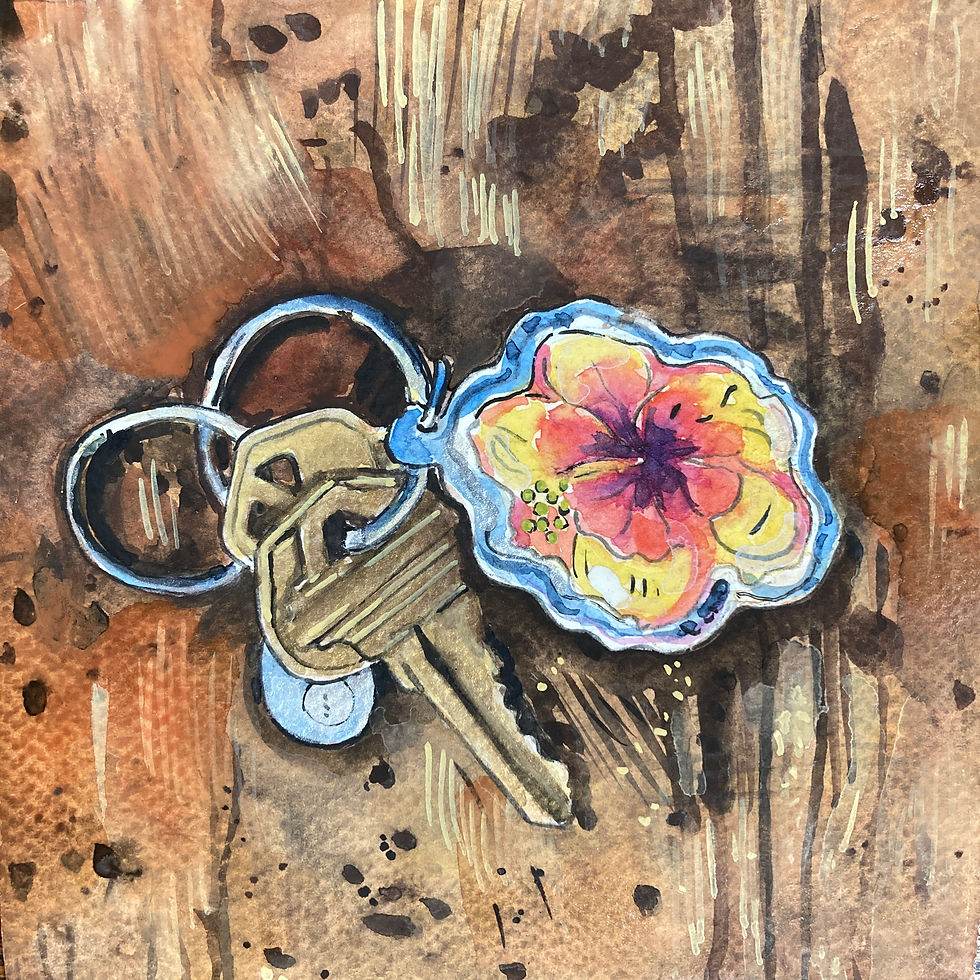
Meridith used watercolor to depict a set of keys with a flower key chain referencing BWAC, symbolizing access, growth, and change.
Digital collage became a powerful tool for many students. Nayarit combined florals, figures, silhouettes, and expressive mark-making to suggest movement, wonder, and transformation.

Lila took a similar approach, layering self-portraits and silhouettes to show personal growth and self-unveiling, capturing herself in different emotional states surrounded by color.

Dami also used digital collage to reflect on her first solo travel experience and the realizations it sparked about herself and life.

Rashida created a traditional collage rooted in nontraditional ideas, using symbolism, shape, and color to communicate her research and personal realizations.

Karla also stuck to her master collage skills by creating a new creature with a collection of images based on anatomy while playing with the human form.

Several students pushed their work further by experimenting with format and surface. Sigrid explored metanoia through the idea of sharing thoughts and experiences by mail, transforming reflection into a participatory exchange game.

Flow utilized an intricately shaped piece of wood to depict the phases of the moon, resulting in a work that functioned both as a sculptural object and a photograph.

Cheyenne created a striking scene featuring a figure, a match, and fire light. Her careful brushwork and attention to detail emphasized the figure’s confrontation with illumination, representing metanoia as a process that is not always predictable or comfortable.

I (Fatima) concluded the session by creating a self-portrait in which clothing and accessories symbolized the chrysalis, while her act of revealing scars embodied metanoia as choosing visibility over concealment.

Overall, the lesson revealed how deeply students connected personal transformation to visual storytelling, using symbolism, material, and process to express moments of change. Each work reflected metanoia as a unique, internal journey shaped by reflection, risk, and growth."
Advanced Studio in person enjoyed a fantastic field trip to see Voice of Space: UFOs and Paranormal Phenomena" at The Drawing Center!! Big ideas, seeing art in person, artmaking, Valentine hearts, and onion rings at Fanelli's!
Evelyn recaps the session: Meridith, Abriel/Bob, Flo, Suzanne, Fatima, Cheyenne, and I (Evelyn) were warmly welcomed by Aimee Good, Director of Education + Community Programs.

All agreed that Aimee was a generous host, providing details about the history of the space and the artists in the two exhibitions on view, as well as an incredible array of art supplies—such that we haven’t seen since losing our studio to the fire last fall. Aimee walked us through the history of the SoHo neighborhood, from many buildings’ origins in the manufacturing industry (evidenced by the high ceilings and cast-iron pillars in The Drawing Center), to the influx of artists after manufacturing moved to the outer boroughs, to the handful of art enclaves that remain as the neighborhood has been overtaken by high-end retail. She described the main difference between The Drawing Center and other museums, namely the choice to forego a permanent collection to focus on rotating exhibitions and artist interactions.
Aimee also introduced us to the work of Trisha Donnelly, whose ethereal drawings were installed in the frontmost gallery, and drew connections between their mysterious nature—a visual language of almost-familiar forms—and the explorations of paranormal phenomena in Voice of Space in the next gallery. Suzanne read aloud an excerpt from the wall text:
In the dao, The spirit of the valley never dies.
This is called the mysterious female.
The gateway of the mysterious female
Is called the root of heaven and earth.
Dimly visible, it seems as if it were there,
Yet use will never drain it.
Lao Tzu, Tao Te Ching, trans. D.C Lau (The Chinese University of Hong Kong Press, 2001), Chapter 6.
Then, we spread out through the space to view both exhibitions. Transitioning into my lesson plan, I asked participants to notice the way each artwork was made—density or sparseness, intense or muted colors, straight and curving lines, geometric and organic shapes, text or no text, symmetry or asymmetry, shading and texture, repetition, handmade mark-making or marks aided by technology such as a straightedge or compass. Meridith noted that the framing of a simple straightedge as “technology” is surprising, but highly intentional—as it makes quite a difference to line quality and can put the resulting drawing in conversation with technical schematics or diagrams, as we noticed in several works in Voice of Space.
We reconvened downstairs and began to create. Several artists responded directly to artworks in the exhibit, such as Suzanne’s drawn and collaged “tower of sound” inspired by one of Iza Genzken’s “Weltempfänger” (“World Receivers”; 1987-2018), a concrete block with antennae of which Meridith was also a fan.
Suzanne Santiago, Paranormal Phenomena drawing, and Iza Genzken, World Receivers, 1987-2018
Fatima brought her signature colorful portrait style to several pages of interpretations of Walter Pichler’s drawing Loch im Kopf (1985), including a delightfully ghostly marker bleed-through on a subsequent page.
Fatima Traore, Paranormal Phenomena drawing
My (Evelyn’s) series of pen drawings on dot paper and drawing paper was inspired by Shusaka Arakawa’s Study for Moral/Volumes/Verbing/ The /Unmind (1977), a mesmerizing composition of conical forms and radiating lines; I used a plastic straightedge and curving stencils, considering the idea of transmissions sent into space that are not received by distant planets. We drew comparisons between Bob’s delicate, organic line drawings (some on white drawing paper, another on a collage of white, black, and translucent tracing paper) and the drawings by Donnelly we had seen upstairs.
Evelyn Beliveau, Paranormal Phenomena drawing, (1-4)
Shusaka Arakawa’s Study for Moral/Volumes/Verbing/The/Unmind (1977)
Flo also used black paper to great effect, using white and red pencils and collaging the wrapper from one of the Valentine’s Day chocolates Meridith passed out to the group. With dotted lines connecting points labeled with dates, he took a diagrammatic approach similar to that used by several artists in the exhibition, such as Howardina Pindell, Stephen Willats, Nolan Oswald Dennis, and Melvin Way—possibly suggesting the tracking and charting of paranormal sightings.


Several participants made use of the notebooks Meridith provided, creating the beginnings of artist books exploding with color and galactic imagery that drew us from page to page. Meridith’s use of sinuous, branching shapes collaged from snippets of outer space photography conveys the sense of a cosmic journey.
Meridith McNeal, Paranormal Phenomena collage (in sketchbook)
Cheyenne, also working in a notebook, used drawing rather than collage, exploring squiggling, oscillating, and looping lines in a playful visual language that evoked Trisha Donnelly or Nolan Oswald Dennis but was all her own.
Cheyenne Rivera at work and Paranormal Phenomena drawing
Drawings by Trisha Donnelly and Nolan Oswald Dennis
After the session, we convened at Fanelli’s (the second-oldest restaurant in NYC) to continue our critique discussion. A convivial evening! Many thanks to The Drawing Center, and we look forward to returning soon.

AYB Artist Evelyn Beliveau reports in from Jersey City on today's session of ART YARD Art Matters at PS 6:
Evelyn recaps: "This week marked the end of our first lesson cycle at PS 6! Dennis, Simone, and I (Evelyn) were joined by Travis, who will be teaching the next cycle.

This cycle, Migration of the Animals, was inspired by the paintings and fiber artworks of Dahlov Ipcar, who created whimsical scenes of animals in their environments with dense pattern and texture. Students had two bonus assignments over the week: to research how old Ipcar lived to be (99 years!) and to come up with a name for their class, in the same vein as a pod of whales or a dazzle of zebras. Our classes picked the following: Threeosixiny (for class 306), The Best Class, and Palpaws (emphasizing the animal theme and their camaraderie).

Each class was quite busy, as we had to finish up the project and conduct critique within an hour. We used a mix of yarn, glue, and colored pencils to continue adding color and texture to the animal silhouettes that students had traced in preceding weeks, plus a background to depict the animals mid-migration over land, through the sea, or in the sky. I was very glad to have our whole team on hand to make sure every student had supplies, troubleshoot creative decisions with students, and reset the room between classes.
The students’ creations really pop! Students used a variety of approaches to depict patterned turtle shells, shaggy wildebeest hides, intricate butterfly wings, and the undulating shapes of water, grasslands, and clouds. For some students, ocean waves meant long, unbroken pieces of yarn that stretched across the whole page, while others used short, squiggly pieces. Some outlined their animals in yarn but used colored pencils for inner details, and others spread their yarn use equally inside and outside the animal silhouette. We love seeing the breadth of choices and creativity students exercised within the framework of the project.


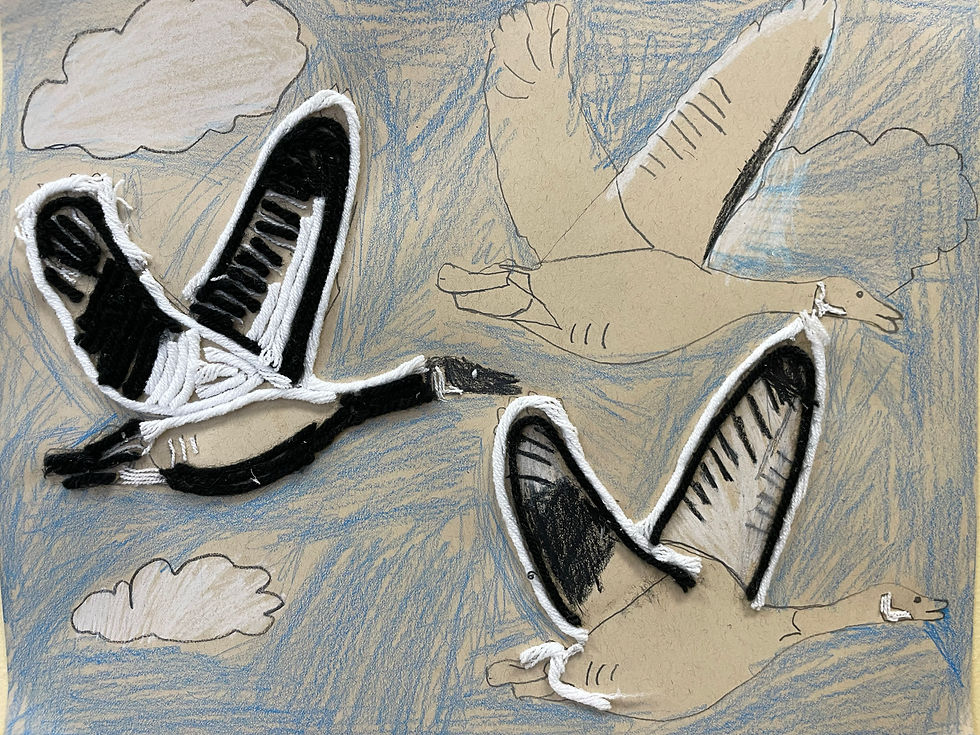
During critique, students drew comparisons between peers who depicted the same number of animals or used a similar technique to depict fluffy clouds; pointed out contrasts between artworks showing the same animal in different media; and gave thoughtful, specific compliments on scenery choices, color contrasts, and level of detail. Dennis and I complimented each class on their focused attention to the project. Many students finished their work, and others’ remain works-in-progress for now, with a standing offer to the classroom teachers to let their students borrow supplies and keep going. Our most meticulous workers, who focused on rendering only the animal with densely packed yarn, may have the option to crop their work for exhibition. We can’t wait to see these migrating animals making their way across the gallery walls!


Other Art News
AYB Board Member Cecile Chong shares that her exhibition "Rumor de la tierra: Ecuador, Jamaica, China opened at Q Galleria in Quito, Ecuador and will remain on view through February 11, 2026. We had an amazing turnout of about 100 people on opening night. Thank you to everyone who made it possible. 💙🤍💙”
Cecile Chong, Rumor de la tierra: Ecuador, Jamaica, China, installed at Q Galleria
AYB Artist TJ Edgar checks in from the start of the spring semester at Spelman College, where she’s settling into a well-rounded lineup of studio courses—traditional art, photography, and digital art. Her traditional class centers on arts fundamentals, with a focus on drawing, collage, and mixed media. TJ shares a recent observational botanical drawing created for the course, highlighting her close study of form and detail.

AYB Artist Ajani Russell has been working on a new series of ceramics. They share works in progress. One of which reminded me of the pointed chin and draped neck of a Remedios Varo figure!

Details of paintings by Remedios Varo for comparison
Tomorrow night we will attend AYB Artist Golnar Adili’s opening 6-8pm at SmackMellon, 92 Plymouth Street in DUMBO.

Golnar Adili: To Measure the Emotions of Others is a site-specific installation which gathers sculptures and reproduced texts as a mediation on language, memory, and material. The exhibition indexes linguistic gestures from the artist’s mother and late father, who were leftist activists during the Iranian Revolution, as well as fragments of the earth and bodies as a form of poetic calculation. The works in this exhibition evolve through repetition, where Adili’s playful transposition of form shifts into the potential for pain, death, sorrow.
Art Opportunities
Open Call for 6x6" artworks to support Rochester Contemporary Art Center (RoCo).
6x6 is an open-call exhibition of 6” x 6” artworks from artists around the world. Open to all ages and experience levels, every submitted work is accepted. Artworks can be mailed by April 4th.

Proceeds from artwork sales directly support RoCo’s exhibitions, public programs, and artist opportunities. Participation is free, and the first 6,000 artworks received will be exhibited both in-gallery and online.
♥️🩷❤️



Comments