
Hit the High Notes

Updated: Jan 30
We started the week early with an AYB Advanced Studio field trip on Saturday, January 25th, visiting Smack Mellon for the opening of To Measure the Emotions of Others by AYB Artist Golnar Adili.
Wall signage and Golnar at the opening. Photos Meridith McNeal.
In this ambitious exhibition Golnar uses sculpture and text to explore how language, memory, and loss are carried through material form. Drawing from her parents’ letters, the exhibition considers how intimate histories shaped by political upheaval can be fragmented, repeated, and reassembled in space.
While looking closely at Golnar’s use of handwriting as a pattern or even a sculptural element, Flo and I discussed language as a lens for comprehension—how meaning shifts when text becomes material. This conversation continued with Ed, who is currently immersed in a graphology-based project for a gallery in Kansas, extending questions of authorship, trace, and interpretation. Kevin poignantly observed that the floor installation evoked the presence of war, grounding the exhibition’s emotional resonance in contemporary and collective realities. Together, these moments of shared looking and dialogue underscored how Golnar’s work invites reflection not only on personal history, but on how we respond to the world around us.

AYB Artist Ed Rath reviews:
Not to be Missed
Smack Mellon 92 Plymouth Street Brooklyn, NY 11201
January 24 – March 29, 2026, Open Wed- Sun, 12 -6 PM
Golnar Adili: To Measure the Emotions of Others
What is most striking about the work in this exhibition is the delicacy, the fragility of the materials, combined with the artist’s sureness in placing every element in its place.
Every stroke of the pen, every carefully cut out letter, “ye,” mounted on what appears to be the thinnest of shish-kabob sticks waving in the space-time continuum, singing softly of times gone by with a sad gaiety, gentle reminders of our fleeting existence.
As you experience the work, you find yourself going inward, to a meditative, non-verbal place, where time no longer exists, a place that feels familiar yet unidentifiable.
It’s so good to know some artists can still hit the high notes.

On Monday, Advanced Studio met on Zoom for a session led by me (Meridith) titled Time Travel NYC 1939–1940. The class was introduced to photographs from the NYC Tax Archive, where WPA photographers documented the city’s buildings, industries, and daily life as part of projects connected to the Federal Writers’ Project and the Tax Department’s property survey.


I shared archival images of my own house and of 180 Franklin Avenue, the site of our in-person classes, using these examples to demonstrate how to navigate the archive and dig deeper—especially when addresses have changed—by searching nearby properties. Participating artists were then asked to find an archived image of a NYC address meaningful to them, such as a childhood home, a relative’s business, or a local library, and to respond emotionally to the photograph.

Ajani responds: "180 Franklin where we host Art yard appeared to be a car painting studio. There were more single and two- story buildings in the 40s. In places where there were houses made of wood there are now houses made of stone. Also the transition from single family homes to apartment buildings in the far reaching areas."
For critique, we shared both the historic images and related artworks. Some artworks are still in progress, as most of the group became absorbed in exploring the archive and its potential as a resource for personal, research-driven work.
Several participating artists shared their thoughts on the session.
Ajani gives us an overview: "This week we traveled back in time to the 1940s. Using an online archive of photographs, we were able to look up places in New York that are important to us, to see what they looked like over 80 years ago. The changes between past and present were drastic in some cases and minimal in others. Some of the outer areas were not yet developed like the central areas. For example, Canarsie still had cobble stone streets, the houses placed farther apart. The Brooklyn public library looks exactly the same but the surrounding area is unfamiliar. It was fascinating to see how the neighborhoods transformed. Fort Greene- where I grew up- looked much like it does today in regards to architecture but it felt like something was missing- the lamp posts, crossing lights, and people to name a few things. I also noticed a general lack of trees in the photos of Brooklyn."
Rashidah sums up the session: “This week for class on Zoom, Meridith fired up her flux capacitor to take us on a journey eight decades into the past. Our objective was to create a piece inspired by photos from New York City in the 1940's, particularly places that have been meaningful to us across the 5 boroughs.
Some artists, like Nayarit, decided to do pieces that showcased the old and the new, striking up nostalgia for an unfamiliar time.

Nayarit opines: “Traveling into the past invites us to reflect on where we have been and on those who occupied these spaces before us—what once existed and what did not. It encourages us to understand change as an inevitable, neutral force, and more importantly, as a catalyst for reflection on what we have witnessed and lived through.
Looking at photographs from the 1940s and the 1980s allowed us to experience New York City in a different way, to see what once was and to reflect through our own experiences, as well as those of family members and strangers alike. These images reveal how placemaking on our street blocks has evolved over time.
Everyone did a wonderful job capturing the sensation of belonging in their pieces, each in a distinct way. The work highlights the strangeness of change within these places while also revealing the rich continuities of history and how they shape the city we know today.”
Lila found a picture of houses in Spring Creek, Brooklyn, which could have easily been mistaken for a much older time and a place far from NYC, and created a colorful collage, placing it among images of new developments in her neighborhood.
Lila Green, Time Travel NYC 1940, photo and artwork
Lila eloquently recounts the ideas touched upon in her digital collage:
The Layers Beneath Our Feet
For our assignment, we were asked to become time travelers. We looked at the maps of our current neighborhoods from the 1940s, the 1980s, and today, using lot numbers to peel back the layers of history. What I found in the stretch of land between East New York and Spring Creek now known as Gateway, was a story of a landscape that refused to stay the same.
The 1940s: The House in the Marsh
In the 1940s, the map reveals a world of silence. Looking at the lot numbers, I discovered a ghost: a single wooden house, weary and weathered, standing behind a simple fence. It looked like something out of Little House on the Prairie (as Meridith so humorously suggested) a tiny outpost of wood surrounded by barren land and the salt-soaked breath of the swamp. It’s hard to imagine anyone finding a home in that "uninhabitable" marshland, yet there it stood. I wonder about the people in that little house. Did they ever look out at the dirt roads and envision the city that was about to swallow them whole?
The 1980s: The Scent of Progress
By the 1980s, the swamp had been paved over by the grit of industry. This is the Brooklyn I remember as a child. I can still feel the bump of my mother’s car on the badly paved streets as we drove past the sanitation warehouses. The air back then was a heavy recipe of sour milk and garbage, mixed with the sharp, chemical sting of paint from the auto body shops. On the other side of the Belt Parkway, the landfill loomed and it was a feast for the seagulls that circled it like a gray cloud. We always knew exactly where we were because we had to roll up the windows to keep the smell of the old world out.
Present Day: The Gateway Renaissance
Today, the "barren land" has found a new purpose. The warehouses have evolved into modern Amazon facilities, and the empty spaces are now filled with townhomes, co-ops, and the hum of a large outdoor mall. But the most magnificent change is the one you can breathe in.
The smelly landfill of my childhood has been reclaimed. It sits under an impenetrable cap, covered in soil and seeds that have grown into Shirley Chisholm State Park. It is a beautiful, green sanctuary where National Geographic photographers now track rare birds and bikers disappear into trails that feel like a faraway mountain range. The air that once required rolled-up windows is now filled with the life of Jamaica Bay. I’m not just passing through anymore; I’ve finally found a place to stay and I now call it home.
Thank you to Meridith for putting together this wonderful lesson. This project allowed me to share a piece of my own history through the lens of the land. I was also able to learn about this area when I thought I knew the full history. I now realize I’ve only scratched the surface. It is a reminder that even the "weary" and the "barren" can be rediscovered and can be reborn into something magnificent, safe and stable.”
Marilyn created a collage that transported the Guggenheim into the past, seamlessly integrating it into the background of some antique cars, giving it the illusion of an actual photograph.
Marilyn J. August, Time Travel NYC 1940, photo and artwork
Marilyn ruminates: "Stepping into the past was truly revealing. One may remember a place tied to specific memories, freezing it in time. But seeing it in another era was like a fantasy. I know my old home in this apartment building as it looked when I lived there in the mid-seventies and today, yet I never envisioned what was there decades before me. In this lesson, there were many surprises from the ‘40s when there were still fields and open spaces in NYC, which are now crowded with high-rise housing, shopping centers, and industrial sites. What fun to travel back in time!"
The ‘40s photo of my old apartment building shows a vintage car parked in front. I used that image as a prompt to superimpose vintage cars around the Guggenheim Museum, which was later built next door.
Flo's piece, reminiscent of math class, depicted his home split into four quadrants by time axes, each quadrant displaying a different time period.
Florian Velayandom Neven du Mont, Time Travel NYC 1940, photo and artwork
Flo shares: “This class felt like opening an old picture book that your grandparents had kept a secret until then—giving a different look at them, situating them in a different era, sheltering different souls. I personally spent a good 30 minutes just contemplating the picture of my building as it was in the 1940s and felt very grateful to live in it almost a century after, wondering about all the different stories it holds in its walls. I felt the same connection I sometimes feel with the trees when I walk in a cemetery, knowing they’ve been there before me and will most likely be there when I’m gone.
It really reminded me how much time has us more than we have it.
I also loved traveling in time with other classmates, hearing the stories behind the addresses they chose and the creativity of their work.”
Ajani comments that: "Flo’s piece, depicting past, present and future at the same time, feels like there was a theosophical approach. The silhouettes of the people feel ghostly, as if they represent the idea of the people that frequented that place."
We were surprised to see a person, perhaps the photographer?, in Travis's vintage photo!
Travis Pereira, Time Travel NYC 1940, photo and artwork
Travis writes: “Monday’s class session was deeply inspiring. We were asked to research specific addresses across New York City, examining archival photographs from the 1940s alongside images from the 1980s. This process allowed us to witness how dramatically certain neighborhoods have transformed over time, and we were invited to create a visual response to what we observed.
I chose to research Canarsie, Brooklyn — the neighborhood where I grew up. Today, Canarsie is a vibrant, family-oriented, and ever-evolving community. In contrast, the 1940s photograph revealed a vastly different landscape: unpaved roads, sparse development, and an overall sense of isolation. The area appeared unfinished, almost suspended in time. Though the images were black and white, they carried a muted, mysterious, and somewhat somber atmosphere.
In response, I created a sketch imagining a solitary home resting on a wide plot of land, with few neighboring structures in sight. The surrounding environment is raw — weeds, cobblestones, dirt, and gravel — echoing the conditions seen in the archival photographs. I reimagined the dirt and gravel as gemstones embedded in the ground, symbolizing hidden value, resilience, and possibility beneath what might initially appear barren or overlooked.
Above the landscape, I introduced a radiant sunrise breaking through the sky. This burst of light represents emergence, transformation, and the quiet promise of what the land — and the community — would eventually become. Through this piece, I sought to inhabit the emotional atmosphere of the 1940s images while honoring the beauty, richness, and potential that existed there all along.”
Aaron's sketch took us far into the future, with a car in the artwork that looked like Doc Brown's DeLorean.
Aaron S., Time Travel NYC 1940, photos and artwork
Aaron explains: “I used the site to explore my old neighborhood in the Bronx and found photos from the 1940s, including one of the elementary school. I then searched for a modern version of the same angle and found a close match from 2012. The school and surrounding buildings were unchanged, with even the street-parked car and tree in the same positions. The only real difference was the car's period-specific design. For my sketch, I built on this by recreating the scene and replacing the car with a futuristic, spaceship-like design.”
Some artists took a more straightforward approach. Meridith painted a wonderful photograph of her home, in which she found children playing on the stoop.
Ajani points out: "The photo of Meridith's house was one of the only ones that had people in it. I wonder if the photographer had everyone in the area clear the frame purposefully for the shot?"
Meridith McNeal, Time Travel NYC 1940, photo and artwork
The photo of Cheyenne's grandfathers building has that familiar Brooklyn architecture and besides the cars on the street and the lack of people, it almost feels timeless." explains Ajani, "The sneakers on the telephone line in her drawing is a very specific trait of New York that places me in a certain time period after the photographs were taken- there were no telephone poles yet. This detail as well as the hopscotch drawn on the floor.
Cheyenne Rivera, Time Travel NYC 1940, photo and artwork (in progress)
Cheyenne adds: “Looking at pictures from the 1940s took my attention for almost the entire work time, how fascinating! It really inspired nostalgia for me and I felt connected to a time I’ve never known.”
The line drawings made by Adji and Ajani had many comparison - both well observed with beautiful line quality and just the right amount of architectural detail to really bring it to life!
Adji Ngathe Kebe, Time Travel NYC 1940, photo and artwork
Adji shares: I enjoyed the time travel class. The ability to research our current abodes in 1940s, was incredible. We were able to connect a present feeling to the past. For example, I was not alive during the 1940s. It is not possible for me to have a recollection of the 1940s. However, looking through images of my current apartment in the 1940s, I began to think about who must have lived there. What was their life like? My building was clearly uninhabited, so when did people start to live there? What memories do the walls, plumbing, floors have? What laughter have the trees in my backyard heard? What lives have been lived? It’s extremely valuable, especially as I continue to live here, and make core memories of my own.”
Ajani did a sketch of the main Grand Army Branch of Brooklyn Public Library that almost felt like it was drawn from a panoramic perspective.

Week to week, I am constantly mesmerized by Leah's command of watercolor. Her paintings, despite being inspired by her own stories of positivity, tend to be mystifyingly eerie. Having witnessed her unfinished piece in class, I along with many of my fellow student artists felt like it was a complete work. The juxtaposition of her painted depiction of a photograph of her home from the 1940s to a poem that she wrote about her adjustment to living in New York City, some words being obscured by her painting, felt cohesive. It made me examine the question: How does one navigate a place where one feels established versus unestablished? The perspective of the painting forces the observer look up toward the top of her building and the elevated train tracks, which makes the onlooker feel a bit trapped, though the sky in between the gap of the two structures gives a glimmer of hope.
Leah Eliopulous, Time Travel NYC 1940, photo and artwork
Leah ruminates: "Seeing my first residence in New York in a new light - 1940 to be exact, was eye opening and exciting. Reflecting on the development of the city and the similarities of back then vs now was a beautiful experience. Thinking about all the different lives that experienced one place, a place that was yours and before you someone else's. And after you someone else's, all while being connected to the place inhabited."
Karla told us about her two great uncles who came to NYC from Milan to work as stone carvers. She researched their apartments and studio, (all around 14th street in Manhattan), then began a collage which includes a marble bust now in her home in Kansas.
Karla Prickett, Time Travel NYC 1940, photos and artwork (in progress)
I (Rashidah) decided to draw the buildings that used to stand where my childhood library currently is, as the library was such an important third space for me in my youth. All in all, it was a great class, and extremely exciting to see snapshots of the New York City landscape during a time we could only imagine.”
Rashidah Green, Time Travel NYC 1940, photo and artwork (in progress)
This week, due to challenging travel conditions caused by snow and ice, Tuesdays usually in-person Advanced Studio met virtually over Zoom. AYB artist Fatima Traoré led a session titled Migration Within: Tracing Ancestral Traits. The session explored how migration lives inside our bodies through inherited physical features passed down across generations. Students selected a single trait, investigated its possible origins, and created artworks in the materials of their choice to celebrate the journey of that feature through time.


Fatima sums up: “My lesson began with a group discussion about ancestry—where our families come from and which roots we feel most connected to. Fatima encouraged artists to consider how migration lives within our bodies, exploring how traits are passed down from generation to generation through genes, memory, and lived experience.
Drawing inspiration from Brandon Deener’s paintings—where he emphasizes specific Black features through color, repetition, and focus—artists were challenged to select one defining feature and repeat it at least three times. The results were eye-opening, revealing deeply personal stories embedded in each work.

Adji explored the freckles that appear in her family after reaching certain milestones.

Cheyanne reflected on her admiration for her mother’s hair and the journey of embracing her own curls as they changed over time.

Margaret focused on her family’s hooded eyelids, placing them within a beach scene layered with symbols of home and scattered freckles.

Lilo honored her family’s legacy of dancing and hip movement, using stars to symbolize motion and rhythm.

Abriel referenced both sides of her family through the shared traits of pronounced noses and distinctive handwriting.

Briana centered her piece on hair, depicting three figures facing one another.

Assata also chose eyes, using two contrasting mediums to emphasize expression and direction.

Meridith reflected on the lines of her palm.

Meridith explains her process and piece for this session: “Years ago, I made a series of over one hundred portraits of people’s palm lines, which I beaded onto vintage gloves. At the time, I was in the habit of photographing palms and became adept at reading their nuanced lines. I was surprised to discover that my father and I share nearly identical palm patterns.
During Monday’s time-travel session, I was struck by seeing New York City as it appeared in 1940. That experience led me to seek out a photograph from the same era of Caribou, Maine—my father’s birthplace. The image shows some boys standing outside their home. Looking closely, each boy holds his hands in a distinct gesture.
Meridith McNeal, Palm Portraits, 2007, beaded vintage gloves, & Photo, Caribou, Maine, 1940
For Fatima’s session, I created a cut paper form of my own hand holding this photograph and painted it in watercolor. To reference a third iteration of my palm lines (as per Fatima’s prompt), I painted my thumbnail as if it were adorned like one of my palm portraits, using bead-like dots. I echoed this gesture by adding gold dots to the boys’ hands in the painted photo.”
I (Fatima) focused on lips and smiles; as both an only child and only grandchild, she used watercolor to illustrate the smiles of her grandfather, grandmother, mother, and herself, floating above a vase and intertwined with floral elements.

Through this lesson, artists not only explored repetition and visual emphasis but also gained a deeper understanding of one another by uncovering the ancestral stories carried within their own bodies."
AYB Managing Director Dennis Buonagura writes: “We are thrilled to kick off the next cycle of programming at ART YARD Art Matters at PS 6 with AYB Teaching Artist Travis Cinco. Working closely with Travis to plan his upcoming cycle is a great example of how we train and support our teaching artists—before they ever step fully into the classroom.
At AYB, teacher training starts with getting to know the artist. We meet one-on-one to talk about their art practice, any teaching experience they may have (not required!), and their overall vibe. New teaching artists then observe a class at one of our partner schools—but this isn’t a sit-back-and-watch situation. They jump in to help with setup, supply distribution, student support, classroom technology, and overall flow, essentially acting as an assistant while getting a feel for the school environment. From there, we talk through grade levels, student needs, lesson planning tied to our annual theme, time management, and supplies. We also cover the less glamorous (but very real) side of teaching—troubleshooting, last-minute changes, student absences, and adapting lessons for different learning levels. The goal is simple: to make sure our teaching artists feel confident, prepared, and excited to create meaningful experiences for students from day one.

Dennis reports on the first day of our new cycle of ART YARD Art Matters at PS 6: "Inspired by the works of artists Isabel and Alfredo Aquilizan, Teaching Artist Travis Cinco created a lesson about tenement housing in the NYC and Jersey City areas built around the time of the late 19th and early 20th century.

Students viewed a presentation of images detailing the architectural style of structures developed to house the tremendous number of people who migrated to these cities. Of those who arrived in Jersey City, many worked in local factories and docks, particularly in the dense, industrial areas. These 4-5 story "railroad flat" buildings, often made of Trenton brick, were concentrated between the waterfront and Van Vorst Park.
The materials used in class are simple - cardboard, glue, tape, pencil (where needed) but the finished pieces will be anything but. Please consider this quote from Isabel and Alfredo Aquilizan when thinking about our materials: “We use cardboard boxes because of their association with travel. They have a history of holding and carrying things.” Extremely fitting choice for our lesson on creating miniature houses AND our theme of migration.
Our teaching artists complete hours of prep work prior to the start of classes - one of the many reasons for this is the understanding of the time constraints in a public school for art-making. Travis scored dozens of pieces of cardboard at home so that students would only need to fold and glue to get their structures started. Additionally, he made two samples for students to pass around.


We had 1st, 4th, and 5th grade students - working at various levels but all accomplishing their common goals.
Travis, Simone and PS 6 students at work
Prior to classes, I sent the classroom teachers two short videos about the artists which were very well received. And - par for PS 6 students - they arrived to class with a good understanding of what their project would be and with lots of questions.


What We Are Reading
I spend a lot of time listening to audiobooks borrowed from the Brooklyn Public Library while working in the studio. I love the library app, but the books I’m searching for are often stuck behind impossibly long waitlists—or haven’t made it to the virtual shelves at all. Every so often, this leaves me without a solid, studio-worthy listen. My mother used to joke that I reread books more than anyone she knew who wasn’t a writer, and this week I found myself doing exactly that.
I returned to Sometimes You Have to Lie: The Life and Times of Louise Fitzhugh, Renegade Author of Harriet the Spy by Leslie Brody (Seal Press, 2020). It’s a deeply researched, information-rich biography that vividly brings Fitzhugh to life—her gender-bending presence, creative ambitions, visual art career, passions, insecurities, romantic entanglements, and even her sharp fashion sense. The title itself borrows from the blunt wisdom of Ole Golly, Harriet M. Welsch’s nanny and moral compass: advice that champions honesty with oneself, even when social survival demands strategic dishonesty. Revisiting this book reminded me just how radical Fitzhugh’s vision was, and I’m now tempted to add Harriet the Spy—again—to my reread list.
Other Art News
AYB Artist Flávia Berindoague shares: “I’m pleased to share with you my recent studio updates starting with my inclusion in Carpe Diem: Select Alumni in the Visual Arts, curated by Sally Morgan Lehman at The George Segal Gallery, Montclair State University, Montclair, NJ.

Flávia writes: "The invitation depicts a detail of a painting is part of my series Imaginary Geography that investigates the language of memory, assembling a mosaic of inherited cultural references. The forms retain traces of architecture - fragments of places accessed through recollection and daily observation. The chromatic palette draws from Brazilian-Bolivian-Syrian lineages, forming a sensorial cartography that navigates shifting identities and forms of belonging."
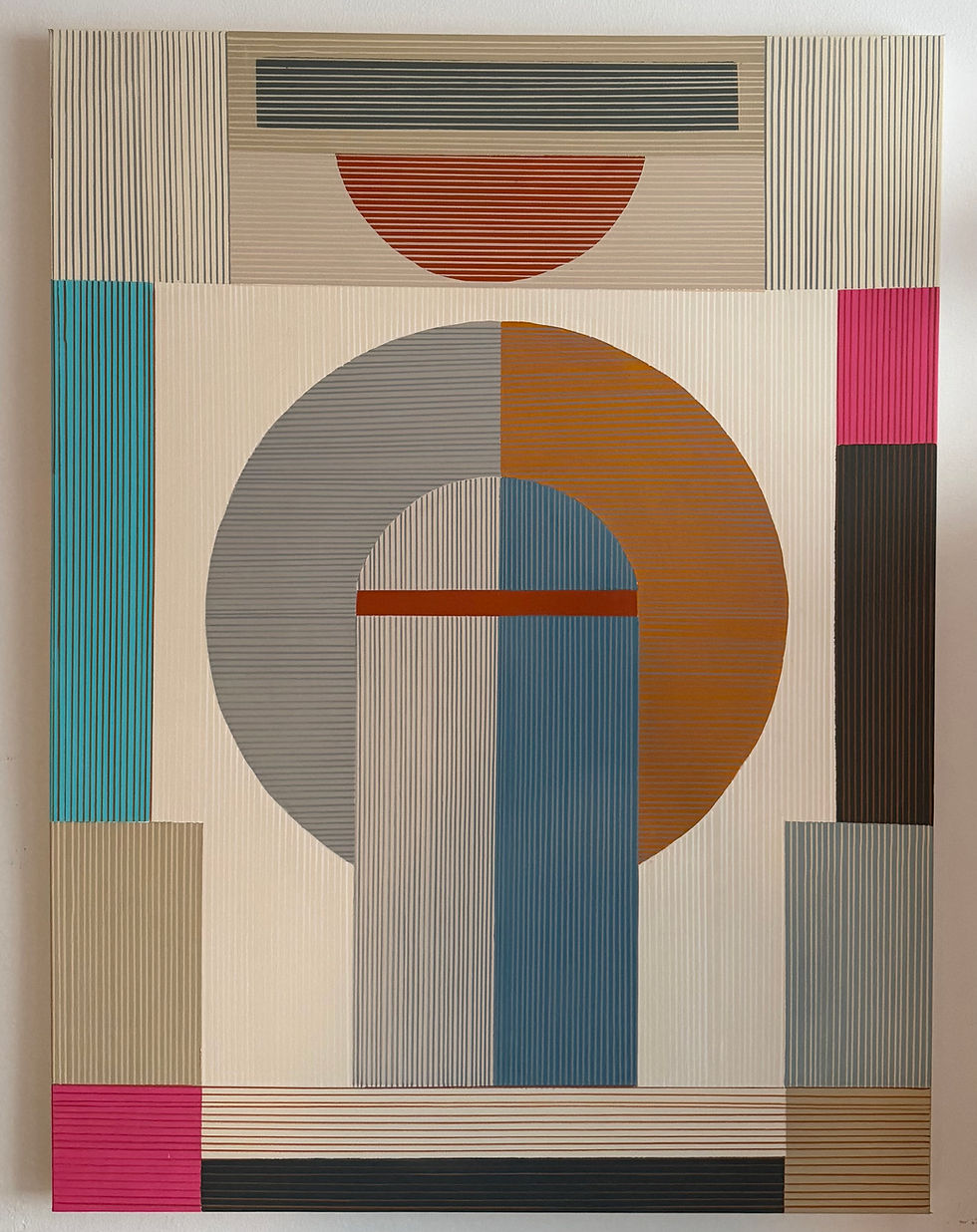
Flávia will be at the opening reception on Tuesday February 3 from 5 to 7pm. To register for this free event, please visit: Montclair Galleries.
AYB supporter Jennifer McGregor invites us to celebrate an exciting new lighting installation on Fulton Mall, on Monday, February 2 @ 5:30pm.
MASARY’s In Every Transition, A Pattern will light up the Fulton Street windows of the former Macy’s building at 422 Fulton Street through March 16, 2026. Junior's will be providing hot chocolate and Palava Unplugged will add their sound to the piece.
MASARY, In Every Transition, A Pattern, video stills
🤍❄️🩵

P.S. Due to ongoing email issue, we will start sending group emails through Mailchimp. Thanks go to AYB Artist Ariel Abdullah for her hard work to find a work around and set a solution in motion!


Comments