
Create something together

Find the people who share your values and interests, and create something together. ~ Amanda Leigh Evans, An Artist Residency As A Door (Nina Vichayapai, 2026)

This final week of AYB Summer Session 2026 has been such a joy! Toward the start of the week, I received the book An Artist Residency Is A Door as a gift from AYB supporter and dear friend Lisa Peet. I perused the book over coffee, looping back repeatedly to the knowledge that we were winding down this season's residency. There are so many layers of art, artistry, development, dialogue, and growth that we shared in our residency. With over 50 years between our youngest and most mature participating artists, it is remarkable—but accurate—to report that we ALL developed new skills, delved into meaningful concepts, challenged ourselves, and did all of this within a spectacular group of friends!
This week, artists new to the role of teaching artist, like Florian Kiniffo-Neven du Mont and Delphine Levenson, or those who developed their practice to include new skills, such as Neah Gray leading us on a museum trip, received support and mentoring from our more experienced folks, like Evelyn Beliveau, who developed a stellar two-part drawing intensive. We ask Teaching Artists to share their thoughts and nuanced reviews of their sessions. While I have very high expectations for all of us, I must take a moment to express my appreciation for the care and rigor AYB teaching artists bring to their written reflections, as well as to the dialogue and visual mediums we practice.
Evelyn Beliveau recaps: “On Monday, I (Evelyn) began a two-day lesson focusing on two types of observational drawing, contour drawing and gesture drawing, with an emphasis on organic forms. These two modes can be seen as opposing poles on a spectrum of approaches to drawing: gesture drawing emphasizes looseness, speed, and a sense of the whole form, while contour drawing emphasizes slow, close, minute observation of details.
We began with a contour-drawing warmup that hearkened back to Ajani’s portraiture exercises two Mondays ago. Using pens and sketchbooks, each participant chose someone to observe and made a contour drawing without looking at the paper. I set aside 10 minutes to complete this drawing, in order to challenge everyone to slow down and allow both the eye and the hand to travel slowly along the contours.

We discussed the experience over lunch, with some participants noting that it was difficult to slow down and others that their expectations for their drawing were very different from how it appeared once they finally got to look. Not looking during the drawing is one way of giving up control, and thus combating perfectionism: we knew the drawings would not be precisely “realistic,” and this freed us to take in each detail on its own terms. Many of the drawings’ subjects could still be easily identified, even with drastic distortions of scale or proportion.

Next, we moved on to gesture drawing. Having prepared the worktable with vases of flowers and cups of diluted Payne’s Gray watercolor, I now gathered participants for a demonstration. First, we rolled our shoulders and limbered up, preparing to use not just the hand but the whole arm or even the whole body to respond to the flowers. I began with a dry brush, experimenting with movements across the paper that captured a sense of the overall shape and “posture” of the flowers. Ignoring details for now, I used a large brush dipped in the faint blue-gray wash to sketch the flowers in quick, intuitive movements.
Then, we spread out around the table so everyone could try out gesture drawing, first with a dry brush, then with monochrome watercolor. Each participant made three to five drawings, most choosing to stand while drawing for more bodily freedom.
We started with gesture drawing in watercolor
For the last part of our work time, we slowed down again, overlaying contour drawings directly onto the gesture drawings. Participants could look at their works-in-progress this time, but still aimed to slow down and follow the contours of the flowers precisely—even if they didn’t match up exactly with the looser brush drawings. This project was inspired by a formative exercise from an early undergraduate drawing class I took, placing these two types of drawing in direct conversation to highlight their different strengths and allow the loose, holistic response of the gesture drawing to inform the subsequent contour drawing.

Participants were free to focus on one contour drawing or make as many as they wished in the remaining time, resulting in a full and vibrant spread of drawings at critique. We began by reflecting on the experience, especially the differences between the two types of drawing, then jumped into our usual comparisons, contrasts, and compliments.
Delphine and TJ pointed out that the initial kinship among all the drawings, due to the shared media and subject matter, gives way to a wide variety upon further looking. TJ noted the level of opacity in the watercolor wash, with some very pale and others quite dark, and August complimented drawings that seemed to emerge from a patch of darkness. Bob admired the specific energy of Meridith’s lines, and I (Evelyn) agreed that I would recognize Meridith’s brushwork anywhere—even though, as Meridith pointed out, the process was the opposite of her usual approach of drawing first, then watercolor.

Marley received many compliments for the delicate pen outlines around her brushstrokes, a unique approach in the group. Brenda and others admired the different interpretations of the baby’s breath included in some of the bouquets. I loved seeing the sensitivity to weight and delicacy in the group of drawings, which speaks to the keen observation of the artists; the sunflower stems are thick and sturdy, while the baby’s breath floats on finely branching stems.

Meridith complimented the interesting, surprising, and quite different compositions, such as Ty’s piece which evokes weight and rootedness by placing the plant at the bottom of the page. Jacob drew a contrast among artworks in which the two drawings lined up or diverged from one another, with some of the watercolor washes acting almost as shadows—Delphine compared these to the photographic documentation of the wire sculptures we made with Chris last week, many of which featured shadows on white walls. Alex contrasted the handful of drawings that featured a lone flower with those that included multiple, and Delphine noted that some artists zoomed in while others included the vase or the line of the table for context. Jacob complimented Keziah’s “diptych,” a vertically divided composition balanced between two groups of flowers.


Reflecting on the process, TJ noted that it was difficult to stick to what could be seen from one vantage point in the contour drawing, with the temptation to peek around the stem to make sense of a tangle of leaves. Ty mentioned he solved a difficult foreshortened petal by stepping closer and then back to his vantage point. Delphine felt more relaxed and free with brush in hand as opposed to the pen, but drew on her experience in Ajani’s contour drawing class to just keep going rather than stressing about it. Jacob noticed that the pen put more control in the artist’s hand, while the watercolor involved more chance, with unintentional lines created from the way it pooled and dried. August compared the pools and blobs of watercolor wash to a Rorschach test, and also compared the experience to a sumi lesson taught by Ed many years ago (when we were hosted by the Kentler International Drawing Center)—as I understood it, there’s something about the permanence of the medium and the balance of control and chance that allows us not to worry so much about imperfections.”
On Tuesday, we concluded Evelyn Beliveau’s two-part lesson on observational gesture and contour drawing, with a mix of new (to this lesson) and returning participants. We reviewed the previous day’s exploration of these two types of drawing, then dove into a series of portraiture exercises.
Evelyn writes: “Before lunch, we warmed up with contour drawings of our hands. Like the flowers yesterday, the hand presents a complicated organic form with plenty of nooks and crannies upon close observation. We had a great discussion of foreshortening, prompted by Leah’s reflection on the difficulty of representing a fingertip directly from the front; Ajani, Delphine, and others weighed in with tips and anecdotes. Meridith advised trying to forget what you know about the body part and see the shapes as shapes, which provided a great segue into our next exercise.

Taking inspiration from a classic drawing exercise from Drawing on the Right Side of the Brain (1976, Betty Edwards), we copied a drawing upside-down. Everyone received a printout of Mother, Bradford. 19 Feb 1979 by David Hockney, a portrait in sepia ink on paper of the artist’s mother. As they began to draw in pen on paper, I invited participants to see the lines themselves, and “forget” the clothing items or facial features the lines described. Afterward, Flo articulated his experience of an illuminating moment: when he recognized the nose as a nose, he felt an impulse to draw it right-side-up rather than continuing to follow the (upside-down) shape he was seeing. This speaks to just how wired we are to see familiar visual information as chunks or symbols rather than breaking them down into constituent parts—a hurdle faced by anyone who draws from observation.
David Hockney, Mother, Bradford. 19 Feb 1979 and drawings of by AYB (use arrows to scroll images)
We also looked at line weights and tried to imagine the gestures Hockney would have used to make the marks, and Jacob noted the tension between mimicking the gesture and committing to precise replication of the contours. Each artist’s drawing turned out slightly differently, but all succeeded in portraying a face with recognizable textures of aging skin, hair, and the fantastic hat composed of many tiny marks.
Next, we brought gesture drawing back into play, with a process familiar to those who’d joined the flower-drawing session the day before. With Ajani agreeing to model, we rolled our shoulders and shook out our limbs for freedom of movement, then I demonstrated making gestural movements first with a dry brush, then with a wash of Payne’s Gray watercolor to capture the posture, center-line of energy, and main clusters of forms. Once this dried, it served as a “map” for a slow, detailed contour drawing. Participants sat in a circle and chose another artist to draw, then set out on the day’s main project: one or more portraits begun with a gesture drawing and finished with a contour drawing.
Evelyn drawing Ajani during demo, and Evelyn portrait of Ajani
This was no easy task. As I worked on my portrayal of Jacob and Ajani in the “overflow seating” at the coffee table, I heard participants express frustration when elements of the drawing didn’t line up or specific features, like hair, proved particularly difficult to capture. An artist mid-drawing is certainly a less static subject than yesterdays flowers! With permanent materials like watercolor and pen, the only way out is through—and everyone pushed through to find success, whether by layering multiple views to capture the minute movements of their portrait subjects, accepting slight distortions, or working on multiple drawings until they felt satisfied.

To bring the two-day lesson full circle, we ended with a five-minute blind contour drawing of the same subject as the longer drawing (just as we’d started Monday morning with blind contour portraits). These were much lauded at critique, as the artists’ hour-and-a-quarter of poring over the minute details of their subjects resulted in strong, succinct contour drawings. Ajani pointed out how the eyes Bob’s blind contour drawing of August seem to have jumped directly from the longer drawing.

Many more compliments and astute comparisons flew around the table during critique. Jacob compared Ariel’s drawing of Yani to Ed Rath’s subway drawings. Flo and Brenda received compliments for their finely rendered chairs (Brenda’s portrait of Bob in a swivel chair, Flo’s of August in a Breuer chair). I (Evelyn) compared the outlines of individual curls of hair in TJ’s drawing of Ariel and Delphine’s drawing of Sanjay; Sigrid compared Delphine’s portrayal of Sanjay’s hair to ribbons, and Ajani’s portrayal of Jacob’s hair to cursive writing. Given the shared cast of characters, Marley suggested Jacob’s, Ajani’s, and my drawings could make for a good short film.
TJ Edgar, Ariel, and Delphine Levenson, Sanjay
Yani Prudent, Ariel, and Ed Rath, New Yorkers, On The Move book cover
Florian Kiniffo-Neven du Mont, August and Brenda Yangali, Abriel (bob)
August and Meridith noted the shared sense of serenity achieved by the “Bob illustrators”—August, Brenda, Marley, and TJ. Ajani compared Brenda’s drawing of Bob to Alice Neel, and Jacob admired how the wash from the gesture drawing inhabits the figure of Bob but not the chair. Leah complimented TJ’s crosshatching in Bob’s shirt, and likewise received compliments for her own use of shading in her portrait of Flo. Brenda contrasted Ajani’s delicate pen use in their portrait of Jacob with the weight and density of Leah’s drawing.
Leah Eliopulous, Flo l & ll
Flo pointed out how the gestural washes function like shadows on the face in some drawings, skeletons within the figure in others, or other spirits in the room when the contour drawing diverged more fully (as in my drawing of Bob, Delphine, Flo, Marley, and Sanjay). On the subject of spirit, Ajani complimented Yani’s drawing of Ariel as capturing her subject’s personality and energy. Delphine complimented Marley's drawing of Bob for its emotion and depth, as well as Marley herself as a fun and insightful neighbor in the circle of artists. Gardell complimented the many emotions, moods, and attitudes present in the drawings.
Yani Prudent, Brenda, Sigrid Dolan, Marley, Sanjay Velayandom-Neven du Mont, Leah, Jacob Rath, Ajani, Brenda Yangali, Flo, Ariel Abdullah, Yani, August Levenson, Abriel (bob), Ariel Abdullah, TJ,
Ariel Abdullah, Abriel (bob)
Meridith complimented the final blind contour drawings as amazing likenesses done with economical mark-making, and gave a particular shout-out to those who met with frustration during the drawing process and ended the day with such beautiful drawings—a result that’s even more satisfying when it’s hard-won.”
60 minute drawing and 5 mintue blind contour of same person:
Ajani Russell, Jacob, Marley Haynes, Abriel (bob), and TJ Edgar, Abriel (bob)
Wednesday, we made a trip to The Museum of the American Indian, located in Lower Manhattan. We met up with AYB Artist Neah Gray, who made her debut teaching in a museum with great success! Her lesson planning was thorough and well researched.
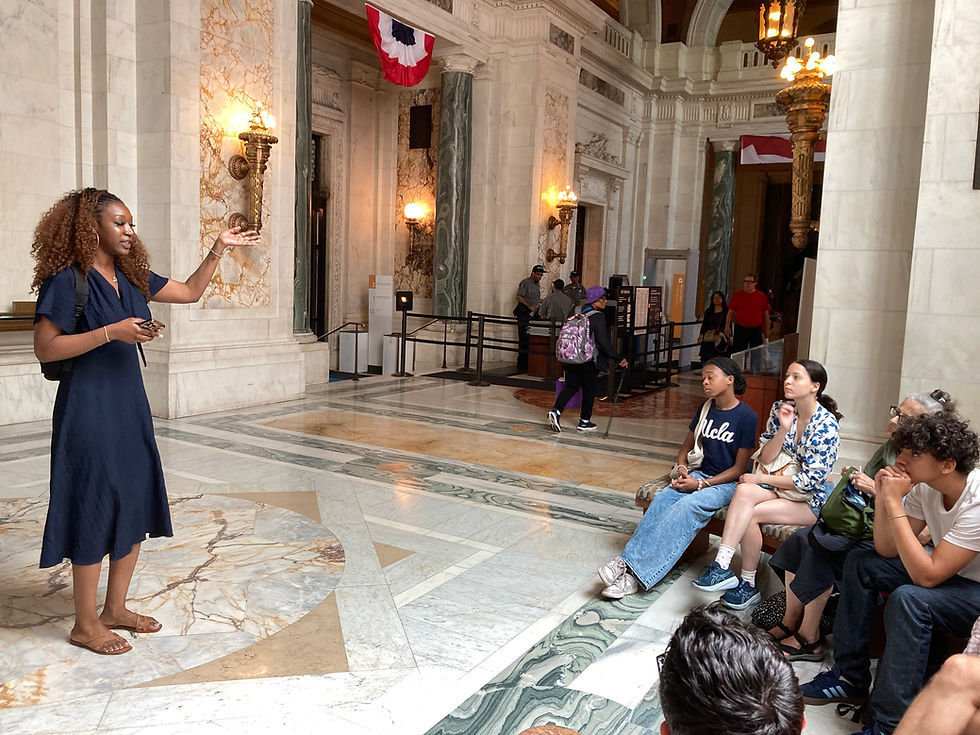
Neah shares: “The Museum of the American Indian offered an in-depth analysis of Native and Indigenous history, and historical context to the origins of Native New York and America. But it allowed us, and any visitor to the museum, to digest this information in more ways than one; from the interactive four-player game where we traded goods and wampum, to the short graphic film that left us with the burning question, ‘Is our documentation of history accurate, unbiased, inclusive, and reflective of true events?’
AYB at The Museum of the American Indian
During our visit, we stopped within the modern and contemporary collection and analyzed sculptures like Remind by Rose B. Simpson. We saved the Jeffrey Veregge exhibit for the very end, which was a creative and conclusive way to connect all of the Native American history we learned that day to art by contemporary Native Americans like Veregge.

Although we used the Jeffrey Veregge, Of Gods and Heroes exhibit as a point of inspiration to create our own superheroes, I was most inspired by the still-life portraits that came to life through students during the trip. Leah and Briana were inspired by native depictions of birds.
Sketches by Leah Eliopulous, and Briana Camacho
Evelyn made gorgeous drawings of many artworks throughout the museum, including an intricate maze basket.
Sketches by Evelyn Beliveau
Alex also drew from more than one art object on view.

Marley, and I (Neah) both combined images we loved. While Delphine combined observational and imagined imagery.
Sketches by Marley Haynes, Neah Gray, and Delphine Levenson (l & ll)
Sanjay melded the feel of Jeffrey Veregge's animated characters with one of his own video favorites. Lola, Meridith's cat appeared in her drawing!
Sketches by Sanjay Velayandom-Neven du Mont and Meridith McNeal
August and Jacob's pieces took personal experience as a springboard, while still taking time to stand and sketch in front of collections to include unique parts of Native culture and clothing.
Sketches by August Levenson and 4 by Jacob Rath
I absolutely love Marie's artwork with the body and floating headdress. The absence of a head draws you in and creates a mysterious undertone. Even though it's a still life of the exhibit, it makes you wonder: Who is the invisible man in this artwork, and what is their story?

Although many of us hadn't been to this museum yet, previous visitors noted they enjoyed the museum's modern updates. During my first visit to the museum, I was able to connect with a few security guards who gave me more context about the collections I was observing. Toward the end, a stranger approached and asked if I was an artist. I told her yes, shared more about ART YARD BKLYN and our upcoming field trip. It was her second-to-last day in New York, and as an artist herself, she wanted to leave with a piece of original artwork from a Native New Yorker. Fast-forward to this week, and I was able to sell her one of my original artworks, marking my first sold art piece. Overall, this field trip was a fun day and a great way to wrap up our summer session.”

We were grateful that, after a spate of extreme weather conditions, we had the perfect day for our final session, team-taught by Florian Kiniffo-Neven du Mont and Delphine Levenson, culminating in a celebratory picnic in Central Park.

Flo writes: “Taking the subway has always been a time of exploration for me, especially in NY. Maybe it's because I didn't grow up here, but I've always found the NY subway exciting. For me, it's like stepping into an experimental museum. The diversity of people using it, the pace, the sounds, the smells, the half-heard conversations...
I really believe that a train is a moving poem, and if we can be present enough, a subway trip is poetry in motion. Some of my favorite personal art was born in the subway, some of the final touches were found in the subway, and I believe this is also why, for many artists, the subway is the perfect space to share their work.
That's why Delphine and I decided to embark on a subway journey for this lesson.
We picked the extension of the Q line on Second Avenue, from 72nd Street to 96th Street, mainly because it was the least known to most of us. We explored the work of Sarah Sze at 96th Street with her installation Blueprint for a Landscape, followed by Chuck Close's subway portraits at 86th Street, and our final stop was 72nd Street with Vik Muniz's Perfect Strangers.


We also passed around a sketchbook throughout our trip with dedicated pages for each of us to contribute to a collaborative poem.
Through the lines and whirlpools of flying papers and objects in Sarah Sze's artwork, we explored the sense of motion and acceleration that we can experience when taking the subway. The assignment for this stop was to draw lines in our sketchbooks to reflect our experience of the subway station. We then wrote down the words that came to us in the process. With Chuck Close, we felt the personal stories and humanity of the MTA riders he chose to portray.
Evelyn Beliveau sketchbook pages depicting motion
It was a great station to start designing and sketching our own MetroCards, even if some of us had already done so unconsciously in the previous station, like Assata's impressive MetroCard inspired by Sarah Sze's art.

Vik Muniz was a great final stop and felt like a combination of both previous artists' work. We could sense the motion and subway-paced energy of his mosaic characters. He did a great job of reflecting the unique, and sometimes quirky, crowd we can encounter in the NY subway and gave it a real sense of camaraderie.
Vik Muniz, Self Portrait in Perfect Strangers, and several sketches from that same stop by Jacob Rath
We spent another 15 minutes inside the station to keep working on our MetroCards and collaborative poem before heading to Central Park, where we finalized it all around food and laughter.

This was my first time teaching a class, and I must say it was a pleasure teaching it with Delphine! I was very, very, very inspired by everyone's work and focus. I can tell by everyone's final pieces that they really connected with the lesson and the artists we explored. I was impressed by everyone's honesty in their work and the playfulness that came with it. I mean, look at these cards—they are all so New York and unique!
I'm also very happy that we started this residency with a class on love and poetry, and naturally ended up creating a BEAUTIFUL love poem for our last lesson. It really is, to me, a perfect reflection of the space ART YARD BKLYN provides to its community.”
A Blueprint For Your Heart
A collective poem written by AYB Artists
A blueprint for your heart
A guide I wish to follow
Is it a direct line from your wants to your needs
Probably not
I'm happy to duck, dodge and skirt the bad
As long as I find you at the center
Remember the swirl?
Papers fluttering for weeks,
or was it Months?
NYC became both the Center and the Whirlwind.
Kindness - little gusts of breeze
As the ash settled
Upon us.
Time is slipping away from me
I grasped at the pages, trying to write
Them down. It seems that my heart
Moves faster than my hand, and only you
Can slow me now.
When you look at me
My heart slows. What
do I notice? Not your
Hair. Not your shh. Not
your untied shoe.
The fold in your shirt.
The tilt in your hat.
The smallest thing catches
My eye.
Other faces blur past me
In an utter flash
My heart quickens
Beneath
Beads of sweat drip down
Leaving my mind in a place
That is lost but found
As soon as the train
Comes tumbling down
Rumbling to a stop
I get off.
Glimpses of faces shutter past
Behind train doors closing
Your eyes dozing back to
The sea of strangers
Slipping in between
End of scene.
The doors open
You become a mirage,
A hologram powered only by
My memory,
Can you compete with the
New strangers sitting across from me,
Staring into the distance,
Into portals leading anywhere
But here.
You are a stranger because you chose
to look away
But
Did you really look away?
From the blueprint of my heart
Or was it me looking away from you
Into your reflection from window glass
I was a stranger looking back
How much of me was lost in you?
And when I boarded my boat, I thought of nothing but you
And I could sail across every blue
For you were never to be found
Except once more when I reached ground.
What I couldn't have known as I sailed away
In a vessel of paper sails filled with air
Was the endless expanse of the buoyant sky
Where I'd flutter and soar without end on high
The ocean hugged me, as I floated
Amongst its waves. Cleansing me of
Any worries. In that moment
We became one.
Three. The number of completion.
Two. The number of companionship.
One. The number of contentedness.
Delphine summarizes: “For our final day of AYB Summer Session 2026, we took a tour of three subway stations on the Q line and explored the work of the artists Sarah Sze, Chuck Close, and Vik Muniz. All of these artists effectively captured the experience of subway life and what it means to be a part of transportation in NYC.

As a way to wrap up the amazing Summer Session of 2026, students were asked to create their own MetroCards inspired by the art we had seen in each station. Questions that sparked inspiration were: What is your relationship to the subway? What is your relationship to the idea of movement, and how can you capture it visually?


Florian Kiniffo-Neven du Mont, Metrocard l & ll


Even in a busy environment, artists were able to concentrate effectively on the task at hand by using careful observation when examining each artwork and engaging in interesting conversation. In addition to the MetroCard task, artists were asked to create a collective poem together. In one notebook, each person was given a full page to write in poetic form while making sure it connected with the prior person's writing.
At the end of the subway tour, we ended up in Central Park and had a picnic on a perfect sunny day. Artists were able to wrap up their work and begin a thoughtful and memorable critique, where they shared their individual pieces as well as the collective poem. Overall, the experience was uplifting, joyful, and perfectly captured the ART YARD spirit!”


Other Art News
AYB Artist Travis Pereira has been painting. He writes: “This week, I stayed at a B&B, and it was such a magical time. I got a chance to paint a bit and wanted to share what I created with you. (It's a picture of the inn my partner and I stayed at.) It felt like I stepped into an elegant home in the early 1900s.”
Travis Pereira, The Inn, 2026, watercolor on paper
I (Meridith) completed another Magical Things for my summer series.

AYB Artist Maraya Lopez shares: “As promised, here are some exclusive still shots from my 34-mile patrol (3 Pointz Brooklyn: Patrol Game) around Brooklyn on April 19th. The walk was live-streamed, and viewers could play the game by following the game prompts and typing them into the chat. I would then act out the prompt, 'live,' on the street during the patrol.”
Maraya Lopez, Painting Fire on a Bagel (for the "Torche-Bagelism" game prompt), Collect Something, You're A Winner with Marie Roberts!, and Arriving in East New York
Day at the Beach = Day in the Studio for AYB Artist Ariel Abdullah!

During Summer Session, there was an ongoing dialogue about what we are working on in our studios: new materials we are exploring (TJ got a bedazzler), projects we are planning to dive more deeply into (Alex has started a new complex narrative pencil drawing, and I (Meridith) am about to start a life-sized Inside Outside Windowphilia painting), and new concepts to explore (Jacob is creating a brand-new reimagined Tarot Card deck, and Ajani has some big Fabriano paper ready for new ambitious drawings) during the month of August, when AYB takes a programming break.
Throughout August, we will share updates from our studios and other art news. Please send me anything you would like to share!
💛🧡❤️💜


Comments