
Discoverers

Updated: 12 hours ago
We are voyagers, discoverers
of the not-known
H.D. (Hilda Doolittle), The Walls Do Not Fall, 1942
Today, September 18th, marks one year since the fire that destroyed the ART YARD BKLYN studio in Red Hook—a devastating loss of our space, supplies, equipment, archives, and artwork. But as we look back, we remember not only what was lost, but what happened next.

Immediately, our community came together. Artists, families, teaching artists, friends, and supporters helped us find space, gather supplies, process the shock, and make it possible to keep showing up for one another. Within days, our Advanced Studio sessions resumed at 180 Franklin Avenue, a space already familiar to our community. What could have been an ending became a moment of reimagining.

The fire also became part of the work. In the months that followed, AYB artists made paintings, drawings, and other works that grapple with the experience—some directly addressing the fire and its aftermath, others reflecting on memory, loss, resilience, and what it means to rebuild. We’re sharing some of those works here as part of today’s anniversary, alongside the work and gatherings that continue to shape AYB.
Ajani Russell, Adji Ngathe Kebe, Karla Prickett, Fire In My Heart, 2025
A year later, the most meaningful measure of what happened is not simply that we survived. It’s that we continued to make, teach, gather, and grow. The community that carried AYB through that moment remains at the heart of everything we do.
And now, here is what we were up to this week with ART YARD, Art Matters in the School, and Advanced Studio—and there are several AYB related openings coming up that we hope you’ll join us for.
ART YARD Art Matters in The School
Dennis Buonagura reports: A beyond busy week at PS 34, The Barack Obama School in Jersey City. We accepted a short-term (but intense) programming assignment at this terrific school - 15 days in a row - and we've already got the first five days under our belt. If I knew how to include an emoji for PHEW (in a good way), I would. All in all, an excellent first week.
Dennis teaching and wall signage at PS 34
While teaching artist Evelyn Beliveau covers both younger and older grades on Mondays, Wednesdays, and Thursdays, teaching artist Lionel (Leo) Emabat works directly with the younger ones. It really just worked out this way, for this cycle, due to scheduling. Wednesdays are the busiest days - first class at 8:45AM and finishing up at 2:45PM - 6 classes with approximately 130 students in total. Another PHEW emoji needed here!
Evelyn and Leo presenting lessons
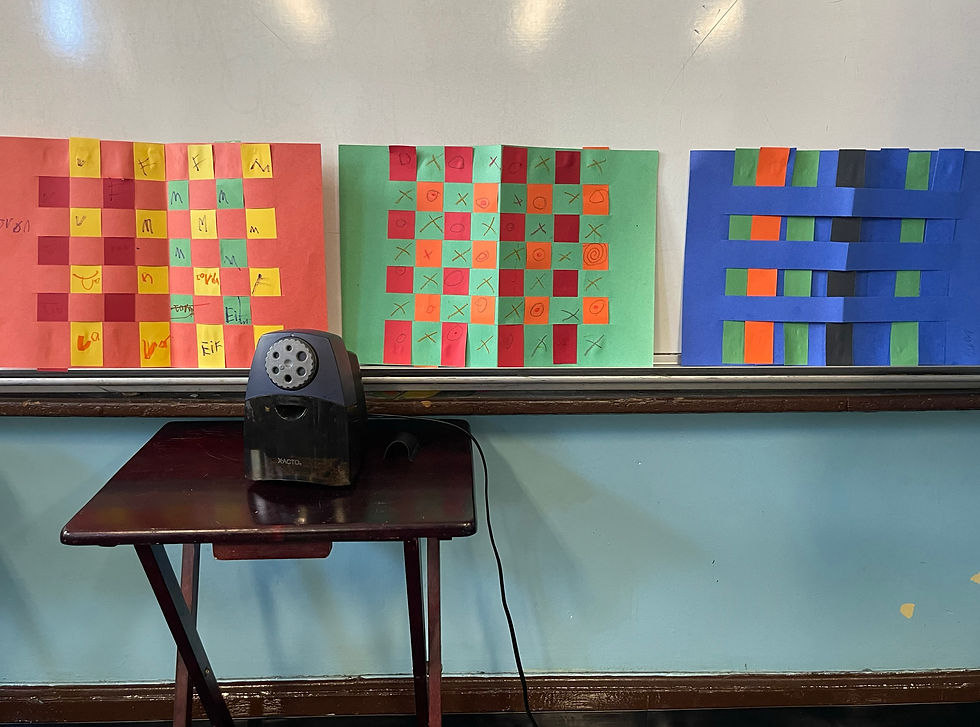
On Tuesday and Friday this week, Leo worked closely with kindergartners, 1st and 2nd graders (the kids LOVE him - he's got a great big smile and he connects with each one of them) on a lesson inspired by artist Sol Lewitt.

Learning about Lewitt's lines (often overlapping, mostly straight, but sometimes curvy) and colors, students jumped right in to recreate his style by using strips of colored paper and arranged and woven into precut (by Leo) paper "looms" (which are also called "warps"). Sounds simple? Not entirely. Each strip is woven through but then the next needs to be alternated to create a checkerboard (or patchwork) style. It can become somewhat of a puzzle - needless to say, these smart kids all figured it out and succeeded.
Once all strips were pulled/pushed through, students used glue to affix the edges. As a final touch, they were offered markers to create shapes and designs in intermittent boxes.

Leo and I were (greatly) assisted by Marilyn Carpena, the PS 34 art teacher, and our excellent intern/volunteer (via FDU) Denzel Jeter.
Evelyn Beliveau shares astute observations: “We are starting off the school year strong with a few weeks of daily classes at PS 34. This is my (Evelyn’s) first time at this school, and we’ve had a warm welcome! Dennis and I are delighted to be working with Ms. Carpena, the school’s fantastic art teacher, who runs a tight ship with class seating and management and has really made us feel like special guests. On Monday, we worked with students in Kindergarten, Grades 1 and 2, and Grades 6, 7, and 8. On Wednesday, our busiest day, we had one class each in Grades 3, 4, 5, 6, 7, and 8—and we were joined by Denzel, this year’s intern, who has done an excellent job so far, especially working one-on-one with students who need a little extra help or encouragement. On Thursday, we met with classes in Grades 1 and 2.

For our theme of Drawing the Line, we are taking inspiration from the work of Swedish artist Hilma af Klint (1862–1944), whose abstract paintings are filled with curved, spiraling, and dotted lines. I developed three variations on a lesson plan for different age ranges: one for our youngest students up through Grade 3, one for Grades 4 and 5, and another for Grades 6, 7, and 8.

With each class, I first presented a bit of historical background on Hilma af Klint, who was one of the first artists to make abstract paintings. Influenced by spirituality and scientific diagrams, she used shapes as symbols for ideas like growth or spirit. We viewed af Klint’s series The Ten Largest from her major body of work, the Paintings for the Temple. The Ten Largest (each measuring about 10 x 8 feet) explore stages of life from childhood through maturity, using symbols such as flowers, spirals, overlapping ovals, and letters of the alphabet. Students were quick to point out comparisons between af Klint’s work and familiar objects, including seeds, flowers, plates, and even a beach ball. They also responded to colors and pointed out lines, dotted lines, and Roman numerals.

As we handed out pencils and watercolor paper, several students asked about the thickness of the paper, and we explained that we need heavier paper because we’ll be using watercolor paints next week. I shared the colorful sample artworks I created, to give students an idea of where the project is going. This week, however, we were just drawing.
Students in K, 1, 2, and 3 followed a step-by-step process, drawing three big overlapping shapes followed by solid and dotted lines. “Overlap” was a new vocab word for some students, and they picked up the concept quickly. Students had a free choice of shapes at every step, and many featured their favorite shapes like hearts or stars, along with geometric shapes like circles, triangles, and squares. When we added lines and dotted lines, I challenged students to extend their lines all the way from one side of the paper to the other.
Grades 4 and 5 also used a step by step process, with a few more choices. They drew at least three shapes, choosing to make the shapes overlap, touch at the edge, or nest one within another. They drew lines from one side of the paper to the other, which became dotted lines when they passed behind a shape, just like we see in some of af Klint’s paintings.

Students in Grades 6, 7, and 8 learned a bit more about af Klint’s use of symbols, taking as an example the spiral, which she used as a symbol for development and evolution. We talked about how we might not be able to “decode” what exactly each symbol means in the painting, but we can see that the artist had strong intentions behind the complex arrangements of shapes. I asked these students to choose three shapes and create a “key” linking each shape to a symbolic meaning. Students chose concepts like goals, persistence, dreams, spirit, unity, calm, and individuality, connecting these ideas to geometric shapes, wavy lines, arrows, flowers, and other symbols. After creating the key, they flipped over their paper to start the final drawing, using the shapes in relation to each other—overlapping, touching, nesting, or linked by lines—in a way that meaningfully connects the concepts.
Student drawings in progress, use arrows to scroll through work.
At the end of each class, we held a robust critique. Two or three at a time, drawings were placed under the overhead projector so students could learn to draw comparisons and contrasts between them. Students started by noticing shapes that did or didn’t appear in both drawings, and we encouraged them to look at line weight and composition, too. We ended with compliments, asking students to offer a kind word to their classmates students who focused and worked hard or whose artwork they admired.”

Advanced Studio
AYB Advanced Studio on Zoom sessions began out of necessity during quarantine, but have become a lasting part of Advanced Studio—allowing AYB Artists to stay connected and participate from wherever they are. This week, we were delighted to see Marilyn participating from California and Travis from Florida.
Ajani Russell kicked off the Advanced Studio semester with a lively session exploring New Yorker–style cartoons inspired by personal experiences and everyday observations. Ajani presented a selection of cartoons as the group considered the distinctive visual language of the form: drawing style, the use of black, white, and grey without color, and the important relationship between image and caption.

Ajani recaps: "This week our online class dove into the comics of the New Yorker. Founded in 1925 by Harold Ross and Jane Grant, the magazine started as a Manhattan-centric “fifteen-cent comic paper” (Harold Ross). More than 100 years later, The New Yorker is a multi-platform publication reporting, political and cultural commentary, fiction, poetry, humor, and reviews on current theatre, film, and visual arts.
The magazine releases a daily comic by various artists - usually a singly image accompanied by a one line statement or caption. Ajani emphasized the relatability that comes when the comics are inspired by personal experiences.
Adji, Ajani and Meridith depicted their cats.
Meridith's cat Lola insists on a GLASS of water with breakfast with such fervor it would seem to be one of those extravagant orders at Starbucks.

Adji drew her two cats- one with a devilish smile tracking cat poop down the hallway, the other looking on from the bottom of the frame. Adji recounted how that very morning her cats had tracked poop around the house so this drawing shows how she imagined them to look at the scene of the crime.

Ajani’s comic “she’s still learning about personal space” is accompanied by an image of a round cat sitting on someone’s head while they lay in bed. Ajani’s cat moonlight has a habit of doing this. Meridith said that you can taste the cat hair in your mouth just by looking at the image.

Cheyenne drew a woman (perhaps herself) sitting at a work desk as a fire rages in the window behind her. The caption says “Yeah, I can send that to you by EOD”. This comic plays into the normalization of working through a crisis in our modern society. Ignoring literal and figurative fires blazing around us just to get the job done.

Marilyn's comic features ants in neat rows marching towards a chocolate chip cookie. Two ants with whimsical faces discuss dessert (the chocolate chip cookie) The formation of the ants and the expressions of the two ants in conversation adds a playful element to the piece.

Jacob examined AI practices and the effects on human intelligence and connection in three different comics. The first touches on romantic relationships between AI and humans. The other point to humans eventually relying on AI more than their own common sense.- especially “AI told me that human beings only have four fingers and I thought my body made a mistake”.


Travis did a mystical swirling image of a woman looking in the mirror to see her future self. There was a more sentimental and wise approach to the comic rather than focusing on humor. The line quality is reminiscent of fashion illustrations.

Aaron’s comic shows an orange and an apple sitting on a couch. The rendering of the fruit leaves them looking very similar, the text alludes to the apple and the orange comparing themselves to each other. The piece looks at the culture of constant criticism and measuring success through other people’s fabricated online optics.

Sigrid’s “Fashion is about lines and shapes” shows a chic woman crosshatched into a dress that blends into reality. The lines in the environment become the dress. I can almost hear Miranda Priestly (Devil Wears Prada) saying this quote.

Leah sent in a portrait of Flo “painfully applying hand sanitizer”- the absolute worst when you have a cut on your hand. She also sent in an image of two people seated in a museum with the phrase “another day, another museum”. I felt this describes our summer of field trips and art viewing very succinctly. The line quality and details like the placement of art on the wall denotes that it is a museum in Avery subtle way.


Flo drew a baby Donald Trump holding up a sign that says free hugs that doubles as a check for 5000 dollars- referencing a recent claim made by Trump where he promised American citizens 5000 dollars in attempts to buy support. Baby Trump stands in a crowd of couples embracing and kissing around him. This piece was compared to Maira Kalman’s work for the orientation and composition of the figures.

Advanced Studio in person at 180 Franklin had us perched on the roof deck with a stunning view as Evelyn Beliveau guided us in observational still life drawing.

Evelyn recaps: “On Tuesday, we kicked off the Year of Drawing the Line at Advanced Studio In-Person with a lesson on Line Weight, inspired by Italian artist Giorgio Morandi (1890–1964). Serendipitously, we moved the class location to the rooftop (kindly invited to do so by 180 Franklin’s management, because of a malfunctioning AC unit in our usual workspace) and enjoyed a lovely sunset and cool fresh air as we worked.

As we started getting set up, our youngest star students Dylan and Delanny helped me choose books to include in a still life. We took pictures of the furniture layout so we could replace everything in its original position at the end, then everyone pitched in to carry chairs and tables over to create two still life stations and a food station (featuring pasta and a delightful orange pound cake by Meridith!). Ajani stayed downstairs for a few minutes to direct participants toward the roof as they arrived. A group effort!
We gathered around the tables to take a look at a brief presentation of selected works by Morandi, including paintings, etchings, and line drawings. A master of still life, Morandi painted deceptively simple groupings of objects clustered on table surfaces, in which every brushstroke contributes to a sense of texture, weight, and light. In his etchings, form is achieved through fields of hatching and cross hatching with dynamic contrasts of light and shadow. As we looked at the line drawings, I asked participants to notice how Morandi still conveys space, weight, and texture without the use of light-dark value (as in the etchings) or color (as in the paintings). Kevin noticed certain lines that were doubled or thickened, showing us the artist’s thought process as he made multiple attempts at capturing a contour or added emphasis underneath or between objects to suggest shadows without shading. Jacob pointed out gaps in the lines, where our brains fill in the blanks to complete the contours, also suggestive of effects of light or the delicacy of materials.
Then, I shared a sample piece and talked through the steps for the lesson. Working from observation, we started with a pencil drawing, making light marks at first to work out the placement of objects on the page. Then, in the same drawing, we manually bolded some lines to create strong, clear contours for nearer objects and suggest weight where one object rests on another, while leaving lines faint for farther-away objects or internal contours and textures. After that, we switched to brush pens, taking a few minutes to experiment with creating finer or heavier line weights by varying the pressure on the brush tip. Lastly, on a new piece of paper, we looked at the same still life and redrew it entirely with the brush pen, varying the line weights through gesture and using all the information we’d gleaned from the slower pencil drawing to help construct the pen drawing.
Evelyn Beliveau, Still Life drawing examples l & ll, 2026
The result was beautiful pairs of drawings by each artist, which we delighted in comparing at the end of the session. After another group effort to clean up and migrate downstairs in the fading light, we laid out all the drawings on the table and conducted critique. Participants drew comparisons and contrasts between the drawings’ compositions, noting how artists’ different vantage points resulted in vases flanking the stack of books or hiding behind other objects on the page.
We noticed how artists used more economical mark-making in their pen drawings, like how Kevin suggested the glass of the nail polish bottle with just a couple of pen-strokes, after having drawn it in more detail in the pencil drawing (Kevin also received several compliments for the fluttering lines he used for the texture of one of the vases).
Kevin Anderson, Still Life drawing l & ll, 2026
Ajani’s use of gaps and simple pen-strokes in their final drawing received many compliments, especially for the depiction of a coil of wire—with the chance addition of what looks like a flyaway strand of wire, which Ajani told us actually resulted from a disturbance of the wind while drawing: an unexpected but successful collaboration with nature!
Ajani Russell, Still Life drawing l & ll, 2026
Leah received compliments for a different but just as enchanting rendition of the same coil of wire, depicted in fine detail in her pencil drawing.
Leah Eliopulos, Still Life drawing l & ll, 2026
Delanny focused on the castle on the front of one of the books in the still life (from Dylan’s favorite series, The Magic Treehouse). The book cover also features prominently in Dylan’s drawing, alongside carefully rendered angles, ellipses, and surface textures of the candlestick, canisters, and vases in the still life.
Dallany Gomez, Still Life drawing l & ll, 2026
Dylan Gomez, Still Life drawing l & ll, 2026
Jacob was shouted out for the use of broken lines for the fluting of the vase in the foreground of his drawings, and Meridith admired the well-observed contour of the lip of the right hand vase in Jazz’s drawings.
Jacob Rath, Still Life drawing l & ll, 2026
Jazz Guillet, Still Life drawing l & ll, 2026
Flo achieved a very fine and delicate line weight with the very tip of the brush pen, which is very difficult to control.
Florian Kiniffo-Neven du Mont, Still Life drawing l & ll, 2026
Margaret received compliments for the use of white space above the objects in the still life, as well as the tricky foreshortening of the stacked books.
Margaret Hardigg, Still Life drawing l & ll, 2026
Kevin complimented Meridith for the depiction of book pages at a foreshortened corner, achieved through two stacks of lines with the slightest gap at the edge where they meet.

Meridith complimented Mich both for slow, graceful pencil work and for diving in decisively with the brush pen. Someone observed that the whole group of drawings is minimalistic for an AYB project, but beautiful in the accumulation of so many finely observed details.
Mich Goenawan, Still Life drawing l & ll, 2026

Other Art News
We are thrilled to announces that ART YARD BKLYN will be featured in the upcoming Grassroots issue of MEANS magazine celebrating grass-roots, underground, and experimental culture. Strange art, unusual music, outsider philosophies, complex processes, and challenging ideas.
Copies of the magazine will be available soon at the Gallery at 180 Franklin Avenue, and you can order copies on the MEANS website.

Travis Pereira shares this update on his self-portrait shown in progress last month!

Karla Prickett sends two photographs of “Skyscapes in western Kansas earlier today!”.


What We Are Reading
TJ Edgar recently recommended Tayari Jones’s Kin (Knopf, 2026), and I make it a point to add AYB-recommended titles to my Brooklyn Public Library list. So, this week, I was happy to read it myself.

As I was reading, I kept thinking about one of my longtime favorites, Pearl Cleage. There was something familiar in Tayari Jones’s storytelling—the richly drawn characters, the distinct and engaging voices, and a plot that pulls you in and keeps you moving along for the ride. I dove into a bit of a search for more about the author and discovered that Pearl Cleage was Tayari Jones’s teacher!
There are a couple of upcoming opportunities to hear Tayari Jones in Brooklyn: she’ll be at the Brooklyn Public Library’s Central Library on Saturday, September 19, as part of The Atlantic’s event on the American reading crisis, and on Sunday, September 27, at 3:30 p.m., for The Places We Carry at St. Ann’s, 157 Montague Street.
I love that books are something we share at AYB. Tangie and I were talking about Tayari Jones, too, and she shared that she really enjoyed An American Marriage (Algonquin Books, 2018). One recommendation leads to another—and another book goes on the list!
Exhibitions to See
Come to the artist’s reception Saturday, September 19, 2026 from 1:00-3:00pm. The Valley Cottage Library is observing Banned Books Week by creating a deck of trading cards featuring the juried artwork including work by AYB Artists Travis Deen (Pereira), Sudan Green, Candy Heiland, Free Inside, Florian Kiniffo-Neven du Mont, Meridith McNeal, Jacob Rath, Marie Roberts and Ajani Russell. You may purchase your own trading card deck for $10 at the opening!

If you are in Brooklyn, I hope you will attend kick-off party on Saturday, Sept. 19 from 4-6pm later that afternoon, at Kentler International Drawing Space (353 Van Brunt Street, Red Hook, Brooklyn) of 100 Works on Paper (including a set of miniatures by Meridith McNeal!).

Iviva Olenick invites us to the opening of “Living Systems: Collective Power in Motion,” the culminating exhibit for Human Impacts Institute’s 2026 Urban Environmental Health Lab Fellowship. Sunday, September 20th, 2026, 2-5pm at Eleventh Hour Art 61 Atlantic Ave., Brooklyn, NY.

Join AYB on Saturday, September 26 from 6-8pm for the opening Ajani Russell: Drawing The Line at The Gallery at 180 Franklin Avenue in Brooklyn.


Comments