
The Air, the Air is everywhere

Updated: Jul 17
Welcome, sulfur dioxide
Hello, carbon monoxide
The air, the air is everywhere
Breathe deep while you sleep
Breathe deep, deep, deep-de-deep
Air, from the musical Hair, 1968

We made some changes to our plans to safely endure the poor air quality and extreme heat. In fact, it was a seamless pivot thanks to the skill and enthusiasm of our Teaching Artists!
On Monday, Jacob Rath and M Boucai teamed up for a movement, physical theater, and drawing session that made use of mirrors as inspiration, tool, and subject. On Tuesday, Chris Allen took the line into a sculptural iteration—a rare three-dimensional foray for some of us.
We visited the Morgan Library & Museum to view the Tarot exhibition. One of our most adept Tarot practitioners, Adji Ngathe Kebe, led us on a deep exploration that had us thinking and planning! (Spoiler Alert—an AYB Tarot deck just may be in our future!)
Undaunted by the atmospheric conditions, we moved the session originally planned for Abolitionist Place in downtown Brooklyn indoors to City Point Mall. M Boucai and Jacob Rath once again had us thinking and making art in a multifaceted and wonderfully challenging manner.
In our welcoming and blissfully air-conditioned space at 180 Franklin Avenue, Brooklyn, we started the week steeped in art history.
Teaching Artist Jacob Rath shared an astonishing 48 pages of artists' work organized into categories: Venus & The Venus Effect, Contemplation of Mortality, Fixing My Hair, More To The Story, Interesting Angles, and Tricky Mirrors. With artists ranging from Diego Velázquez to Kikugawa Eizan, Jan van Eyck, and even a screenshot from The Simpsons, this well-researched and fascinating investigation proved ample fodder for lively, engaged dialogue. Next up was accomplished actor/clown and Teaching Artist M Boucai, who took us out of our comfort zone and into the world of performance.


Jacob summarizes: “I began the lesson by giving a PowerPoint featuring artworks with mirrors. This led into M's activity, where we did mirroring games and looked at ourselves while lip-syncing.

After M's theater-based activities, we took time to play with the mirrors, alternating between moving around the room and looking at them. We then placed the mirrors in different spots around the room. Our final assignment was to make a drawing that featured at least one of the mirrors.

Fun with mirrors!
Everyone made artwork based on their observations while also expressing their personal style. M commented that these critiques are fun because they are an opportunity to learn about people through their artwork. People enjoyed the exercises that got them to move around the room, move their bodies, and move their eyes.

Mirror Drawings by Yani Prudent, TJ Edgar, Moss Hsia, Leah Eliopulos, Jazz Guilet, Jacob Rath, Florian Kiniffo-Neven du Mont, and Alex Lopez


Jazz was so enthralled by Rashidah's piece that she wanted to ask Rashidah to design a tattoo.”
Teaching about artmaking and ideas one is passionate about is the perfect place to begin planning an AYB lesson for any of our programs. The perk of Summer Session is that we can really dive in, with double the time to observe, discuss, and create.
Teaching Artist Chris Allen, who has been delighting our elementary school students in ART YARD Art Matters in the School and participating in Advanced Studio, brought his enthusiasm for and expertise in found-object sculpture. We were challenged to Draw the Line in three dimensions.

Chris summarizes: “This Tuesday we worked around the theme of figurative sculpture, looking at references to the human body and nature throughout the history of sculpture. Reviewing the work of artists like Louise Bourgeois and Alberto Giacometti, as well as my own, we found how varied representations of bodies could be in sculptural form. Using Ruth Asawa’s body of work as a reference, particularly her wire sculptures, each member of the class worked independently to create their own wire sculpture, some incorporating found objects or different kinds of thread.


Ultimately, the work that resulted was quite amazing given the time restrictions. Some referenced specific parts of the body, like hands, hearts, and ears, while others referenced animals or plant life. Despite certain commonalities, each artist created a unique work that spoke to their own perspective on the subject matter.”
Flo at work and Florian Kiniffo-Neven du Mont, Wire Sculpture
Ariel Abdullah, Drawing, and Wire Sculpture
Bob at work, and Ariel (bob) Gardner, Wire Sculpture
TJ Edgar, Wire Sculpture l & ll
Sanjay Velayandom-Neven du Mont, Wire Sculpture and Bonsai at BBG, photo Ariel Abdullah
Evelyn, Moss, Leah and Delphine at work, Wire Sculptures by Evelyn Beliveau, Moss Hsia, Leah Eliopulos and Delphine Levenson
Briell, Ariel, Alex, Sanjay, and Yani at work, and Wire Sculptures by Briell Adams, Alex Lopez and Yani Prudent
Wire Sculptures by Jazz Guilet, August Levenson, Chris Allen, Briana Camacho
Jacob describes his sculpture: “My sculpture is of an alien from Tralfamadore. These aliens are two feet tall. They look like toilet plungers with hands on top and an eye in the center of each palm.
While I was waiting for the bus, a man stopped and asked me what the name of the plant was in English. I said I didn't know. He told me that when he had gonorrhea, a woman made tea from this plant, and it cured him.”
Jacob at work, and Jacob Rath, Wire Sculpture
The Morgan Library and Museum does not allow outside groups to present in the galleries. This makes perfect sense. It is a small and popular museum, and visitors should be given the opportunity to focus without interruption on viewing the thoughtfully conceived and expertly curated exhibitions.
We gathered in the vestibule upon arrival, where we were able to both cool down and hear Teaching Artist Adji Ngathe Kebe present a concise and compelling introduction to the Tarot. As an expert reader, Adji was able to answer questions and guide our discussion with ease. Jacob, who also has Tarot experience, brought up intriguing points as well. Adji had us each select a card from the Major Arcana of the Smith and Waite deck as an additional focus while we viewed the show.

Adji describes the exhibit and our process in more detail: “Tarot! Renaissance Symbols, Modern Visions, at the Morgan Library and Museum was phenomenal. Not only did we delve into the history of Tarot, but we had contemporary versions of Tarot to compare. The exhibition explored 600 years of Tarot and its influence. There was a huge variety of artists, from Remedios Varo and Chris Ofili to artists from the Visconti and Sforza families, who created some of the first Tarot decks around the 15th century. Only a few cards have survived and have been preserved for display.
Tarot deck and related works on view by Remedios Varo, Marcel Dzama, Elezabeth Colomba, and Betye Saar
What started as a card game of skill became a portal. In many of the descriptions of the artwork, artists described Tarot as a piece of magic, something otherworldly—occult. As much as people were drawn to it, they also feared it. The Devil card, the Death card, and the Tower were three cards that were often defaced, torn apart, or simply discarded. They were seen as harbingers of bad luck. However, both the Devil card and the Tower are followed by the Star, while the Death card is followed by Temperance—i.e., bad things are temporary and are always followed by a glimmer of light. Tarot often reveals the cyclical nature of life, which makes it such a hopeful practice of divination. Things do get better, and they often do. It’s part of the cyclical nature of life.

I started the lesson by having everyone pick a card to focus on. They had to find their card in the exhibit and do their own rendition of it. It was great seeing people do more research to delve deeper into the cards and understand their meaning and impact. The artwork produced as a result was deeply personal and, much like the exhibit, showed great variety. Some wrote poems, while others reinvented the imagery completely. It was great hearing everyone’s approach and what the card they chose symbolized to them.”

I (Meridith) selected The Lovers from Adji’s deck. There were several versions on display, including the Visconti-Sforza deck, as well as several contemporary versions, which I sketched quickly as I flitted about, leading the class using a one-to-one method.
Meridith's card pick, The Lovers from a contemporary deck, Peter Hujar contact sheet
It was while upstairs looking at Hujar: Contact that I was inspired by a rather layered concept for my piece. Having reread Anthony Doerr’s Four Seasons in Rome the night before, I was already reminiscing about my time in Italy. Looking at Peter Hujar’s tiny contact sheets, I spied a tiny square photograph that could work to portray the lovers.
Label text: “In 1958 Hujar's boyfriend, painter Joseph Raffael, won a Fulbright grant to study altarpiece paintings in Italy. The couple lived for a year across the Arno River from Florence, then in Rome for several months. When photographing a ballet troupe in Florence, Hujar used the grounds of a formal garden for his studio.”
Once at home, I cropped the composition to Tarot card size, then painted Hujar’s dancers in the style of Pamela Colman Smith (Smith and Waite Tarot deck).


What was remarkable about this visit was the depth with which participating artists engaged with the concepts. Our critique was held in a sanctioned area on the lower level—and boy-oh-boy, did we have a lot to talk about. Most of our work in the gallery was what I would deem artistic investigation and the processing of ideas and images. It was truly an inspiring session. As I hinted in my introduction, there will be more to come on the subject of Tarot!
Tarot Sketches from the trip
Breathing like a sullen perfume, indeed.
We solved the air quality dilemma by moving our observing and drawing of the public indoors to City Point Mall. I give compliments to AYB Teaching Artists M Boucai and Jacob Rath for their flexibility in planning and their enthusiastic embrace of the subject.
M recaps: “Today’s lesson, held amid the hustle and bustle of the City Point/DeKalb Market Food Hall in Downtown Brooklyn, focused on the art of observation. Participants were treated to a fabulous lecture/presentation on how artists have captured the energy and multiplicity of urban life and then completed a number of performance and ethnographic exercises before setting off on their own to capture a slice of life in picture form.

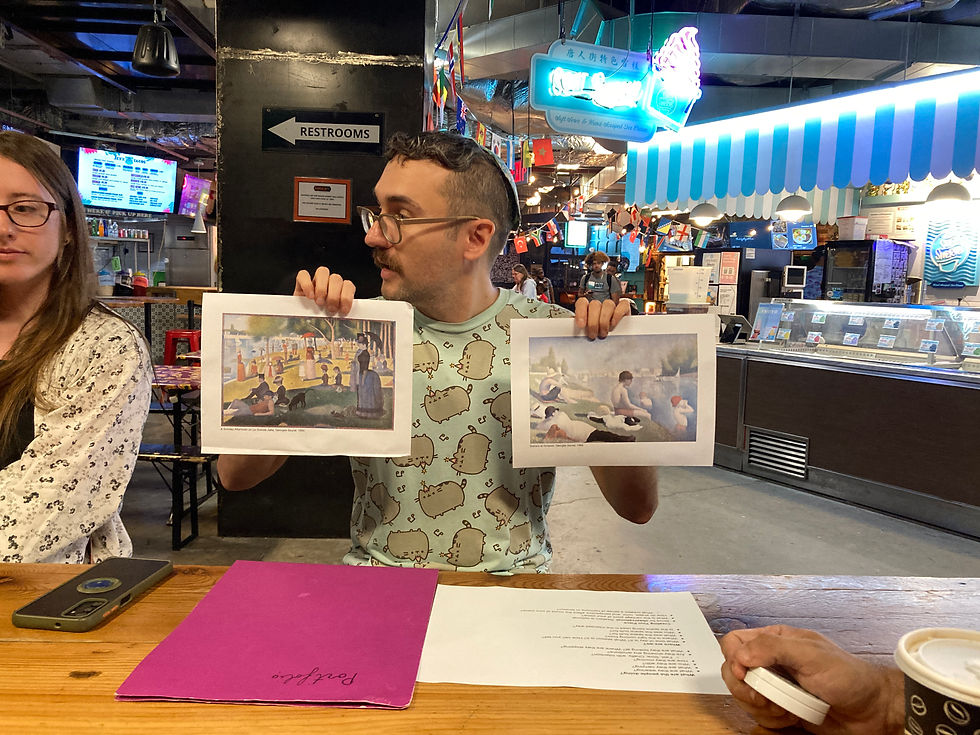
Jacob started things off by discussing the difference between realistic artwork and observational artwork. I discussed the work of artists who make paintings of people engaging in public spaces, including Georges Seurat, Ed Rath, Shadra Strickland, and Albert Robida. None of these artists create work that looks 100% realistic, but because they all make art based on observation or personal experience, they are able to create compelling and relatable artworks. We discussed how honing in on the details of what you see—such as people’s clothing, movements, gestures, expressions, and architectural details—can provide clues to a story about what is happening. We discussed what was going on in each piece, who was in it, where it was, and which details told us the story.


After this deep dive into art history, I (M) took over and proceeded to lead students through a number of exercises in observation and research. After breaking off into small groups and examining the movements of people in the space, students “animated” people as they walked by, creating a soundtrack/noisescape for the people they observed. Next, students went off on their own and, for fifteen minutes, recorded everything they observed as objectively as possible. After completing this exercise, students came back to our home base, a table in the food court, and proceeded in small groups to share their “objective” notes with each other. Students were tasked with finding patterns in their peers’ notes and calling out anything that could be read as subjective or biased. This exercise was extremely fruitful, with many students learning things about how they see the world they inhabit, and it set the groundwork for an enlightening conversation about narrative vs. narratology and history vs. historiography. Delphine summed it up best by saying that, after millennia, we finally get that history is actually an amalgamation of at least six different eyewitness accounts of the same event, and that any attempt at official capital-H HISTORY will always be subjective, limited, and flawed.
After this enlightening conversation, students were given their final assignment: to journey into the public sphere and spend an hour drawing a piece based on deep observation of the space and the people inhabiting it. The work produced during this time was staggering and made clear the scope, scale, and multiplicity of the assignment. Many of the artists presented work that included five to ten human subjects, plus a rendering of a complete urban landscape. The works, though in different mediums, all managed to capture the light and the dark, the speed and the energy, and the complexity of experience of a space such as a city mall and an urban park. As an expert in performance, I was blown away by the specificity and nuance contained in the artworks created by the AYB students.”


Jacob adds: “Everyone did a good job of capturing the atmosphere, energy, and activity happening in the spaces they drew. Evelyn compared Meridith's piece to the Van Gogh landscape drawing Ajani shared with us last week. (Oh là là! ~ Meridith beams.) Many people enjoyed making art inside the food court because it was an unusual environment, with lots of bright colors, a confusing sense of space, and plenty of interesting details to notice. Delphine commented that working in this new environment pushed her to try new techniques with the alcohol markers.


I enjoyed this lesson both as a teaching artist and as a participant. As a teaching artist, I had fun planning this lesson with my partner, M. M suggested that I use my dad's (AYB Artist Ed Rath's) artwork for this lesson, which I had not considered. I appreciate that, even though I've watched my dad make art my entire life, M helped me see my dad's art in a different way. I also really appreciated the part of the lesson where we gave feedback on each other's observations, since I was able to get observations about my artistic process from expert artist Marie Roberts.”

AYB Artist Marie Roberts, an experienced observational artist, comments: “The location was visually chaotic, but participants made visual order. I was impressed with the focus—everyone honed in on their drawing project, ignoring personal and location chaos. It is always a joy to see how each participant solves the day's visual challenge.”
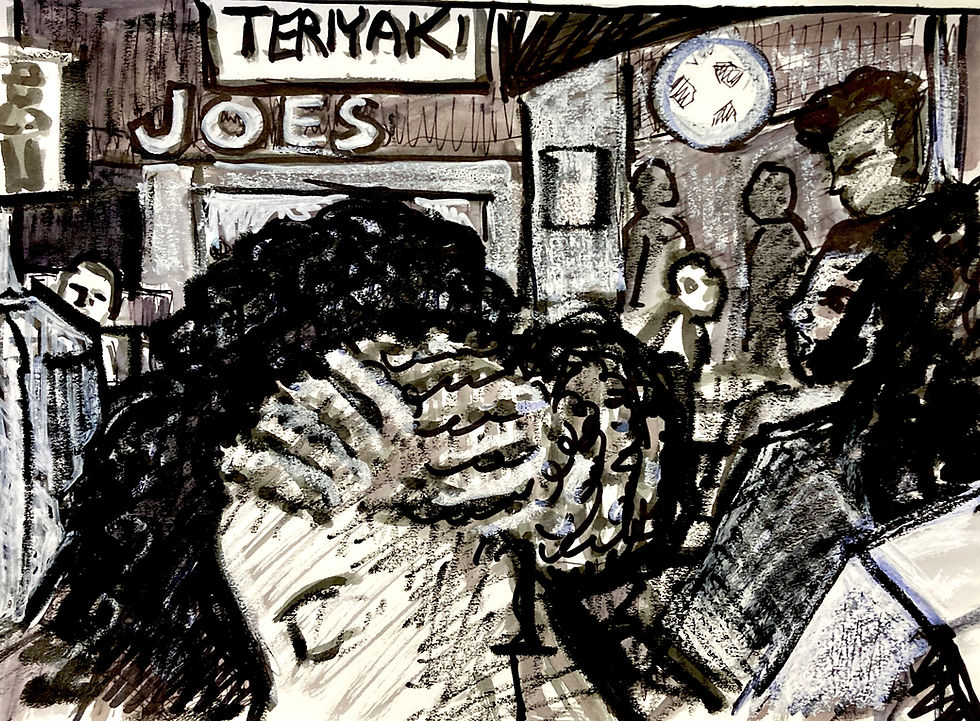
During critique, Marie complimented August on his drawing, comparing his work to that of David Hockney:
August Levenson, Observational Drawing at City Point, and David Hockney, Self Portrait with Blue Guitar, 1977
Adding: “I read that Everett Shinn (1876–1953), painter and member of the urban realist Ashcan School with an excellent facility for depicting animated movement, and friends would sit outside their art school at lunchtime and sketch passersby—in seconds.”

AYB Artist Evelyn Beliveau, who is participating in as well as teaching Summer Session, shares their thoughts at this 2/3 mark: “Another great week of summer session! I'm so glad my friend Moss (visiting from Denver) was able to join for M and Jacob's session on Monday and Chris's session on Tuesday. They had great things to say about what they observed (and participated in!) in our community, especially the mutual respect across generations and experience levels. As Delphine mentioned during critique on Tuesday, our table had some great conversations during work time. Wire sculpture is a seldom-explored realm for many of us, but Chris gave us a foothold with the open-ended prompt to respond to the human figure or other living forms. Each artist's sensibility shone through in the new medium, from Moss's meticulous jewelry-like twists and Delphine's smooth shapes of color to Alex's graceful drawing-like rendition of a bird and Leah's tactile hand built up from many different gauges of wire.

I also loved the field trips--like Ajani at the Met last week, Adji prepared us well to explore the Tarot exhibition at the Morgan with keen, seeking eyes. I pulled the Justice card from Adji's deck, and it totally shaped my experience of the exhibition-- I hunted for renditions of the card (with sword, scales, or both) from the gilded surfaces of Renaissance-era cards to the popping colors of more recent eras.

Like Monday's exploration of mirrors--encountering moving glimpses of one another through double and triple reflections-- Thursday's observations of crowds at City Point offered an angle into figurative art-making different from my usual approach, which I really appreciated. M and Jacob once again proved a complementary teaching team. Jacob shared a selection of crowd scenes in public places from art history and asked us to infer context from details of dress, architectural surroundings, and clues about time (seasonal or historically specific). M assigned a series of exercises that built on one another--like Ajani's succession of contour drawings in the first session last week--starting by observing and responding with sound instead of mark-making, then written notes, and lastly a drawing. I enjoyed the small-group feedback on our notes, and the insight that any attempt to capture the moving chaos of a public space will necessarily be an abstraction or selection of the elements present, but we can still attempt to be aware of our own biases and hold multiple stories in tandem within an artwork.

It's been a delightful Summer Session so far, and I (Evelyn) am excited to lead a two-part lesson on Monday and Tuesday in observational gesture and contour drawing!”
Other Art News
AYB Artists Sudan Green, Candy Heiland, Free Inside, Florian Kiniffo-Neven du Mont, Meridith McNeal, Travis Pereira, Jacob Rath, Marie Roberts, and Ajani Russell have work included in Banned Book Trading Cards 2026.
The exhibition of the included artworks opens to the public on Saturday, September 19, from 1–3 p.m. at Valley Cottage Library in upstate New York. We will remind you as the opening nears. In the meantime, here is a preview of our artworks—you will have to see the cards to get the full effect and read our artists' statements.
Banned Book Covers by Sudan Green, Candy Heiland, Free Inside, Florian Kiniffo-Neven du Mont, Meridith McNeal, Travis Pereira, Jacob Rath, Marie Roberts, and Ajani Russell
Exhibitions to See
Congratulations to AYB Artist Aisha Tandiwe Bell, who has work included in BLOODLINES at NextWave Gallery, 37 N. 15th Street, Brooklyn. Aisha invites us to celebrate with her at the opening on Sunday, July 19.

Have you seen the AYB exhibition Resized, currently on view in The Gallery at 180 Franklin Avenue, Brooklyn?
If you have not, we invite you to swing by Monday July 20th, or Tuesday July 21st. We will be there for Summer Session from 11-3pm and would love to share our work with you!


Comments